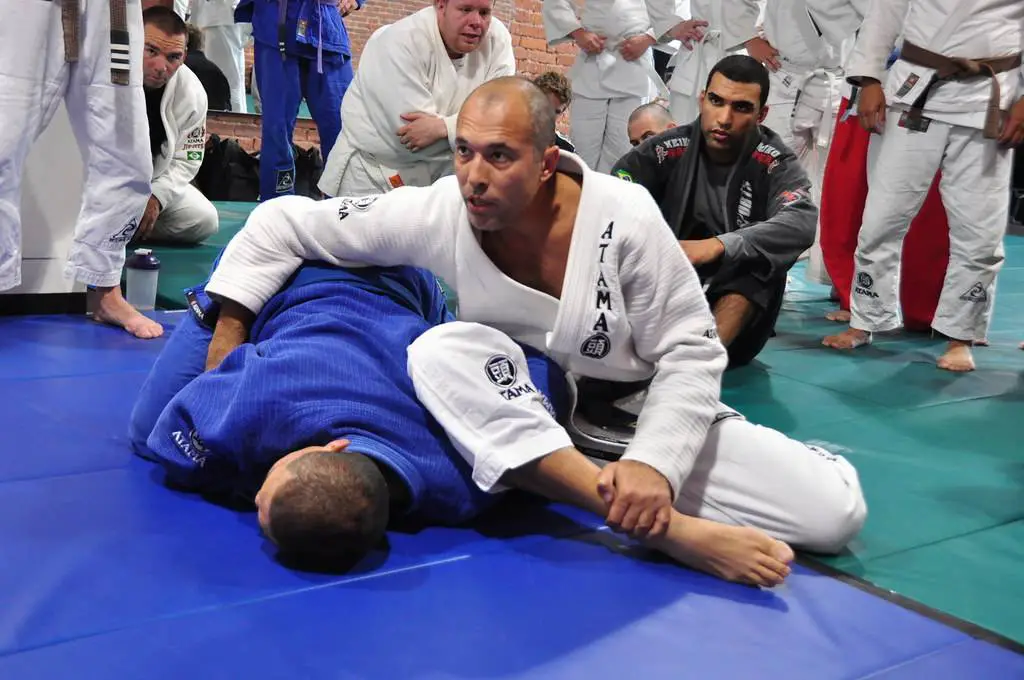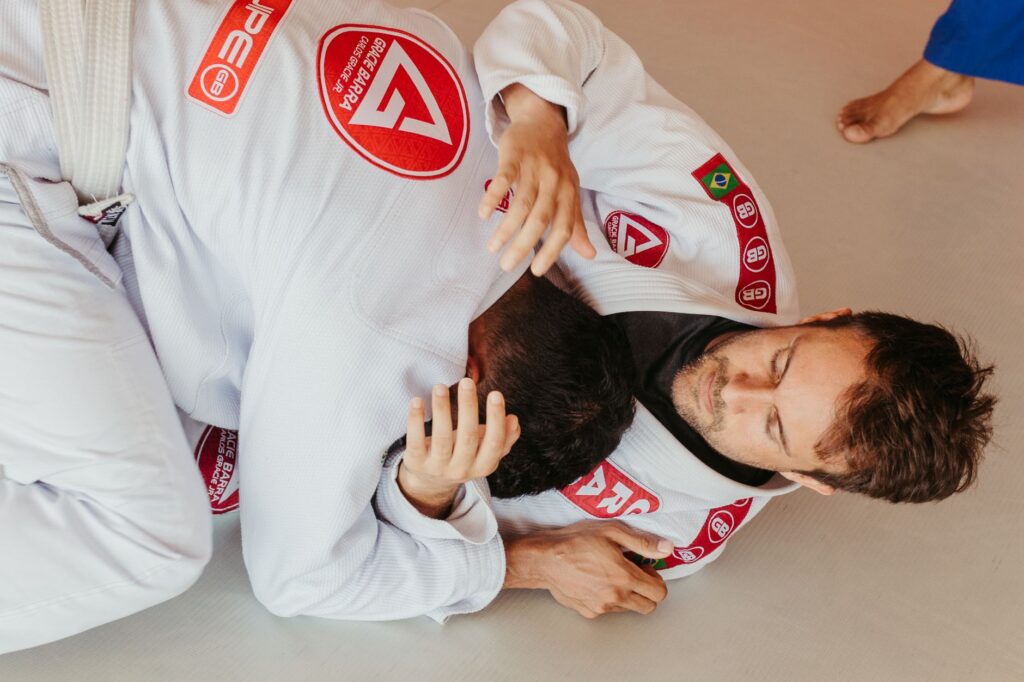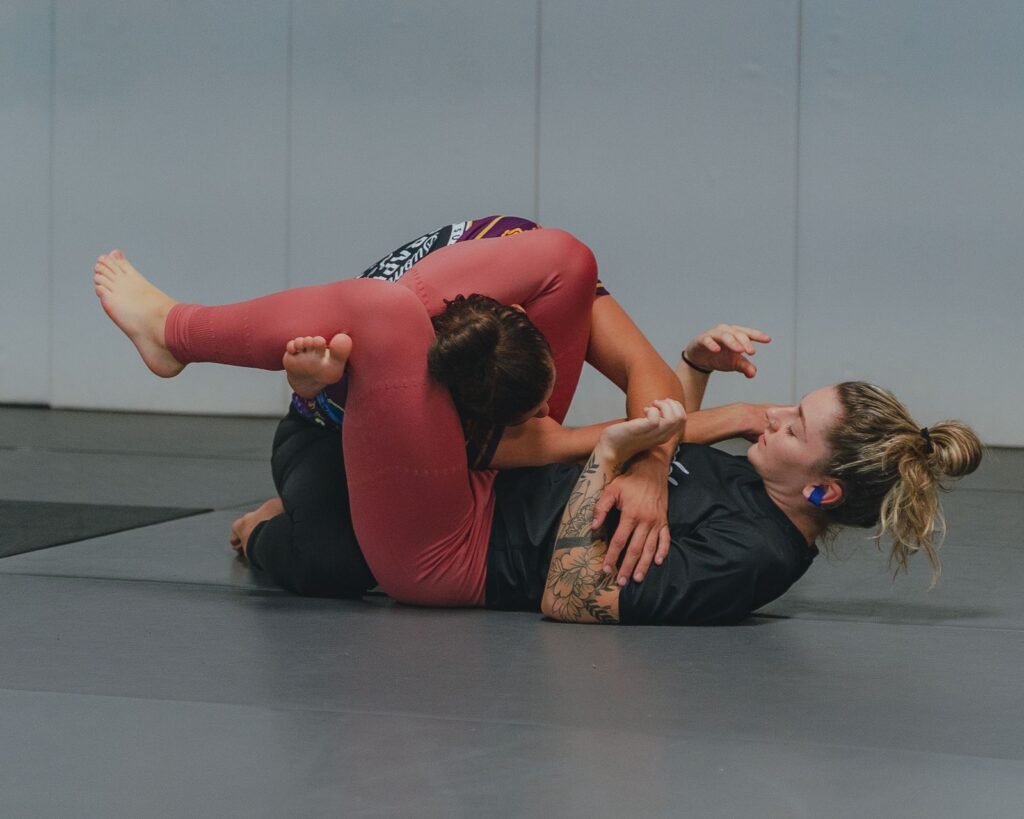
Quick answer: the Tarikoplata is a shoulder lock built from a kimura grip and an omoplata-style leg finish. Tarik Hopstock, who created and named it, used the clam that stalls a plain kimura as the entry, then rotated the shoulder with his leg and hip instead of a stronger arm pull. Its finish cue is short: elbow high, knee down. Under the checked IBJJF illegal-moves table, neither the Tarikoplata nor a general shoulder lock is listed, so a normal shoulder-lock application is legal for adult white-to-black belts in gi and no-gi; just check your age band and the current event rules.
Last updated: November 11, 2026 (Pacific). Teaching video inspected and IBJJF documents checked on November 11, 2026 UTC.
This guide is educational. Practice under qualified coaching, apply pressure gradually, tap early, and release immediately when a partner taps or cannot communicate clearly. The Tarikoplata rotates the shoulder; cranking it as a neck or spine attack is a different, higher-risk hold.
Before you hunt the finish, settle two things: is the arm really trapped, and can you control the roll? Most failed attempts miss one of those two, not the final rotation.
Free every Tuesday
The Grappler Brief
The week’s biggest stories from BJJ, judo, wrestling, and submission grappling—curated for people who train.
Sent out weekly.Opt out anytime.
Tarikoplata at a glance
| Detail | What to know |
|---|---|
| Technique family | Shoulder lock combining a kimura grip with an omoplata-style leg position |
| Named after | Tarik Hopstock, who created it and demonstrated it on the BJJ Fanatics channel |
| Signature cue | “Elbow high, knee down” — a small shoulder rotation, not a big body pull |
| Best-known setup | The North–South arm-clamp kimura, when the defender hides the arm |
| First control priority | Keep the far arm isolated; keep your own leg behind the neck and off the spine |
| IBJJF adult baseline | Not listed as an illegal move; treated as a permitted shoulder lock for gi and no-gi adults |
| Difficulty | Entry and leg placement need patience; the finish is technically small |
What is the Tarikoplata?
The Tarikoplata sits between the kimura and the omoplata. The official description on the published demonstration calls it a “mixing of omoplata with kimura.” You keep the figure-four shoulder grip the whole way, then put a leg over the shoulder and rotate with your upper body and hips instead of your arms.
That shift matters: shoulder strength is not where the move comes from. Against a heavier grappler you are not trying to out-pull the arm — you change your own base so the leg gets over and the shoulder turns. Hopstock is explicit about this; the leg is what supplies the mechanical advantage.
It is not the same as a plain side-control americana or a standard kimura, and it is not the omoplata your coach shows from closed guard: grips and rotation direction differ even though the shoulder-“over-the-head” idea is shared.
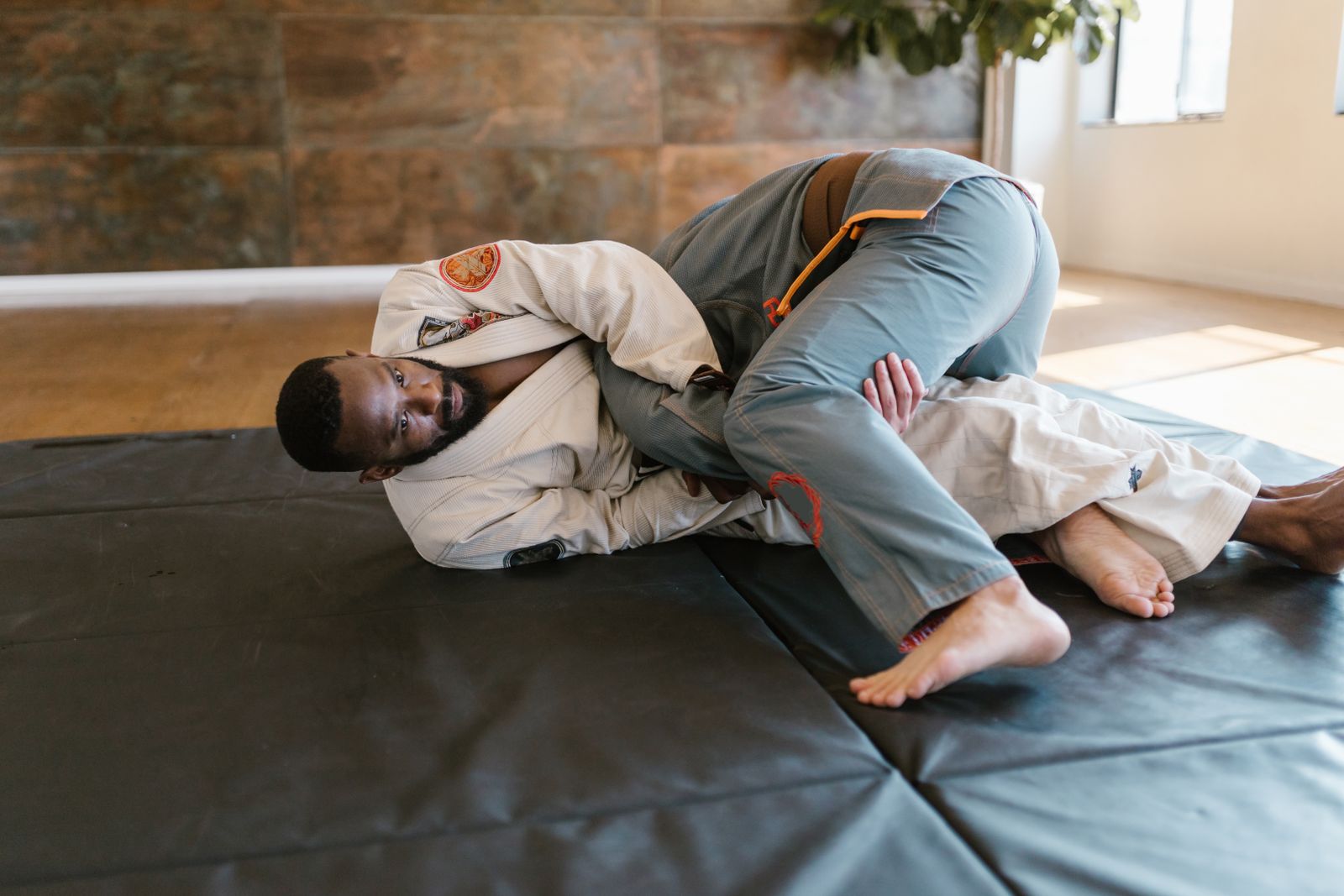
In the gym: free hand and the leg does the work usually means the omoplata family; figure-four locked while the leg climbs means Tarikoplata.
What you control before the finish
Four checkpoints come before the rotation itself.
1. Win the arm, then read the reaction
Everything starts from a kimura grip on a trapped arm. When the defender clamps the arms together to block the kimura, a straight pull stalls — and that clamp is the invitation. Hopstock reads it and switches to the leg finish. No isolated, pinned arm means no Tarikoplata; you only have a tug.
2. Change your base, not your pull
Against a heavier partner Hopstock does not push the leg away; he brings his hip up to the defender’s shoulder to free the bottom leg, then feeds it through on the outside and points the heel toward the roof. Hips replace arm force.
3. Point the heel to the roof
Letting the leg splay out to the side releases the wrist and kills the lock. Instead the leg climbs over the shoulder so the foot points toward the defender’s head on an omoplata line, setting the shoulder in the rotation path.
4. Control the roll with the pant grip and a post
As the defender rolls, Hopstock grips the pants to control the speed, keeps one leg behind the head (off the spine), posts a hand, and comes up on top, stepping so the body lands beside the foot. Lose the roll, and you end up glued to their back or in a scramble.
One entry, broken down
The Hopstock demonstration runs a North–South / passing-arm sequence. Steps follow what he shows, with timestamps mapped for review.
- Build the frame (from about 01:14) — push the head away and get your position above the defender’s head without lifting the knee over the shoulder.
- Catch the arm (from about 01:53) — connect a kimura-style figure-four on the far wrist as the pass finishes.
- Read the clamp (from about 02:07) — when he hides the arm, switch to the leg finish instead of forcing the kimura.
- Free the bottom leg and point the heel to the roof (from about 02:17 and 02:47) — bring the hip up, pull the leg through, then point the heel skyward, not out to the side.
- Steer the roll (from about 03:22) — grip the pants, keep the far leg behind the head, and come up on top as he rolls beside your foot.
- Finish: elbow high, knee down (from about 04:13 and 05:16) — a small upper-body rotation turns the shoulder; apply it slowly and release on the tap.
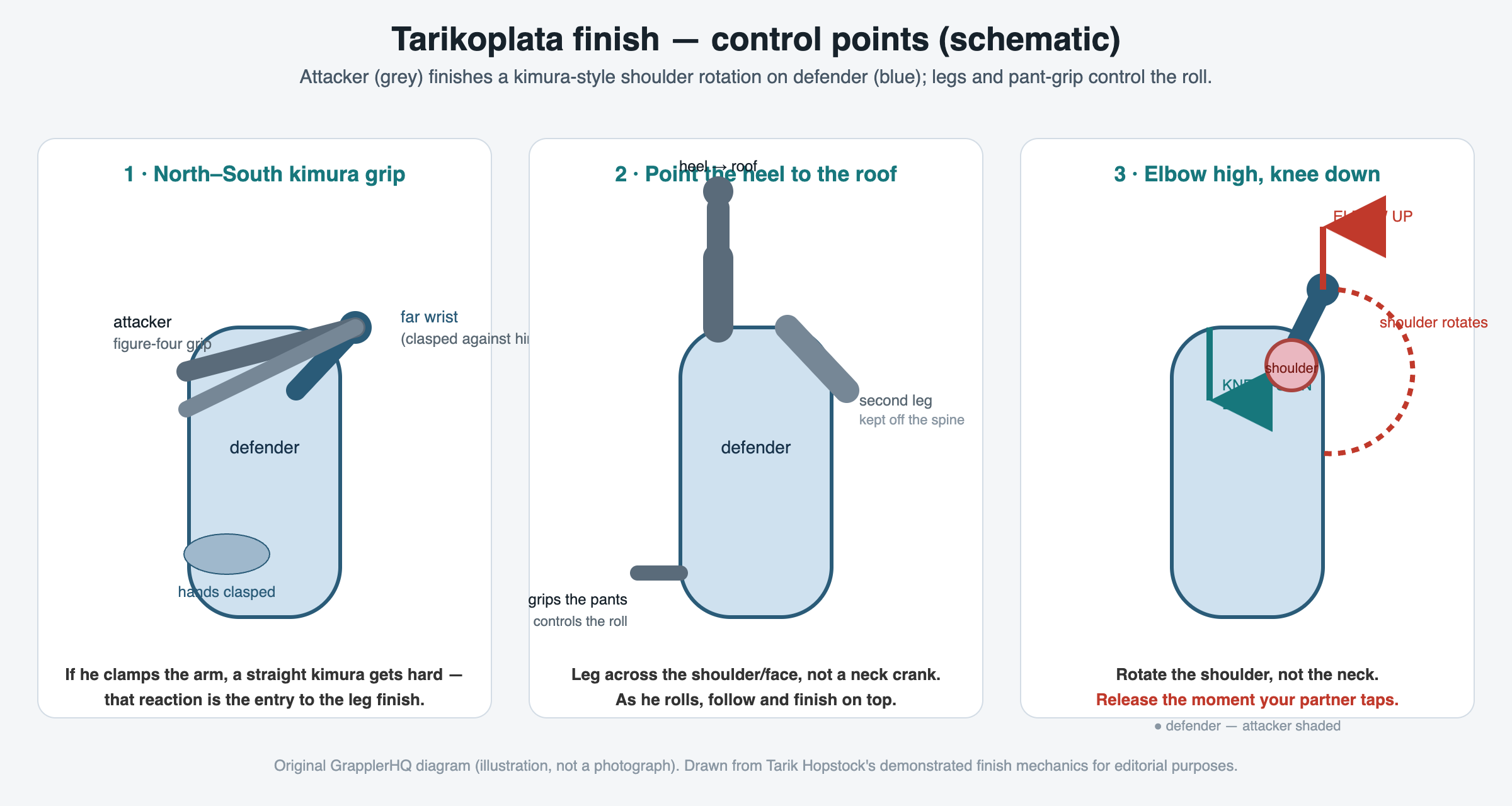
One honesty note: the “teabag” North–South position is the version the inventor demonstrates, and the one Grapplearts describes. You will also see the Tarikoplata taught off a closed-guard or triangle setup and from back control in other videos. Those entries are outside this inspection, so treat this write-up as covering the North–South/kimura version, and confirm any other entry with a qualified coach.
Common mistakes and better cues
| Mistake | Why it breaks | Better cue |
|---|---|---|
| Pulling the arm hard before the leg is set | Turns it back into a contested kimura | Get the hip up and the leg over first; the shoulder rotates because of base, not arm force |
| Letting the leg splay out to the side | Releases the wrist and kills the lock | “Point the heel to the roof”; leg over the shoulder toward the head |
| Skipping the roll control | Defender rolls over you or lands on your foot and scrambles | Grip the pants, keep the far leg behind the head, post a hand, come up on top |
| Pressing on the neck instead of the shoulder | Changes the technique into a neck/spinal hold and raises risk | Rotate the shoulder, elbow high; keep the second leg off the spine |
| Finishing with a big body crank | Rough on the partner, easy to overshoot | Small rotation under control; apply slowly, tap early |
Defensive priorities
Defend before the leg crosses the shoulder, because once the shoulder turns the lock is close to done.
- Do not clamp into a dead end. Clamped hands stop a kimura but hand over the entry; the instant you feel the leg coming over, attack it.
- Kill the leg over the shoulder. When you see the heel start to point up, fight the leg rather than waiting for the rotation.
- Keep posture off your back. If you stay flat and let them come up on top, the attack lands more easily.
- Tap early, not late. Shoulders give less warning than many joints. Ask a qualified coach to show the escape for this exact position in slow drilling rather than gambling on a late scramble.
Safety boundaries
This is a shoulder lock first. Build the position without pressure, add tension gradually, and release on the tap. Do not turn it into a neck ornament: the demonstrated finish is drawn over the shoulder, and the second leg sits behind the neck, off the spine. If the rotation drifts into a neck or lower-spine crank, stop and reset.
Is the Tarikoplata legal in BJJ?
Yes, under the IBJJF documents checked for this guide, as a standard shoulder-lock application. The federation’s illegal-moves table lists neither the Tarikoplata nor a general shoulder lock or kimura, which places it beside the kimura: available at every adult belt in gi and no-gi.
Two caveats, both deliberate.
- Its closest named relatives are listed: the omoplata appears on the table with age-band restrictions, and the “spinal lock without choke” row governs any finish that stops being a shoulder rotation and becomes a spine or neck attack. So: keep the shoulder rotation, keep the second leg off the spine, and never market the move as a neck crank.
- The illegal-moves poster is a graphic, so its cell-level age-band shading is not machine-readable from the PDF. Confirm your exact age band and the event’s own rules before competing; juvenile divisions can read differently from adult ones.
The checked rulebook carries the same version quirk the site has flagged elsewhere: the front cover and running headers read V6.1, while the final page also reads VERSION 6.2. The poster consulted is marked v4.0. The legality statement covers adult white-to-black belts in gi and no-gi; masters and juvenile categories are separate columns.
How to train the Tarikoplata
- Learn the position without the finish. Get the hip-up, leg-over, pant-grip control with no shoulder loading.
- Drill the leg centre-line. Point the heel to the roof and keep the lower leg off the side; this detail makes or breaks the lock.
- Add the roll slowly. Have a partner roll at your speed while you post, step across, and take top control.
- Apply pressure gradually. Only then work the elbow-high, knee-down rotation against a partner who can tap and communicate.
- Keep to club and rules limits. A legal tournament move is not an invite to crank beginners; match resistance to the drill.
Tarikoplata FAQs
Who created the Tarikoplata?
Tarik Hopstock, a Norwegian grappler, is credited with creating and naming it. The official description on the demonstration inspected here credits him as the creator and describes the move as a mix of omoplata and kimura mechanics.
Is the Tarikoplata legal in IBJJF competition?
Under the checked illegal-moves table and rulebook, a normal shoulder-lock application is legal for adult white-to-black belts in both gi and no-gi because neither the Tarikoplata nor a general shoulder lock is listed. Applying it as a neck or spinal crank is separately restricted, and juvenile/age-band details need confirmation on the current event documents.
What is the difference between a Tarikoplata and an omoplata?
They share the shoulder-rotation idea but differ in grip and setup: the Tarikoplata keeps a kimura-style figure-four and finishes with the leg over the shoulder; the omoplata lets the hand go and swings the leg as the finish from guard. A coach can point out where each appears in sparring.
Is the Tarikoplata good for smaller grapplers?
The inventor’s demonstration beats a heavier partner by changing base rather than out-pulling the arm, which is why the move suits lighter grapplers. It still needs clean hip movement and leg placement, so drill it slowly instead of leaning on force.
Is the Tarikoplata dangerous?
Any shoulder lock carries risk because the shoulder gives little warning before injury. Controlled pace, gradual pressure, and an early tap keep it safe; a neck-crank version is where risk climbs sharply.
Bottom line
Treat the Tarikoplata as a control problem rather than a trick finish. Win the kimura on a trapped arm, read the clamp, put the leg over, control the roll, and let elbow-high-and-knee-down rotate the shoulder. It is legal for IBJJF adults in gi and no-gi — as long as it stays a shoulder lock. Check your age band, rotate the shoulder, and release on the tap.
Sources
- Tarik Hopstock — “Understanding The Tarikoplata by Tarik Hopstock (The Creator Of The Tarikoplata)”, BJJ Fanatics (Bernardo Faria channel, 2019-08-02, 7:22 — primary mechanics and finish cues; video downloaded and timestamped November 11, 2026).
- Grapplearts — Tarikoplata Step-by-Step Breakdown, Stephan Kesting: corroborates the North–South “teabag” kimura position and leg-over finish.
- IBJJF Books and Videos — linked June 2024 rulebook (V6.1 cover/running headers; VERSION 6.2 final page) and illegal-moves poster v4.0: shoulder-lock legality; checked November 11, 2026.