Quick answer: Closed guard is the position where the bottom player wraps both legs around the top player’s waist and locks the ankles behind their back. It is the only common bottom position where the person underneath is often the one attacking: armbars, triangles, cross-collar chokes, and sweeps all start here. Nobody scores while the guard stays closed — the fight is over posture, and whoever wins posture wins the exchange.
This guide is educational. Drill with qualified coaching, apply pressure gradually, tap early, and release immediately when a partner taps or cannot communicate clearly.
| Detail | Closed guard summary |
|---|---|
| Technique family | Guard (bottom position) |
| Also called | Full guard |
| IBJJF scoring | Neutral; sweeps from it score 2, submissions end the match |
| Core battle | Bottom player breaks posture down; top player restores it and opens the legs |
What is closed guard in BJJ?
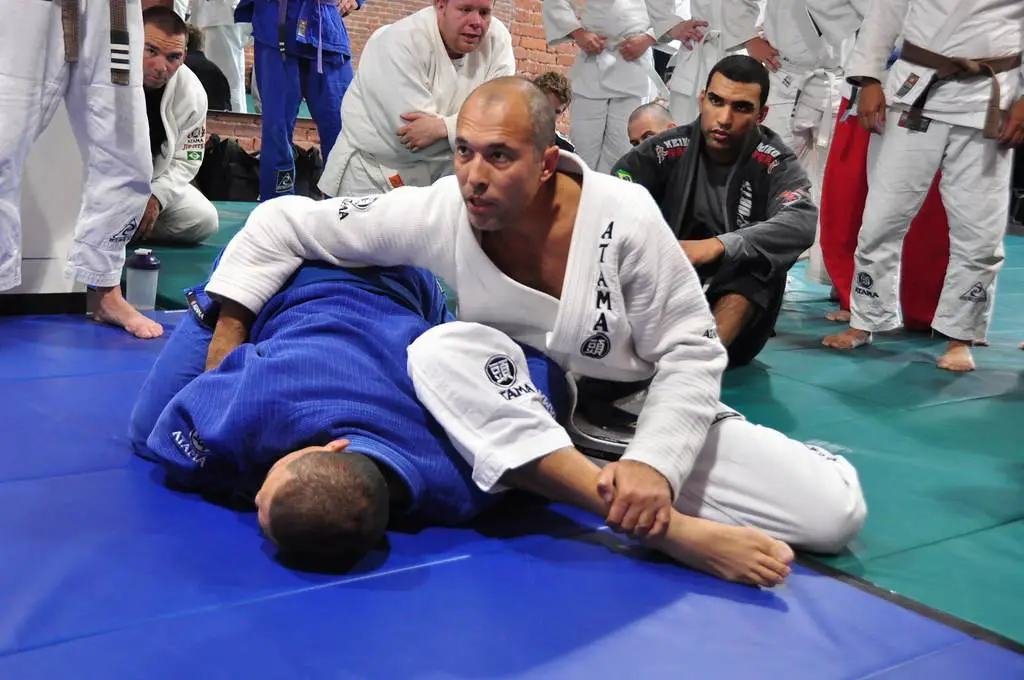
Closed guard (or full guard) is the classic bottom position of Brazilian Jiu-Jitsu: legs locked around the opponent’s torso, controlling their hips so they cannot create the distance or angle needed to pass. In most other combat sports, being on your back means losing. Closed guard is the position that made BJJ’s reputation by turning it into a place to win.
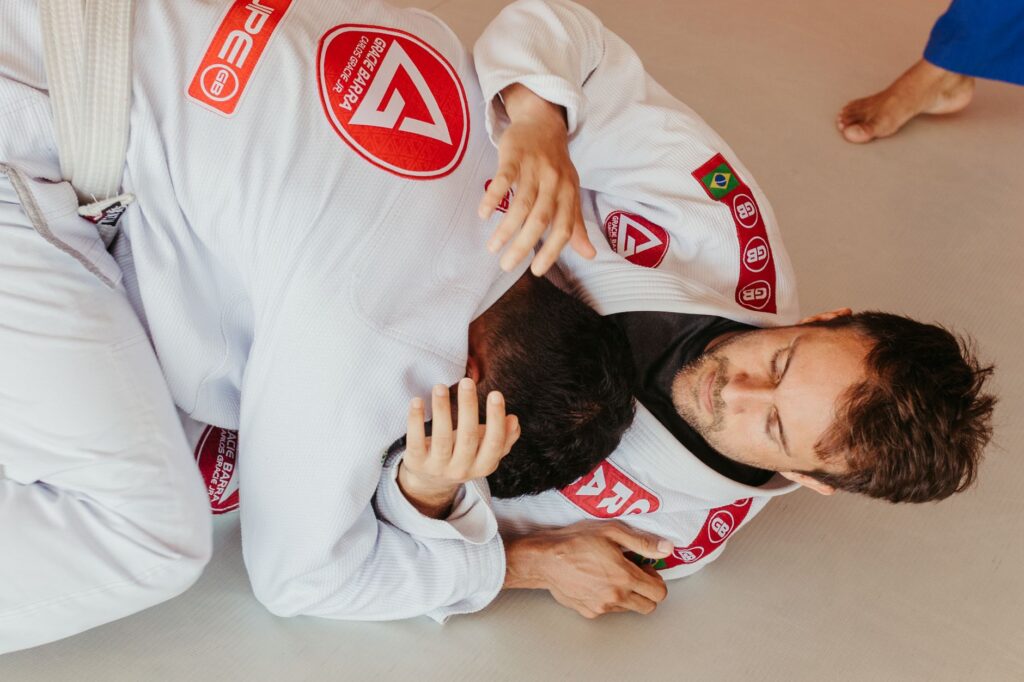
The position lives or dies on one variable: the top player’s posture. When the top player sits tall with straight spine and controlled grips, the guard is mostly neutral. When the bottom player breaks that posture down — head pulled to the chest, hands off the hips, elbows behind the knees — the submissions and sweeps stack up fast.
Free every Tuesday
The Grappler Brief
The week’s biggest stories from BJJ, judo, wrestling, and submission grappling—curated for people who train.
Sent out weekly.Opt out anytime.
How closed guard actually works
- The legs are grips, not a belt. Squeezing the knees accomplishes little; pulling the knees toward your own chest to tilt their hips forward breaks posture.
- Attack the posts. The top player stays postured through hands on your hips or chest and a straight spine. Strip a wrist, climb the legs higher, and the structure folds.
- Angles beat squeezing. Nearly every finish from closed guard requires cutting an angle — hips off the centerline, shoulders rotated — rather than staying flat and square.
- In the gi, grips multiply everything. Collar and sleeve control lets the bottom player hold broken posture and chain attacks; no-gi closed guard leans harder on overhooks, wrist control, and head control.
Common entries into closed guard
- Guard pull: in sport BJJ, gripping and sitting straight into closed guard is a deliberate strategy, especially in the gi. Under most rulesets a clean pull concedes nothing if the legs lock before a takedown lands.
- Failed takedown defense: when a takedown puts you on your back, wrapping the legs before the opponent clears them turns a lost exchange into a neutral one.
- Scrambles and submission escapes: many escapes — mount elbow escapes, side control recoveries — finish by climbing back to closed guard as the safest home base.
What to attack from closed guard
The classic attacking chain works as a triangle of threats. The cross-collar choke forces the top player to defend the neck; defending the neck extends an arm, feeding the armbar; pulling the arm back to escape opens the space for the triangle choke — and the omoplata catches the arm that swims wrong. Sweeps run on the same reactions: the hip-bump sweep punishes a top player who leans back, the scissor and flower sweeps punish weight committed forward. Roger Gracie won world titles at the highest level starting from exactly this basic chain — closed guard, collar grip, break posture — proof that the position rewards depth more than novelty.
Common mistakes
| Mistake | Why it fails | Better cue |
|---|---|---|
| Lying flat and holding on | A postured opponent dictates when and how the guard opens | Break posture or take an angle — do something, constantly |
| Squeezing the knees to “control” | Burns the legs without affecting their base or posture | Pull knees to your chest to tilt their hips forward |
| Attacking with no angle | Square-on armbars and triangles get stacked and passed | Hips off the centerline before you commit to a finish |
| Opening the guard without a plan | The pass starts the moment your ankles unlock | Open the guard into an attack, a sweep, or a grip — never into nothing |
How opponents pass closed guard
- Posture and open: straighten the spine, control the hips or a collar, stand or wedge a knee in, and force the ankles apart. Every closed guard pass starts with getting the guard open.
- Standing breaks: standing up inside the guard uses gravity against the locked ankles — the standard route at higher levels.
- Once open, it becomes a normal guard passing problem — knee slides, torreando, over-under — against a guard that no longer has its lock.
- For the bottom player, the counter-lesson: the moment your guard is opened is the moment to attack or retain, not to re-close and rest.
How closed guard is scored in competition
Closed guard itself is neutral in the IBJJF-style points system — no points for holding it, none against you for being under it. Sweeps from guard that reverse the position and stabilize score 2 points. Submissions from guard end the match anywhere. In MMA judging, guard reads differently: the fighter on top is usually seen as controlling unless the guard player is visibly attacking, which is why closed guard strategy differs sharply between sport BJJ and MMA. Confirm specifics in the BJJ rules and scoring guide and the current event rulebook.
Safety and training notes
- Armbars from guard extend fast. The hips do the finishing, so lift them gradually — partners need time to tap before the elbow is at its limit.
- Mind the stack. When the top player stacks a triangle or armbar attempt, the bottom player’s neck takes the load; both partners should treat heavy stacking in drilling as a reset, not a war.
- Unlock the ankles when someone stands with you attached in drilling — falling with locked legs is how knees get hurt.
Stop if a partner reports unusual pain, numbness, or trouble breathing beyond normal positional discomfort. This article does not diagnose injuries; seek qualified medical care for concerning or persistent symptoms.
Examples to study
- Roger Gracie’s collar-grip closed guard. Watch how the cross-collar grip alone forces reactions, and how rarely he needs more than the classic chain to finish elite opponents.
- Modern no-gi closed guard players often use closed guard as a transit hub — breaking posture to wrist-ride into back takes rather than finishing in place. Compare that with the gi approach and notice how grips change the position’s whole logic.
Related GrapplerHQ guides
Sources and further reading
- IBJJF Books and Videos — current rules materials
- ADCC Rules and Regulations
- Injury prevalence among BJJ practitioners — PubMed
FAQ
Is closed guard the same as full guard?
Yes — the terms are interchangeable. Both describe the bottom position with legs wrapped around the opponent’s torso and ankles locked.
Do you get points for closed guard?
No. Holding closed guard scores nothing under IBJJF-style rules. Sweeps from it score 2 points once you reverse and stabilize, and submissions end the match.
What should a beginner attack first from closed guard?
Learn the classic chain as one system: cross-collar choke, armbar, triangle, plus the hip-bump sweep. Each attack covers another’s defense, which matters more than any single technique.
Is closed guard good in MMA?
It is defensively essential but judged differently: the top fighter usually scores as the controller unless the guard player visibly attacks. Active submission threats and standing back up rate higher in MMA than patient guard play.
Bottom line
Closed guard is a posture argument, and the bottom player starts it with the stronger hand. Break posture and the classic chain — choke, armbar, triangle, sweep — plays itself. Let the top player sit tall and pick grips, and the guard is just a waiting room for the pass. Flat and passive loses; angled and busy wins.