
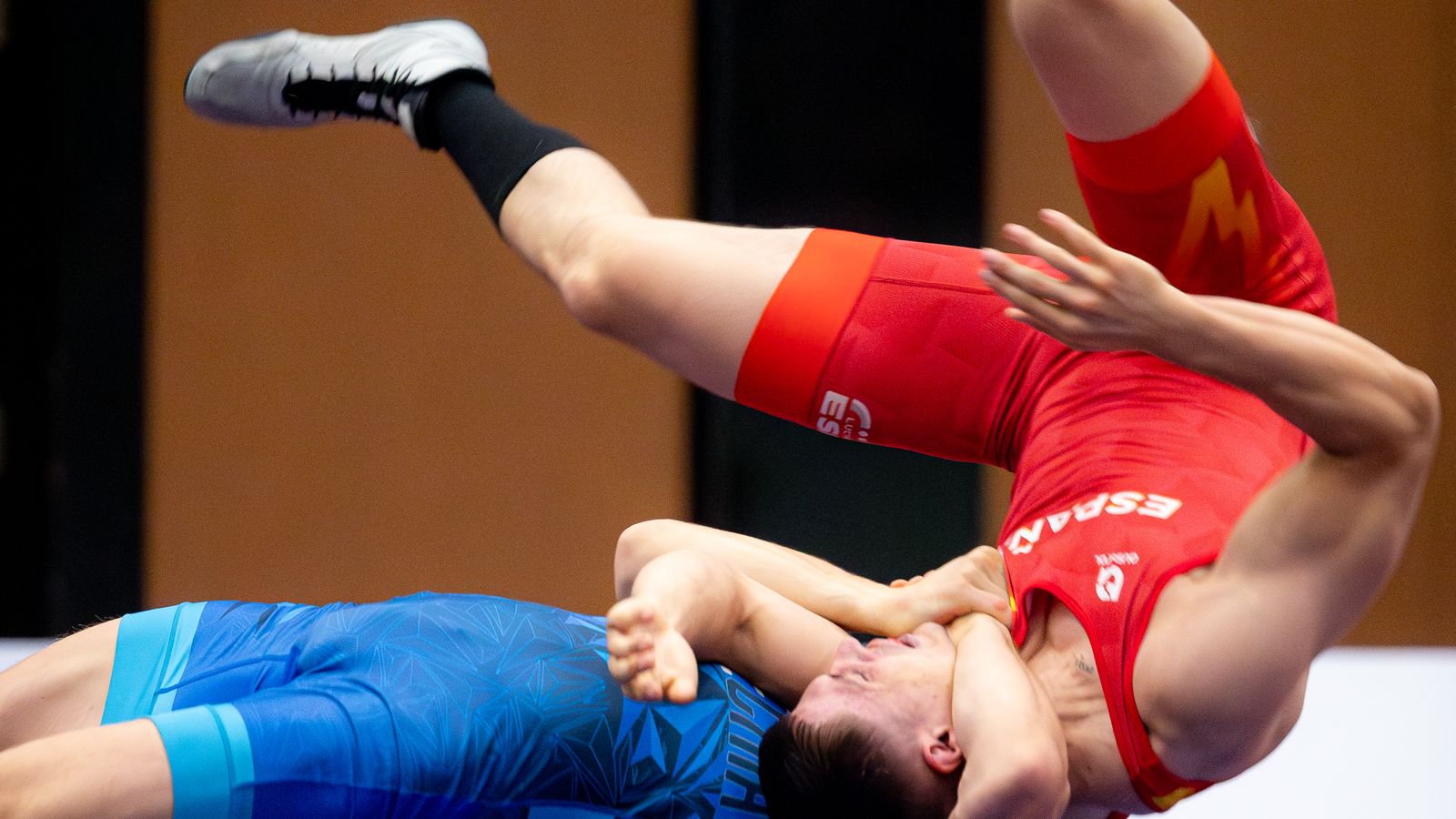
Quick answer: wrestling is a grappling sport where you win by pinning your opponent’s shoulders to the mat or by out-scoring them with takedowns and control. There are no submissions and no jacket to grip. The catch is that “wrestling” means different rulesets in different places — freestyle and Greco-Roman internationally, folkstyle in American schools — and the differences change which techniques matter. This page explains each style, the takedowns that transfer directly to BJJ and MMA, and where to go deeper on each one.
Last updated: 2026-07-10
Most people land on this topic from one of two directions. Either they watched a wrestler dominate a BJJ competition or MMA fight and want to know why, or they’re a grappler trying to fix their takedowns and heard “just learn to wrestle.” Both roads lead to the same problem: wrestling isn’t one sport with one rulebook. A high-school folkstyle wrestler, an Olympic freestyle wrestler, and a Greco-Roman specialist train under different rules and develop noticeably different skills.
Free every Tuesday
The Grappler Brief
The week’s biggest stories from BJJ, judo, wrestling, and submission grappling—curated for people who train.
Sent out weekly.Opt out anytime.
The three main wrestling styles at a glance
| Style | Where you’ll see it | Leg attacks | How you win |
|---|---|---|---|
| Freestyle | Olympics and international competition, governed by United World Wrestling | Yes | Pin, or points from takedowns and exposing the opponent’s back |
| Greco-Roman | Olympics and international competition (men’s divisions) | No — nothing below the waist | Pin, or points from throws and upper-body control |
| Folkstyle (collegiate/scholastic) | American high schools and NCAA college wrestling | Yes | Pin, or points that reward escapes, reversals, and riding control |
What is wrestling?
Wrestling is one of the oldest recorded sports — it was contested at the ancient Olympic Games and appeared at the first modern Games in 1896. At its core, every style answers the same question: can you take another person down and control them against their will, using no strikes, no jacket grips, and no submissions?
That “no submissions” point surprises people coming from BJJ. A wrestling match never ends with a tap. It ends with a fall (both shoulders pinned to the mat), a points decision, or a lead so large the referee stops the match. Whether wrestling still counts as a martial art when it has no finishing holds is a fair question — we cover it properly in is wrestling a martial art?
How the styles differ in practice
Freestyle is the international standard. Leg attacks are legal, matches are short and explosive, and points come from takedowns and from exposing your opponent’s back to the mat — even briefly. Freestyle wrestlers tend to have fast, committed shots and dangerous leg-lace and gut-wrench turns on the mat.
Greco-Roman bans every attack below the waist. No single legs, no double legs, no trips using the legs. Everything happens in the over-under clinch: body locks, arm throws, and high-amplitude suplexes. Greco specialists are the strongest clinch fighters in grappling, which is why their skills show up constantly in MMA against the cage.
Folkstyle is the American school and college format. It keeps the leg attacks of freestyle but scores differently: escapes and reversals earn points, and controlling your opponent on the mat (“riding”) is rewarded rather than stalled out. That scoring produces wrestlers with relentless top pressure and strong scrambling instincts — the trait BJJ players notice most when they roll with a college wrestler.
Wrestling takedowns every grappler should know
These four techniques are the wrestling canon for BJJ and MMA, and each has a full GrapplerHQ guide:
- Single-leg takedown — the highest-percentage shot in grappling, and the safest entry for BJJ rulesets where a failed shot can cost you your neck.
- Double-leg takedown — the classic power shot: level change, penetration step, and drive through both legs.
- Ankle pick — a low-risk snatch of the lead ankle, usually set up off collar ties and snap-downs.
- Body-lock takedown — the Greco-flavored option: lock your hands around the torso and take away the sprawl entirely.
Defensively, wrestling revolves around the sprawl and the front headlock. In BJJ those same positions feed directly into the guillotine choke — the single biggest adjustment wrestlers have to make when they cross over, because in wrestling a lazy shot costs two points, while in BJJ it can end the match. The turtle position plays a similar double role: in wrestling it’s a way to survive; in BJJ it invites back takes.
Wrestling vs BJJ
The short version: wrestling wins the battle of where the fight happens, BJJ wins the battle of what happens on the ground. Wrestlers decide whether the match stays standing; BJJ players decide how it ends once it hits the mat. The styles are so complementary that most serious no-gi competitors now train both. For the full breakdown — rules, scoring, difficulty, and which to start with — see our BJJ vs wrestling guide. And for how wrestling measures up against the other great takedown art, see judo vs wrestling.
The crossover runs in both directions. Wrestlers like Nicky Rod have jumped straight into elite no-gi grappling and reached ADCC finals within a couple of years, while a wrestling base remains the most common grappling foundation among UFC champions — our UFC statistics study breaks down how those fights actually end.
FAQ
Is wrestling a martial art?
Yes, by any reasonable definition — it’s a codified system of combat techniques with thousands of years of history, even though modern versions are practiced as sport. We make the full case in our dedicated guide.
Does wrestling have submissions?
No. All three major styles win by pin or points only. Chokes and joint locks are illegal. Wrestlers who want submissions cross into BJJ, submission grappling, or MMA.
What’s the difference between freestyle and folkstyle?
Freestyle is the international Olympic style; folkstyle exists only in American schools and colleges. Freestyle rewards back exposure and big turns; folkstyle rewards escapes, reversals, and riding control. A folkstyle wrestler’s top pressure usually transfers to BJJ better than their turn game.
Is wrestling good for BJJ?
Extremely. Takedowns, top pressure, and scrambling are the three most common holes in a pure BJJ game, and wrestling trains all three. The adjustment is defensive: wrestlers must learn to protect their neck and stop turning to their knees under pressure.
Wrestling guides: wrestling weight classes · wrestling moves · types of wrestling · wrestling rules.
Bottom line
Wrestling is the art of deciding where the fight happens. Freestyle gives you the shots, Greco gives you the clinch, folkstyle gives you the ride — and all three produce grapplers with takedowns and pressure that BJJ alone rarely builds. Start with the single leg, learn to sprawl, and browse the full techniques library for the rest.
Wrestling’s submission ancestor is catch-as-catch-can, the 19th-century English style won by pin or submission. Amateur governing bodies stripped out the joint locks to create Olympic freestyle; the submission half went to professional wrestling and, later, to Japanese shoot-style and MMA.