Quick answer: the cross collar choke is a gi choke where both hands grip the opponent’s opposite collar — thumbs on top, fingers inside — and scissor the forearms against the sides of the neck. It is legal at every adult belt in IBJJF gi competition, because it does not appear on the federation’s illegal-moves table, but it is built entirely on the collar: take the gi away and the choke mostly disappears with it. Done with deep grips it is a blood choke on the carotid arteries; a shallow grip drifts onto the windpipe, which is weaker and harsher for the person receiving it.
Last updated: November 10, 2026 (Pacific). Sources checked November 11, 2026 UTC.
This guide is educational. Practice under qualified coaching, apply pressure gradually, tap early, and release immediately when a partner taps or cannot communicate clearly.
Cross collar choke at a glance
| Detail | What to know |
|---|---|
| Technique family | Gi collar choke — a blood choke when the grips sit deep on the collar |
| Grip | Both hands on the opposite collar, thumbs on top, fingers inside; the wrist bone cuts into the side of the neck |
| Gi dependence | Complete. No collar, no choke — the classic version does not transfer to no-gi |
| Judo lineage | The juji-jime family (nami-, gyaku-, kata-juji-jime) in Kodokan shime-waza |
| Verified demonstrations | Roger Gracie from mount; Jon Thomas (via Grapplearts) from closed guard |
| IBJJF adult legality | Legal at all belts in gi — not on the illegal-moves table |
| First control priority | Kill the bridge and elbow escape (mount) or break posture (guard) before gripping deep |
What is the cross collar choke?
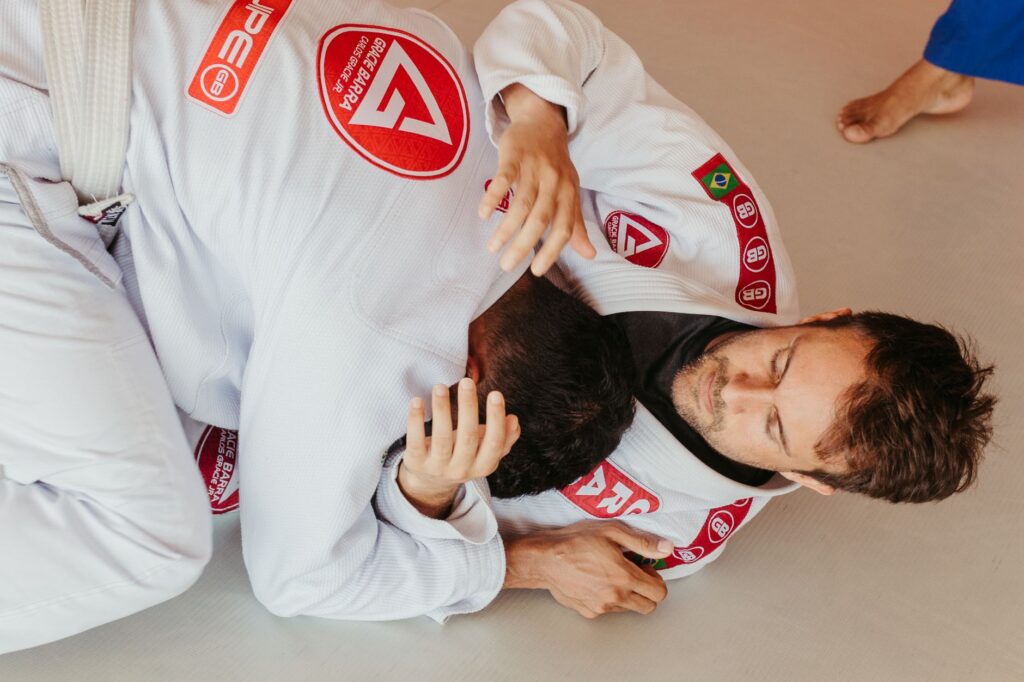
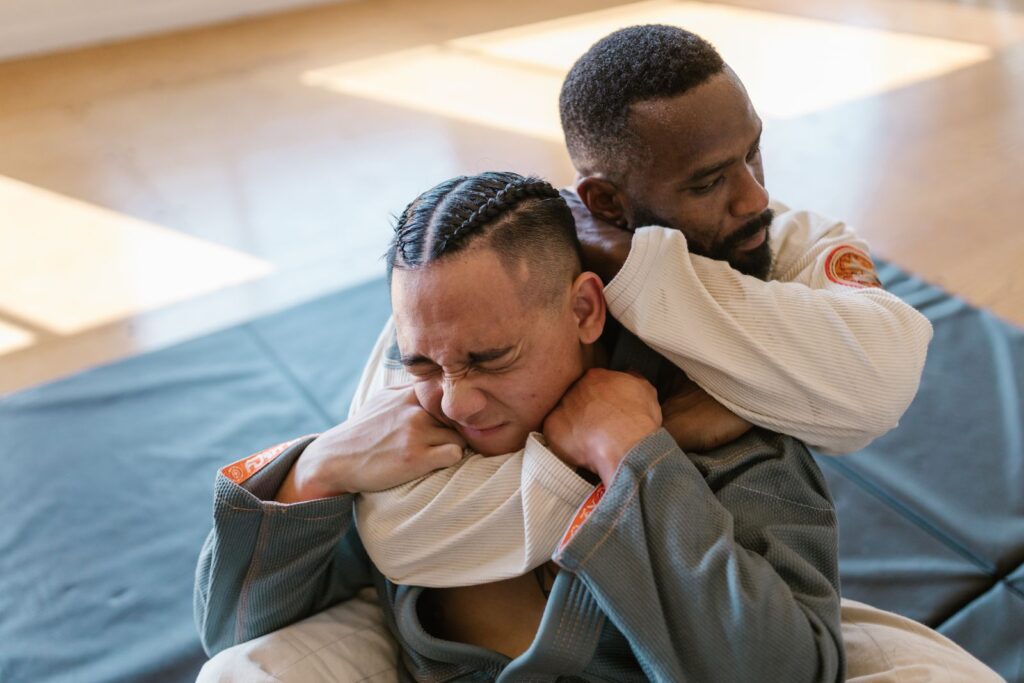
The cross collar choke uses the opponent’s own collar as the tool. One hand grips the collar on their left, the other on their right, fingers inside the fabric and thumb on top. When both grips are deep — behind the neck, roughly at the angle of the ears — you draw the elbows down and apart, and the forearms close like scissors on the sides of the neck. That is a strangle, not a windpipe crush: the pressure belongs on the carotids, not the front of the throat.
Free every Tuesday
The Grappler Brief
The week’s biggest stories from BJJ, judo, wrestling, and submission grappling—curated for people who train.
Sent out weekly.Opt out anytime.
It is the mirror image of the rear naked choke: “naked” means no cloth, so the RNC transfers unchanged from gi to no-gi to MMA, while the cross collar choke is all cloth. Its roots run through judo, whose Kodokan shime-waza list includes the cross-strangles nami-, gyaku- and kata-juji-jime — the same thumbs-on-top, fingers-inside collar grips.
How the cross collar choke works
Two grips do different jobs. The first grip is the anchor: it goes in deep, stays tight, and gives you the control to hold position or break posture. The second grip is the cutter: it slides in when the defense slips and completes the scissor. Both instructors stress the same wrist detail — the sharp edge of the wrist angled to cut into the side of the neck, not the flat back of the wrist. If your wrist does not seem flexible enough for the angle, adjust your body position until the angle appears. The finish is weight over arms: a body drop with the elbows drawing down, not a two-arm tug.
Cross choke from mount — Roger Gracie’s sequence
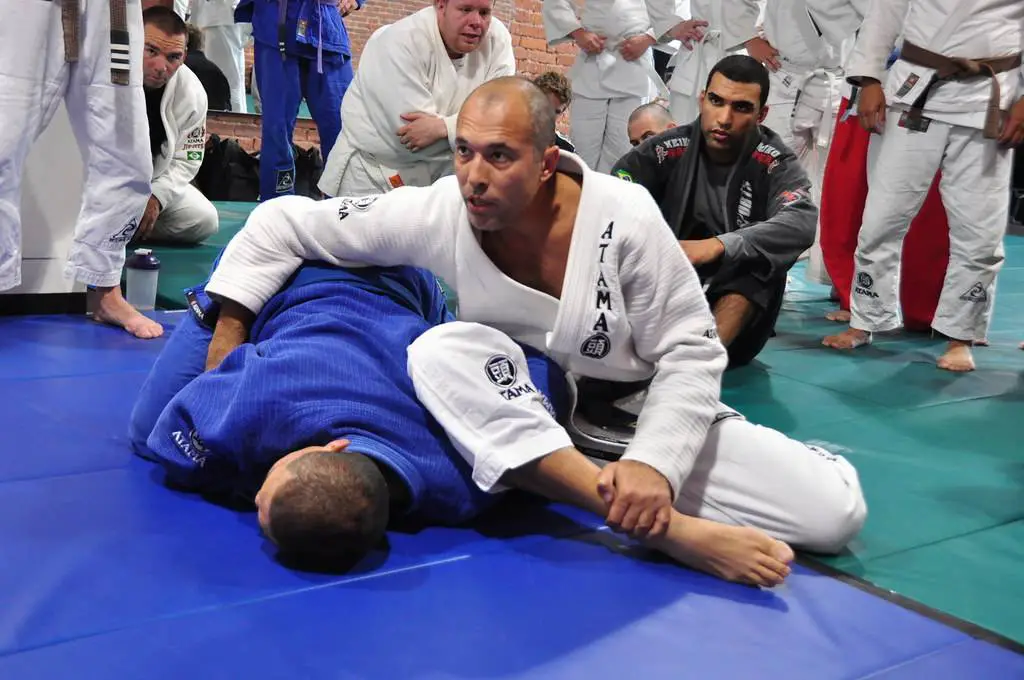
The BJJ Fanatics-linked demonstration is the canonical version. Roger’s emphasis is rarely on the choke and almost always on the mount underneath it:
- Establish the high mount first. Stay high enough that the bottom player cannot fit an elbow in — the elbow escape and the bridge are the two things he says he must stop before attacking.
- Put the whole arm through before gripping. Thread the arm through so the forearm rests across the neck, and only then set the grip, with the weight shifted toward the free arm so a bridge cannot roll him onto the trapped arm.
- Drop for the second grip. He sinks lower, forehead toward the mat. The lower the head, the higher the hips, and the less purchase a bridge has — a bridge now drives him into a stable block and the roll exposes the back.
- Go behind the ear with the thumb. Four fingers in is hard on the second side because the defender defends with both hands. Roger goes thumb-in, deep behind the ear, where the collar is hard to reach — and reaching to defend opens the armbar. The wrist must also pass the defender’s fingertips so the rotation “cleans” their fingers off; he calls this the difference between finishing and not.
- Finish low, feet connected. The body drops while the feet stay attached — not the knees — so a last bridge cannot pop the base off. He describes two safe places in mount: very tall or very low; anything in between is where you get thrown.
That is more mount control than choke mechanics, and that is the point: without the base, the same grips get escaped.
Cross collar choke from closed guard — Jon Thomas
The Grapplearts-published demonstration by Jon Thomas shows the bottom-side logic, which inverts the mount version:
- Pummel in and pin the elbow to the sternum. Win the collar grip by pummelling inside; the elbow pins against the sternum so the opponent cannot re-pummel, and the knees stay tight so they cannot stand up.
- Set the wrist angle, then cinch deep. Give the grip room to rotate to the sharp-bone angle on the side of the neck, then pull the lapel deeper. The first grip must be genuinely tight — it is the base the whole attack hangs from, and it doubles as the setup for the triangle, the armbar and the high guard.
- Fast second grip on the shoulder. The second hand does not need to thread deep inside the gi. A quick grip on the shoulder material — or over the back for a deeper version — completes the scissor.
- Come up to finish. Sit up into the choke with the elbows in and the chest opened, pulling in tight rather than flaring out.
The guard version is a control position before it is a submission. Kesting’s commentary on the video: get the first grip at the right angle, then genuinely attack the other threats so the defensive arm structure breaks and the second grip sinks in.
Side control and other positions
| Position | First control priority | How the finish changes |
|---|---|---|
| Mount | High mount; stop the bridge and elbow escape before attacking | Drop the body low with the head on the mat; feet stay connected |
| Closed guard | Break posture; pin the elbow to the sternum; keep the knees tight | Sit up into the choke; the deep first grip doubles as base control for triangle and armbar |
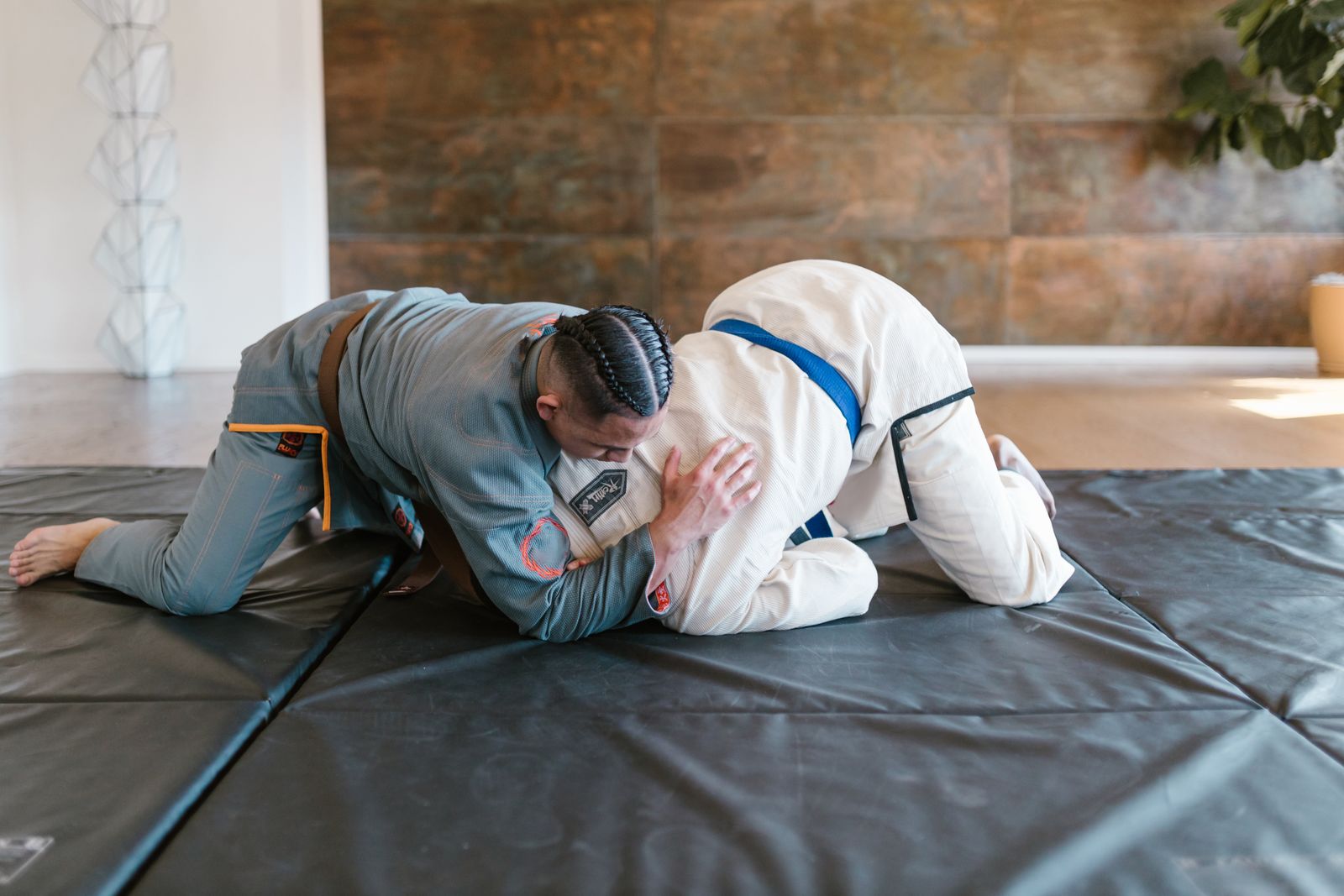
| Side control | Clear the near arm and frames so the grip can reach behind the neck | Same grips and scissor as mount; the near arm must be handled first or it posts and defends |
The side-control version uses the same collar grips once the near arm and the frames are cleared; the verified mechanics carry over, and only the entry work of removing the blocking arm changes.
Common mistakes and better cues
| Mistake | Why it fails | Better cue |
|---|---|---|
| Grabbing the collar before controlling the position | The opponent bridges, elbow-escapes or postures and the grip fight is lost | Establish high mount or broken posture first; the choke is the last step |
| Shallow grips | Pressure lands on the windpipe instead of the sides of the neck | Cinch both grips deep, behind the angle of the ears, before adding pressure |
| Flat wrist against the neck | The broad part of the wrist presses the throat instead of cutting in | Rotate the wrist so the bone edge cuts the side of the neck; adjust body angle, not force |
| Finishing with an arm pull | Straight-armed tugging wastes energy and gives the defender time | Drop the body weight; draw the elbows down and apart |
| Never threatening anything else from the first grip | The defender only defends one thing and never leaves the second grip open | From guard, chain to triangle, armbar or a sweep; from mount, to the armbar |
Defending the cross collar choke
- Fight the grip before it goes deep. Both demonstrations reward a deep first grip. Hand-fight the collar, keep your hands in close, and do not let the attacker’s wrist get behind the line of your head.
- Protect the second side. Once the first grip is in, the battle is stopping the second hand from connecting. Both hands defending the collar does that — but both instructors warn that reaching up to defend is exactly what opens the armbar. Your real task is to buy time to escape the position.
- Escape the position, not the choke. From bottom mount that is the elbow escape or a bridge that reloads guard; from guard, breaking posture and standing. If you cannot stand, the choke is usually already on.
- Tap early once both grips are deep. There is no reliable late escape from a finished cross collar choke. Tap and ask a coach to show the defence for the exact grip that caught you.
Safety boundaries
- Depth determines what you squeeze. Deep grips close the sides of the neck — a strangle. Shallow grips drift onto the windpipe. A partner who is coughing and gagging is telling you the grip is shallow; fix the depth, do not squeeze harder.
- Tap early, release on the tap. Apply pressure gradually and release the instant your partner taps, goes still, or cannot speak clearly. Chokes put people to sleep fast when done right; never crank a resisting partner.
- No belt, no thumb on the windpipe. The checked IBJJF rulebook lists using the belt to assist a choke (while untied) as a foul, and applying thumb pressure to the windpipe as a foul. The cross collar choke needs neither.
- Supervise it. Learn it under qualified coaching, starting without pressure. Choke training is not a solo activity and not a party trick.
Is the cross collar choke legal in BJJ?
Under the checked IBJJF documents, yes for adults in gi, at every belt. The cross collar choke does not appear on the federation’s illegal-moves table, which names other chokes (choke with spinal lock, the sleeve-fed Ezekiel, frontal guillotine) but not the cross choke. Note the checked rulebook front cover reads version 6.1 while the final page also carries “VERSION 6.2”; this summary covers adult divisions only — juvenile and masters categories can have their own columns.
| Division | Cross collar choke | What to check |
|---|---|---|
| White, blue, purple, brown, black — gi | Legal — not on the illegal-moves table | The exact event’s rules; the table is per-organization |
| No-gi | N/A — no collar, so the classic version is unavailable | No-gi hand chokes are a different family |
| Related fouls that still apply | Belt-assisted chokes (belt untied); thumb pressure on the windpipe | Separate fouls, not cross-choke restrictions |
The gi dependence is the practical rule. Our gi vs no-gi guide explains which submissions survive the format change; collar chokes are on the list that do not.
How to train the cross collar choke
- Drill the grips without pressure. Thumbs on top, fingers inside, both hands on opposite collars; have a coach check the wrist angle.
- Drill the depth. Cinch each grip until it sits behind the angle of the ears. Your partner should be able to speak; if they cannot, you are adding pressure before the position is ready.
- Add the position. From mount, hold the high-mount base while the grips go in; from guard, break posture first. Drill the choke only once the base holds.
- Add resistance slowly. Have your partner defend the first grip and the second side while you keep the pace controlled. Increase resistance only if the base holds and the finish is still a body drop, not a tug.
- Follow club rules. A technique being legal at one belt division does not make it appropriate for every class or partner.
Cross collar choke FAQs
Is a cross collar choke the same as an Ezekiel choke?
No. The cross collar choke uses both hands on the opponent’s opposite collar. The Ezekiel uses one arm behind the neck while you grip your own sleeve — no opponent collar required. Our bow and arrow choke guide covers another collar-choke family member.
Does the cross collar choke work in no-gi?
Not in its classic form, because there is no collar. The two-collar grip and the scissor both depend on the fabric; no-gi hand chokes are a different family with different control points.
Is the cross collar choke a blood choke?
With deep grips, yes — the pressure closes the carotids on both sides of the neck. A shallow grip drifts onto the windpipe, an air choke, weaker and more painful. Grip depth decides which one your partner feels.
Can you hit a cross collar choke from side control?
Yes. The same collar grips and scissor finish apply once you have cleared the near arm and the frames. The verified mechanics here come from the mount and guard versions; the side-control entry is about removing the arm that blocks the grip first.
Bottom line
The cross collar choke is the purest gi choke in jiu-jitsu: two hands on the opposite collar, deep grips, wrist-bone pressure on the sides of the neck, and a body-drop finish. It is legal for every adult belt in IBJJF gi and unavailable without the gi, so it rewards the grappler who wants a gi game. Learn the control before the choke — the high mount, the broken posture, the cleared near arm — and the finish takes care of itself. Start with the mount version, add the closed guard game, and read our rear naked choke guide for the no-gi contrast.
Sources
- Roger Gracie — cross choke from mount (Bernardo Faria BJJ Fanatics channel) and the linked BJJ Fanatics Mount System page — teaching mechanics, entries and finishing details; video inspected November 11, 2026.
- Jon Thomas — cross collar choke from closed guard (Stephan Kesting / Grapplearts channel) and the linked Closed Guard System page — guard-side mechanics and control; video inspected November 11, 2026.
- IBJJF Books and Videos — linked June 2024 rulebook (version 6.1 on the front cover and running headers; “VERSION 6.2” also appears on the final page) and illegal-moves poster v4.0; both inspected November 11, 2026.
- Gyaku Jūji-jime — Wikipedia — Kodokan shime-waza classification and cross-strangle grip description; checked November 11, 2026.