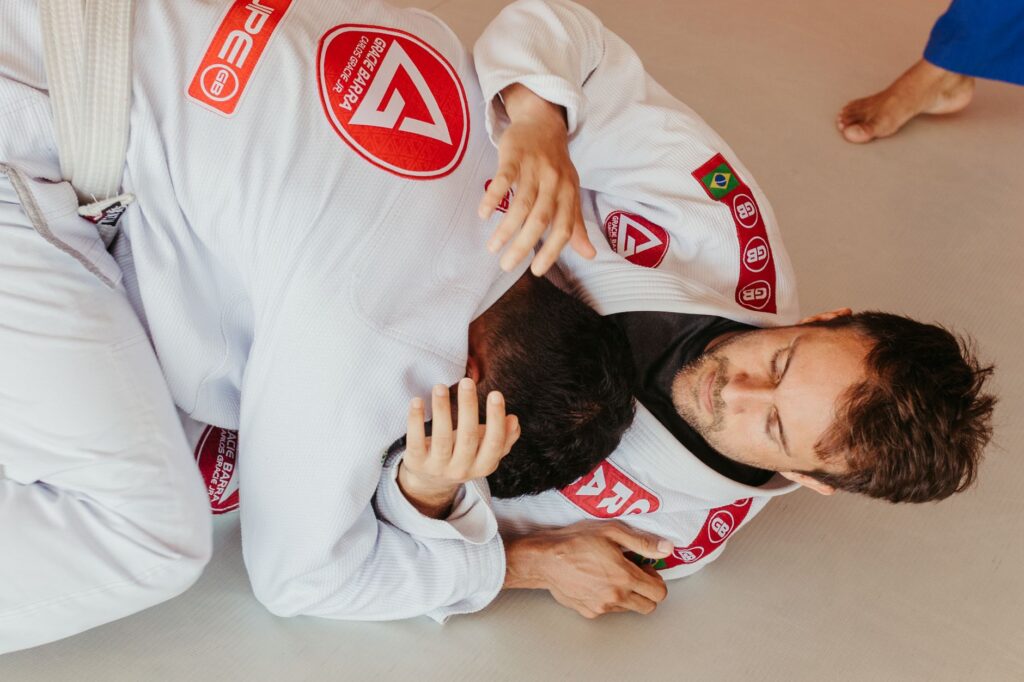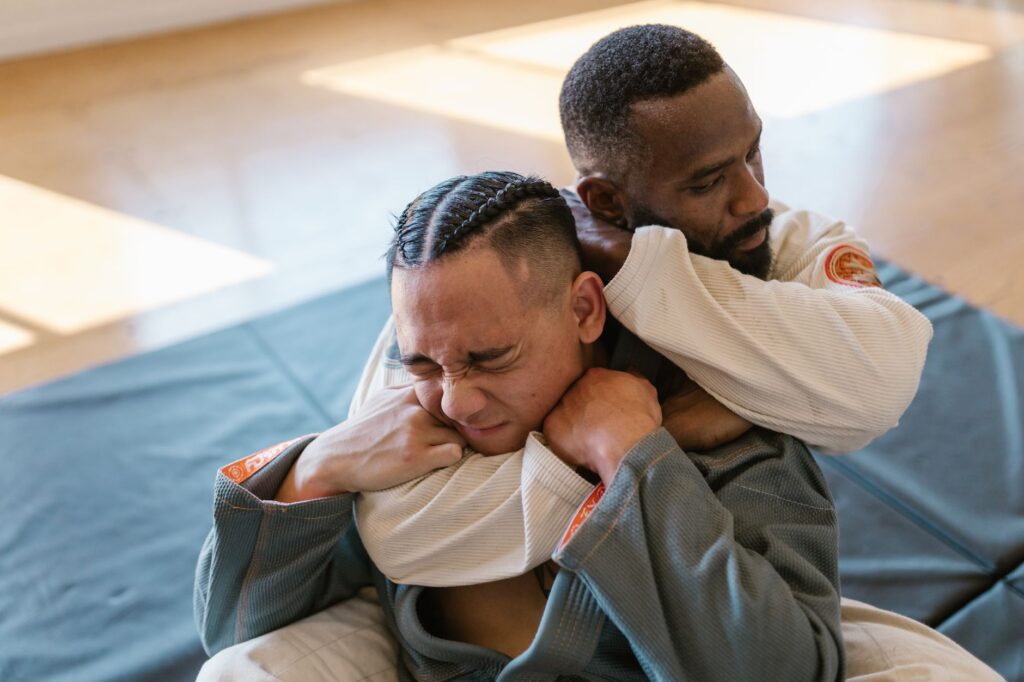
Quick answer: the rear naked choke is a blood choke applied from back control — one arm wraps the neck, the other locks it in place, and the squeeze closes both carotid arteries. It is the most effective submission in combat sports by a wide margin: in GrapplerHQ’s dataset of 8,591 UFC bouts it accounts for 648 of 1,659 submission finishes (39.1%) — more than the next three submissions combined. “Naked” means no clothing is required, unlike collar chokes, which is why it works identically in the gi, in no-gi and in MMA. Judo calls it hadaka-jime; in Brazil it is mata leão, “lion killer.”
Last updated: July 29, 2026. UFC figures come from our own analysis of 8,591 bouts (1994–2026) — methodology in the UFC statistics study. Legality is from the official IBJJF rule book and illegal-moves table.
Train chokes only under qualified supervision. Apply pressure gradually, tap early, and release the instant your partner taps or stops responding clearly. This guide explains the position and the mechanics for safe, supervised training — not for use outside a controlled grappling environment.
Every grappling art arrives at the same conclusion eventually: get behind your opponent and the fight is close to over. The rear naked choke is why. It needs no cloth, no size advantage and no unusual flexibility — only the back, which is the one position offering the person underneath almost no offence of their own.
Free every Tuesday
The Grappler Brief
The week’s biggest stories from BJJ, judo, wrestling, and submission grappling—curated for people who train.
Sent out weekly.Opt out anytime.
Rear naked choke at a glance
| Question | Answer |
|---|---|
| Type | Blood choke (strangle) — not an air choke |
| Other names | RNC, hadaka-jime (judo), mata leão (Portuguese, “lion killer”) |
| Why “naked” | Uses no gi or clothing — unlike collar and lapel chokes |
| UFC finishes | 648 — 39.1% of all UFC submissions, #1 by a wide margin |
| Prerequisite | Back control with hooks or a body triangle |
| IBJJF legality | Legal at every belt, gi and no-gi |
| Common failure | Chasing the neck before the position is secure |
Why it is called a “naked” choke
The name confuses people constantly, and the answer is simple: “naked” refers to the absence of clothing in the technique. Most classical Japanese strangles use the jacket — a collar grip, a lapel drawn across the throat. Hadaka-jime means “naked strangle” because it uses only the arms.
That is also why it dominates modern competition. A collar choke stops existing the moment the gi comes off. The rear naked choke transfers unchanged from gi BJJ to no-gi to MMA, a property almost no other high-percentage submission has. Our gi vs no-gi guide covers which techniques survive that transition and which do not.
Blood choke, not air choke
The rear naked choke closes the carotid arteries on both sides of the neck, cutting blood flow to the brain. It is not — and should never be — a crush on the windpipe. Applied correctly, the crook of your elbow sits centred under the chin so pressure lands on the sides of the neck, not the front.
| Blood choke (correct) | Air choke (wrong) | |
|---|---|---|
| What it closes | Carotid arteries, both sides | Windpipe, front of the throat |
| Elbow position | Centred under the chin | Off to one side, forearm across the throat |
| Partner’s reaction | Quiet — pressure, then a tap | Coughing, gagging, panic |
| Reliability | High and fast | Slow, escapable and injurious |
If your partner is clutching their throat afterwards, it was applied wrong. A good rear naked choke is undramatic — they simply run out of time and tap.
How common is the rear naked choke? UFC data
We classified the finishing technique of every submission across a snapshot of 8,591 UFC bouts (March 1994 to March 2026). Submissions ended 1,659 fights — 19.3% of all bouts. The rear naked choke is not merely first; it is first by a distance.
| Rank | Submission | UFC finishes | Share |
|---|---|---|---|
| 1 | Rear-naked choke | 648 | 39.1% |
| 2 | Guillotine choke | 293 | 17.7% |
| 3 | Armbar | 195 | 11.8% |
| 4 | Arm-triangle choke | 126 | 7.6% |
| 5 | Triangle choke | 114 | 6.9% |
648 is more than ranks 2, 3 and 4 added together (614). Nearly two in five UFC submissions are this one technique. No other move in grappling has that separation from the field — and it is the strongest available argument for prioritising back control over everything else in your training.
Back control comes first
The choke is the easy part. Almost every failed rear naked choke is really a failed back control — the position slipped before the hands ever got into place.
- Hooks or a body triangle. Two heels inside their thighs, or one leg locked over the other across the body. Crossing your ankles in front is the classic beginner error — it invites a footlock and gives no real control.
- Chest glued to their back. Space is what lets them turn in. Stay attached through the shoulders, not just the legs.
- Win the hand fight first. They will defend with both hands. Peel one wrist and immediately occupy the space — do not release to re-grip.
- Stay behind the shoulder line. Slide toward their side and back control quietly becomes side control, taking the choke with it.
Finishing the choke
- Thread the choking arm across the throat until the crook of your elbow is centred under their chin. If the chin is tucked, attack the grip or use the other hand to create the gap.
- Hand to the opposite bicep. Palm down or thumb up — either works, provided the connection is tight.
- Second hand behind their head — behind, not pressing down on top, so the two arms form a closing frame.
- Squeeze by expanding your chest and drawing the elbows together rather than pulling with the arms. Move your head to one side so they cannot posture back into you.
Common mistakes
| Mistake | Why it fails | Fix |
|---|---|---|
| Crossing the ankles in front | Invites a footlock; no real control | Hooks inside the thighs, or a body triangle |
| Choking across the windpipe | Becomes a painful air choke they can survive | Centre the elbow under the chin |
| Squeezing before the arm is deep | They tuck the chin and defend indefinitely | Win the hand fight, then finish |
| Chest coming off their back | Space lets them turn in and escape | Stay glued through the shoulders |
| Chasing the neck over the position | You lose the back entirely | Secure control first — the choke follows |
Defending the rear naked choke
- Tuck your chin immediately and hard. A chin buried against the chest denies the arm the path it needs.
- Two hands on the choking arm while it is still shallow. Fight the arm, not the whole position.
- Get your back to the mat. Turning in and pinning your own back down removes their base and begins the escape — see our back escape guide.
- If it is locked and deep, tap. Once both carotids close, unconsciousness follows in seconds. There is no heroic escape from a finished rear naked choke.
Training safety
Blood chokes work quickly, and the person applying one often cannot tell how close their partner is. Apply progressively rather than explosively, and release the moment a partner taps or stops responding. Never hold a choke on after the tap. If a partner does go unconscious, release everything immediately, stop the round, and let them recover fully before training again — and tell the coach.
Tap early and often. Ego is the only thing lost by tapping to a rear naked choke, and it is the submission least worth testing.
FAQ
Why is it called a rear naked choke?
“Naked” means it uses no clothing — unlike collar and lapel chokes, which need a gi. The Japanese name hadaka-jime translates as “naked strangle” for the same reason. “Rear” simply describes where it is applied from.
What is the strongest choke in BJJ?
By competition results, the rear naked choke — 648 UFC finishes, 39.1% of all submissions in our 8,591-bout dataset, more than the next three techniques combined. It needs no cloth and comes from the most dominant position in grappling.
Is the rear naked choke a blood choke or an air choke?
A blood choke. Applied correctly it closes the carotid arteries on both sides of the neck with the elbow centred under the chin. If it is crushing the windpipe it is being done wrong — that version is painful, slow and unnecessarily dangerous.
How long does a rear naked choke take?
Once both carotids are properly closed, only seconds. That speed is exactly why you should tap as soon as it is locked in rather than trying to survive it.
Is the rear naked choke legal in BJJ competition?
Under IBJJF rules, yes — at every adult belt in gi and no-gi. It does not appear on the illegal-moves table, unlike knee bars and toe holds (brown and black belts only) or heel hooks (adult brown and black, no-gi only).
Can you do a rear naked choke without hooks?
Yes — a body triangle is the common alternative, and it can be finished in a scramble or against the cage without full back control. But hooks or a body triangle raise the finish rate substantially, because the choke rarely fails on its own; the position fails first.
Bottom line
The rear naked choke is the highest-percentage submission in combat sports — 39.1% of all UFC submission finishes, more than the next three combined — and it earns that through one property: it needs nothing but your arms, so it works in every ruleset and every uniform. Train the back position and the choke largely takes care of itself. Centre the elbow, win the hand fight, squeeze by expanding rather than pulling, and release the instant they tap. Next, read our back control guide or compare the other high-percentage finishes in the triangle choke guide.
Sources
- GrapplerHQ UFC submissions dataset — 8,591 bouts (1994-03-11 to 2026-03-28), 1,659 submission finishes classified by technique. Methodology and limitations in our UFC statistics study.
- IBJJF Rule Book and Technical Fouls & Illegal Moves table — submission legality by belt