Quick answer: in Brazilian jiu-jitsu, the red belt is the senior-most rank for the founders and grand masters of the art. Under the official IBJJF General System of Graduation, the red belt is the 9th and 10th degree of the black belt; the 7th degree (red-and-black) and 8th degree (red-and-white) are the belts people usually call coral. Red-belt holders must be at least 66 years old and, for the 9th degree, to have 48 years of proven activity at black belt. The 10th degree, per IBJJF, has been given only to the pioneers of the sport — Carlos, Oswaldo, George, Gastão and Helio Gracie. No official worldwide count of red belts is published, so exact numbers are unverified.
Last updated: November 10, 2026 (Pacific). Requirements below are from the official IBJJF General System of Graduation, June 2026, checked the same day.
Most people asking about the red belt are really asking two things: what it takes to get there, and whether it is even attainable. The honest answer to the second is that the red belt is not a normal career goal — it is a lifetime marker reserved for a tiny number of people. This page explains what the source actually says, how the colors fit into the belt system, and why “how many red belts are there?” has no clean, verifiable answer.
If you are newer to belts, the full BJJ belt-order guide maps the everyday white-to-black sequence before the senior ranks. This page is about the level above black.
Free every Tuesday
The Grappler Brief
The week’s biggest stories from BJJ, judo, wrestling, and submission grappling—curated for people who train.
Sent out weekly.Opt out anytime.
Red belt vs coral belt vs black-belt degree
The words overlap, which is where most confusion starts. “Coral” is a nickname, not an official IBJJF term. In current IBJJF language the senior belts are described by color and by degree:
| Belt | Degree | Meaning |
|---|---|---|
| Black | 1st–6th | Standard black-belt progression |
| Red and black (often called coral) | 7th | First senior “Masters'” belt |
| Red and white (also called coral) | 8th | Second senior “Masters'” belt |
| Red | 9th | Grand Master’s belt; red-belt rank |
| Red | 10th | Highest rank; given only to the pioneers |
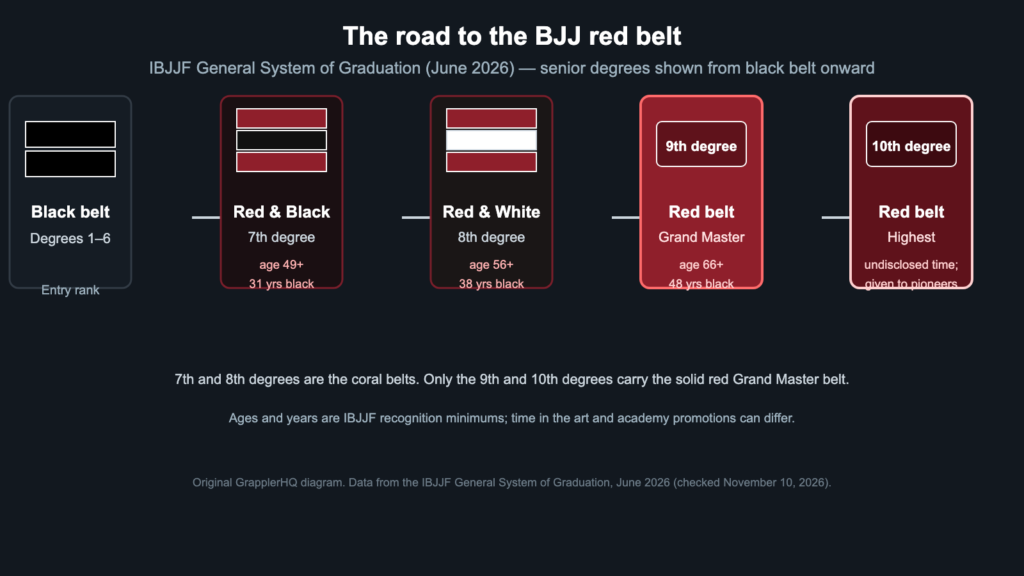
Two easy rules to remember. First, coral is not the red belt — coral usually means the red-and-black or red-and-white 7th or 8th degree belts. Second, the true solid red belt is only the 9th and 10th degree. IBJJF calls it the Grand Master’s belt, and it sits above every other rank. Our coral-belt guide covers the 7th- and 8th-degree level in more depth; this page focuses on where the red belt sits above them.
What the official IBJJF requirements say
The requirements below come from the current IBJJF General System of Graduation (June 2026). These are recognition and eligibility conditions for IBJJF; an academy or lineage can promote on its own, but IBJJF recognition follows these rules. Confirm the exact current document before planning around any number.
| Senior rank | Minimum age | Time at black belt |
|---|---|---|
| Red and black (7th) | 49 | 31 years (fixed) |
| Red and white (8th) | 56 | 38 years of proven activity, or 7 years from the 7th |
| Red (9th) | 66 | 48 years of proven activity, or 10 years from the 8th |
| Red (10th) | 66+ | Not set as a period; given only to the named pioneers |
Read those ages for what they mean in practice. A 9th-degree red belt must be at least 66, which already means a person almost certainly had to become a black belt decades earlier. Even the 8th-degree (red-and-white) belt requires being 56 and having 38 years of proven black-belt activity. These are not minimums a young competitor can hit; they are effectively lifetime commitments.
The 10th degree is a special case
Article 4.1.6 of the June 2026 document is explicit: the 10th degree was given only to the pioneers of Brazilian jiu-jitsu — named there as Carlos, Oswaldo, George, Gastão and Helio (the Gracie brothers who founded the art). That is the source’s whole answer to the 10th degree. It is not described as available to anyone alive today under a normal progression.
How rare is a BJJ red belt?
Extremely rare — but you should be careful with any number you read online. The IBJJF does not publish a tally of how many red-belt holders exist worldwide. That means statements like “only X red belts in the world” cannot be sourced to the federation, and this guide treats any such count as unverified.
What you can verify is the mathematics of rarity. A 9th-degree red belt needs to be 66 and have 48 years of proven black-belt activity. To hold that, someone effectively must train, teach and remain active in the art from roughly their late teens or twenties through retirement age. That combination — age, decades of proven activity, and the small pool of people who reach it — is why the red belt is rarer than the coral belts and vastly rarer than a black belt. The rarity is built into the time requirement, not into a count that anyone publishes.
For scale against the ranks people actually encounter, a black belt is already a small minority of practitioners, and the coral ranks are far smaller again. Our BJJ brown-belt guide explains how far down the path brown sits; the red belt is an order of magnitude beyond that again.
Where organizations differ
Not every organization uses the same colors for these senior degrees, so the IBJJF scheme is not a global standard. The June 2026 IBJJF document uses red-and-black (7th), red-and-white (8th) and red (9th and 10th). Some lineages and associations use a coral-and-black or other conventions for the same senior degrees, and a few rank the red belt slightly differently. The pattern in the wider community is: the higher the degree, the more organizations can diverge.
If a rank or color matters to you — for example, interpreting someone’s belt at a seminar or checking a competitor’s credential — check the awarding body (the federation or lineage that promoted them), not a general web summary. When the IBJJF table and another organization’s description disagree, that does not mean one is “wrong”; it means they are different systems.

What a red belt holder is
Because of everything above, a current red-belt holder is almost always a lifelong teacher and leader of the art, not a competitor who had a long career. The IBJJF’s “proven activity” requirement (Article 4.2) for degrees counts things like active IBJJF membership, being listed as a professor at a registered academy, approving students’ memberships, and titles — evidence of sustained contribution, not just sparring time. Accepting that framing matters: the red belt is a recognition of contribution and longevity, not a finishing move or a trophy.
Do not read this as a set of rules every red belt follows to the letter. Some were recognized at a time before these formal requirements existed, and many predate the current document. The requirements describe the system as it is now.
Red belt FAQs
Is a coral belt the same as a red belt?
No. “Coral” is a nickname for the 7th and 8th degree belts (red-and-black and red-and-white). The red belt is the 9th and 10th degree. The two are separate levels, and treating them as one blurs the highest ranks of the sport.
How many years to get a red belt?
At the 9th degree, 48 years of proven black-belt activity (or 10 years from the 8th degree) under the current IBJJF document, plus a minimum age of 66. The 10th degree is not set by a period and has been given only to the named pioneers. These are recognition conditions, not a promise of promotion.
Can anyone alive earn a red belt today?
Graduation is a matter for the awarding body, so a short answer cannot cover every case. Under the IBJJF structure, the 9th degree is technically reachable through the age and activity requirements. The 10th degree is reserved by the document for the founders and has no described pathway for new holders.
How many red belts are there in the world?
There is no official published count from IBJJF. Any number you see online is not federation-sourced and should be treated as unverified. The rarity is better understood through the age and activity requirements than through a disputed tally.
Bottom line
The red belt is the top of the BJJ senior rank system — the 9th and 10th degree of black belt, according to the current IBJJF graduation document. Coral belts (7th and 8th) are below it, and the two are not the same. It is rare not because of a secret count but because it demands 66 years of life and 48 years of proven black-belt activity; the 10th degree has been given only to the founders. Organizations can color these ranks differently, so check the awarding body when a senior rank matters. For the ranks most students actually climb, start with the belt-order guide.
Sources
- IBJJF General System of Graduation, June 11, 2026 PDF (articles 1.2, 1.3.4–1.3.5, 2.1.2, 3.1.4, 4.1.2, 4.1.5–4.1.6); fetched and inspected November 10, 2026. The document carries multiple version strings (“VERSION 3.1” in page headers, “VERSION 3.3” on the final page); this article cites it as the June 2026 edition rather than selecting one version number.
Worldwide red-belt and coral-belt holder counts are intentionally left unlabeled because the cited official source does not publish them.