Last reviewed: October 26, 2026.
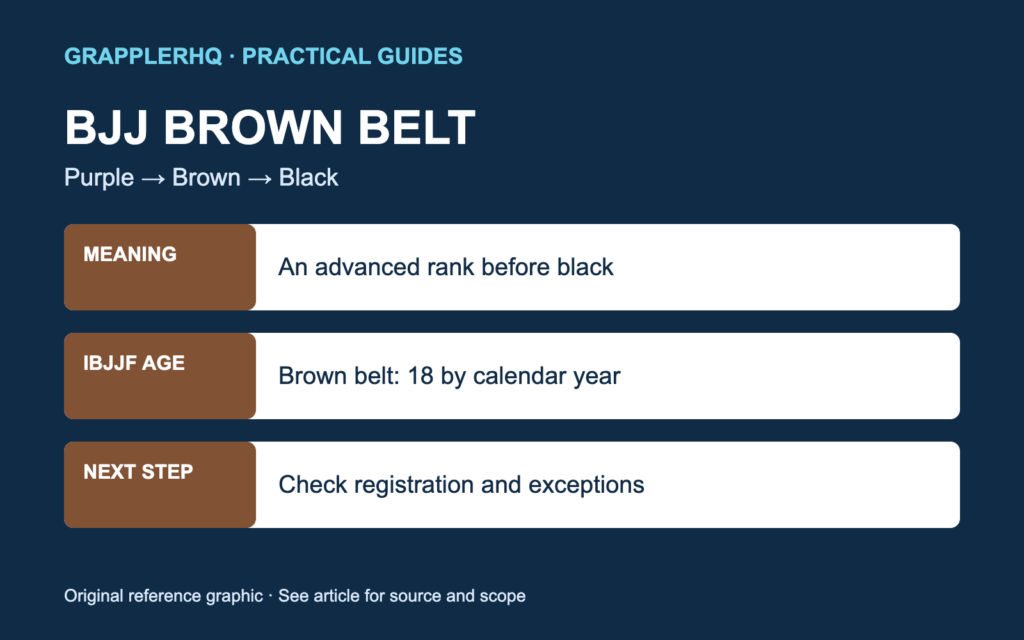
Quick answer: brown belt is the rank between purple and black in the adult BJJ progression. IBJJF sets the minimum brown-belt age at 18 under its calendar-year age system. For athletes on the standard adult path, its documented minimums include 18 months at purple before brown and one year at brown before black; the current graduation document lists important exceptions. Your instructor’s promotion decision and IBJJF’s recognition requirements are related, but they are not the same thing.
The full BJJ belt-order guide explains the whole progression. This page focuses on the brown-belt stage: what the official requirements actually say, what they do not establish, and what to ask as you work toward black belt.
Where does brown belt fit?
The main student sequence is white, blue, purple, brown and black. Brown is an advanced rank, but a belt color does not make every person the same age, size, competition level or kind of instructor. It is useful evidence of progression within an academy; it is not a universal prediction about who wins a round.
Free every Tuesday
The Grappler Brief
The week’s biggest stories from BJJ, judo, wrestling, and submission grappling—curated for people who train.
Sent out weekly.Opt out anytime.
People sometimes describe brown belt as a polishing stage. Treat that as a way of discussing development, not an official standardized syllabus. A useful conversation with your instructor is more specific: which positions are reliable, which decisions repeatedly cause trouble, and which gaps matter for your goals?
What are IBJJF’s brown-belt requirements?
The current IBJJF graduation download has a June 2026 cover and includes its updated black-belt age provision. Its articles on age, minimum periods and registration are the reference for the table below. The rules describe recognition and eligibility; they do not set a date on which your professor must promote you.
| Question | Standard requirement | Detail that changes the answer |
|---|---|---|
| Minimum age for brown belt | 18 | IBJJF calculates age as current year minus birth year, not solely whether a birthday has occurred. |
| Adult purple-belt minimum before brown | One year and a half | Article 3.1.3 lists shorter or no-minimum routes for specified prior juvenile registrations and Adult Purple Belt World Champions. |
| Brown-belt minimum before black | One year | No minimum period for an Adult Brown Belt World Champion under the listed exception. |
| Black belt at age 18 | A specific exception, not a general shortcut | The current document permits this for an athlete who has won the Adult World Championship at brown belt. |
| When registered periods begin | From completed IBJJF registration at each belt | Time in an academy and time registered with IBJJF may be different records. |
Read the exact route in the document with your professor or the federation if your registration history involves juvenile ranks, a world title or missing prior registrations. Do not take the standard adult row and assume it covers every athlete’s circumstances.
Does meeting the minimum mean you should be promoted?
No. A minimum recognition period is not an automatic promotion promise. The graduation document leaves white-to-black promotion timing to the professor while requiring the applicable conditions for IBJJF recognition. A calendar entry cannot assess your entire training history.
This distinction helps avoid two common mistakes. One is treating the minimum as a typical timeline for every student. The other is assuming the minimum does not matter because academy promotions are a coaching decision. For someone who wants to register and compete through IBJJF, both the instructor’s decision and the documented recognition conditions matter.
The same distinction applies earlier in the sequence. Our purple-belt guide describes that stage; it is not an alternative registration authority.
How long does it take to reach brown belt?
There is no single total that the official document assigns to every beginner. Previous ranks, recognized exceptions, training history and an instructor’s judgment prevent a universal countdown. Adding standard minimum periods together also leaves out time at white belt and ignores paths that use different listed conditions.
A hypothetical example shows why registration matters. Suppose a student’s academy awarded purple belt before the student completed purple-belt registration with IBJJF. The elapsed time since the academy promotion and the federation’s registered period are not necessarily identical. Before planning a brown-belt event entry, check the actual registration record instead of relying on a remembered promotion anniversary.
Do not use another student’s unusually fast promotion as a benchmark without knowing which rules and history apply. Ask what evidence your own instructor wants to see, and which registration steps are relevant to your intended competitions.

What should you work on at brown belt?
An internet checklist cannot replace your academy’s standards. You can still make a coaching conversation more productive by bringing concrete questions rather than asking only, “How close am I to black belt?”
- Recurring situations: which positions keep producing the same problem, and what should you prioritize there?
- Connected decisions: can you explain what you will try when the first option is stopped, rather than listing unrelated techniques?
- Rules knowledge: do you understand the scoring and legal-technique conditions for the division you actually enter?
- Training habits: what does your instructor expect around partner communication, control and helping newer students?
- Your goal: are you preparing for competition, aiming to teach within your academy or concentrating on a particular part of your game?
Those are discussion prompts, not a claimed universal brown-belt exam. Write down the agreed priorities and revisit them with the same instructor. A specific answer is more useful than collecting a larger number of unsupervised technique requirements from unrelated schools.
Do brown belts get stripes?
IBJJF’s graduation document provides four degrees for white through brown and leaves adopting that degree system up to the professor. That means you should ask how your own academy uses stripes. A certain number of pieces of tape is not a universal promise that a black-belt promotion follows next month.
The BJJ stripes guide explains progress markers within a rank and why they differ from the formal senior degrees associated with black belt.
What changes in competition?
Check the specific event, age division and gi/no-gi rules rather than assuming every brown-belt bracket has the same legal techniques. Rank alone is not the complete eligibility question. Our leg-lock reference and IBJJF no-gi guide explain why the format also matters.
If your next goal is black belt, discuss the applicable recognition and certification steps before you enter events under a new rank. The black-belt timeline guide gives wider context without replacing the current official requirements.
Brown-belt questions
Is brown belt higher than purple?
Yes. In the standard adult sequence, brown follows purple and comes before black.
Can a brown belt become a black belt at 18?
The current IBJJF document allows that age through its specific Adult Brown Belt World Champion provision. Do not apply it to every 18-year-old brown belt.
Does brown belt mean someone can teach anywhere?
Do not infer unrestricted teaching, registration or certification permission from the color alone. An academy’s role and any organization’s requirements should be checked directly for the proposed activity.
Do you have to win competitions to get brown belt?
The official graduation framework does not turn an adult world title into a universal requirement for brown belt. Titles matter for particular listed exceptions; academy promotion expectations are a separate conversation with your instructor.
Official reference
Source: the IBJJF General System of Graduation, current-linked June 2026 document, especially articles 2, 3 and 4. It includes prior-rank exceptions that a short summary cannot decide for an individual registration history.