Quick answer: the standard adult BJJ belt order is white, blue, purple, brown, and black. After black belt, the red-and-black and red-and-white coral belts, followed by red belt, belong to the senior degree system and represent decades of contribution rather than ordinary student promotions. Children use a separate youth belt system, and athletes generally transition into the adult ranks under age and federation rules. Progress is not automatic: instructors consider technical skill, live performance, consistency, judgment, and academy standards, while federation minimums govern recognition in specific contexts rather than promising promotion on a fixed date. For most students, the useful path is simple—build survival and fundamentals at white, a reliable base at blue, a connected game at purple, deeper refinement at brown, and broad technical maturity at black. This guide explains every rank, common timelines, stripes, and how promotion standards vary.
BJJ belts by the numbers: the IBJJF system has 8 belt ranks for athletes 16 and older — white, blue, purple, brown, black, red-and-black (7th degree), red-and-white (8th degree), and red (9th degree). White through brown belts carry up to 4 stripes each, and most students take 8–12 years to reach black belt. (GrapplerHQ, updated July 2026)
Last updated: June 28, 2026. This guide is the GrapplerHQ hub for BJJ belts, belt order, belt progression, and how the belt system fits together. It summarizes the official IBJJF graduation structure, explains what each belt usually means in training, and links to deeper GrapplerHQ guides for blue belt, purple belt, black belt, coral belt, and belt tying.
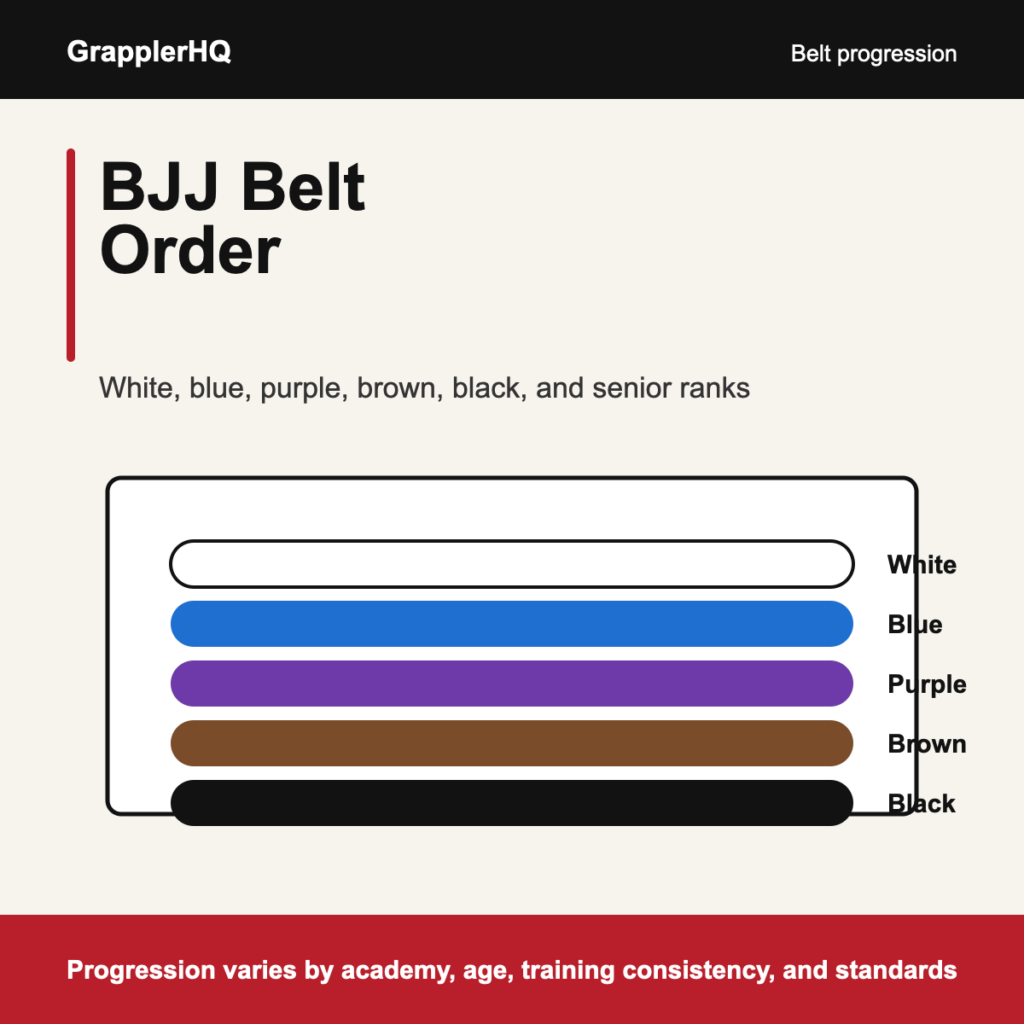
BJJ belt order chart
The official IBJJF Graduation System lists the belt ranks for athletes aged 16 and older as white, blue, purple, brown, black, red and black, red and white, and red. The table below turns that into a practical training map.
Free every Tuesday
The Grappler Brief
The week’s biggest stories from BJJ, judo, wrestling, and submission grappling—curated for people who train.
Sent out weekly.Opt out anytime.
| Belt | Where it fits | What it usually means in the gym |
|---|---|---|
| White belt | First belt | Learning survival, positions, escapes, basic submissions, and training habits. |
| Blue belt | First major promotion | Understands the basic game, can defend better, and starts building reliable sequences. |
| Purple belt | Intermediate-to-advanced | Has a more personal game, better timing, and enough knowledge to help newer students. |
| Brown belt | Advanced pre-black belt | Sharpens weak areas, polishes details, and prepares for black-belt-level standards. |
| Black belt | Expert rank | Shows long-term skill, consistency, teaching ability, and mature understanding of the art. |
| Red-and-black belt | 7th degree black belt | Senior master-level rank, often called a coral belt. |
| Red-and-white belt | 8th degree black belt | Higher senior master-level rank, also commonly grouped under coral belt language. |
| Red belt | 9th degree black belt | Grandmaster-level rank associated with a lifetime in Brazilian Jiu-Jitsu. |
Adult BJJ belts vs kids BJJ belts
BJJ uses different belt systems for children and older athletes. IBJJF lists kids belt ranks for ages 4 to 15 as white, grey group, yellow group, orange group, and green group variations. Athletes aged 16 and older move into the white-to-red progression used for juveniles and adults.
That distinction matters because a green belt in the kids system does not mean the same thing as an adult black belt. IBJJF’s graduation document says athletes turning 16 move into the 16-and-up system based on their previous rank, with some decisions left to the professor.
How long does each BJJ belt take?
BJJ belt timelines vary by academy, instructor, training frequency, age, competition experience, technical progress, and consistency. Most recreational students should think in years, not months. The official IBJJF graduation document includes minimum registered periods for some ranks, but it also says time from white belt to black belt is at the professor’s discretion.
| Belt question | Best GrapplerHQ guide | Use it for |
|---|---|---|
| How long to blue belt? | How long to get a blue belt in BJJ | First promotion expectations and beginner progress. |
| What does purple belt mean? | BJJ purple belt journey | Intermediate skill, game development, and training maturity. |
| How long to black belt? | How long to get a black belt in BJJ | Long-term timelines and realistic black-belt expectations. |
| What is a coral belt? | BJJ coral belt guide | Senior ranks above sixth-degree black belt. |
| How do you tie the belt? | How to tie a BJJ belt | Basic gi class and competition presentation. |
| How many black belts are there? | How many BJJ black belts are there? | Rarity, estimates, and black-belt population context. |
What each BJJ belt means
White belt
White belt is the learning-to-train stage. The biggest wins are showing up consistently, learning the major positions, staying safe, escaping bad spots, and building enough mat awareness to understand what is happening in sparring.
Blue belt
Blue belt usually means a student understands the core positions and can defend themselves better against beginners. It does not mean mastery. Many blue belts are still building consistency, connecting techniques, and learning how to train through plateaus.
Purple belt
Purple belt is where many students start to look like they have a recognizable game. A good purple belt can usually explain techniques clearly, help newer students, and make smart adjustments during rolls instead of relying only on memorized moves.
Brown belt
Brown belt is the polishing stage before black belt. The athlete is usually dangerous, experienced, and technically mature, but still refining details, closing gaps, and developing the consistency expected at black belt.
Black belt
Black belt is an expert rank, but it is not the end of learning. It signals a high level of technical skill, mat experience, and understanding. Black belts continue progressing through degrees over time, and standards can vary by academy and organization.
What are stripes in BJJ?
Stripes are smaller progress markers within a belt. Many academies use up to four stripes before promotion to the next belt, but stripe standards vary widely. Some instructors use stripes formally, some use them loosely, and some do not use them much at all.
IBJJF says white, blue, purple, and brown belts for athletes 16 and older can be divided by four degrees, while the adoption of the degree system up to brown belt is at the professor’s discretion. In plain English: stripes are useful, but your coach’s standards matter most.
BJJ belt progression is not just time
Time matters, but it is not the only factor. A student who trains four times per week, studies carefully, competes, stays healthy, and gets consistent coaching may progress differently from someone training once per week with long breaks. Promotions also reflect the academy’s standards and the instructor’s judgment.
- Consistency: steady training over years beats occasional bursts of intensity.
- Technical breadth: each belt should bring better escapes, guard, passing, control, and submissions.
- Mat awareness: higher belts make better decisions under pressure.
- Training quality: good coaching, drilling, feedback, and thoughtful sparring all matter.
- Character and safety: many coaches also care how students train with partners.
Bottom line
The BJJ belt order for athletes 16 and older is white, blue, purple, brown, black, red-and-black, red-and-white, and red. Most students are focused on the path from white to black, while coral and red belts belong to the senior black-belt degree system. Use the official IBJJF Graduation System for federation-specific details, and use GrapplerHQ’s belt guides to understand what each step feels like in real training.
For a deeper explanation of progress markers inside each rank, see our BJJ stripes guide.
FAQWhat is the order of belts in BJJ?
For athletes 16 and older, the BJJ belt order is white, blue, purple, brown, black, red-and-black, red-and-white, and red.
What are the main adult BJJ belts?
The main adult student progression is white, blue, purple, brown, and black. Senior ranks above black belt include red-and-black, red-and-white, and red belts.
How long does it take to get a black belt in BJJ?
Many students take around 8 to 12 years or more, but timelines vary by academy, training frequency, consistency, competition experience, injuries, and instructor standards.
Are BJJ stripes official?
Stripes are common progress markers, but standards vary. IBJJF recognizes degrees in its graduation system, while stripe use up to brown belt is largely at the professor’s discretion.
Are kids BJJ belts the same as adult belts?
No. Kids use a separate belt system with grey, yellow, orange, and green groups. Athletes aged 16 and older move into the white-to-red belt progression.
{ “@context”: “https://schema.org”, “@graph”: [ { “@type”: “BlogPosting”, “headline”: “BJJ Belt Order: Jiu Jitsu Belts and Progression Explained”, “description”: “A practical guide to BJJ belt order, jiu jitsu belt ranks, kids belts, adult belts, stripes, progression timelines, and official IBJJF graduation references.”, “datePublished”: “2026-06-15”, “dateModified”: “2026-06-28”, “author”: { “@type”: “Organization”, “name”: “GrapplerHQ” }, “publisher”: { “@type”: “Organization”, “name”: “GrapplerHQ” }, “mainEntityOfPage”: “https://www.grapplerhq.com/brazilian-jiu-jitsu/bjj-belt-order/” }, { “@type”: “FAQPage”, “mainEntity”: [ { “@type”: “Question”, “name”: “What is the order of belts in BJJ?”, “acceptedAnswer”: { “@type”: “Answer”, “text”: “For athletes 16 and older, the BJJ belt order is white, blue, purple, brown, black, red-and-black, red-and-white, and red.” } }, { “@type”: “Question”, “name”: “What are the main adult BJJ belts?”, “acceptedAnswer”: { “@type”: “Answer”, “text”: “The main adult student progression is white, blue, purple, brown, and black. Senior ranks above black belt include red-and-black, red-and-white, and red belts.” } }, { “@type”: “Question”, “name”: “Are kids BJJ belts the same as adult belts?”, “acceptedAnswer”: { “@type”: “Answer”, “text”: “No. Kids use a separate belt system with grey, yellow, orange, and green groups. Athletes aged 16 and older move into the white-to-red belt progression.” } } ] }, { “@type”: “BreadcrumbList”, “itemListElement”: [ { “@type”: “ListItem”, “position”: 1, “name”: “Brazilian Jiu-Jitsu”, “item”: “https://www.grapplerhq.com/brazilian-jiu-jitsu/” }, { “@type”: “ListItem”, “position”: 2, “name”: “BJJ Belt Order”, “item”: “https://www.grapplerhq.com/brazilian-jiu-jitsu/bjj-belt-order/” } ] } ] }