Last updated: .
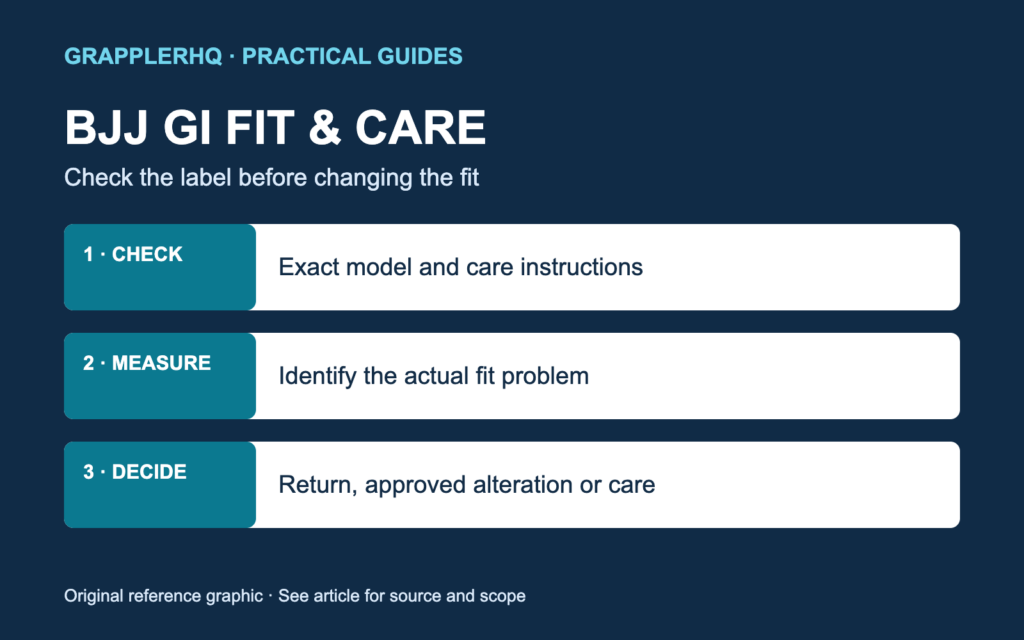
Quick answer: heat can change a cotton gi’s fit, but there is no reliable universal “shrink one size” setting. First check the instructions for your exact jacket and pants. If the manufacturer says cold wash and air dry, a hot wash or tumble-dryer recipe goes against that advice. An unworn gi that is substantially too large is usually a sizing or return decision before it is a laundry experiment.
This guide is about changing an oversized gi’s fit. Routine washing has a different goal: cleaning it while preserving its size. Start with the BJJ gi sizing guide if you are deciding whether you bought the right size.
Before shrinking a gi, identify the actual fit problem
“Too big” can mean several things: sleeves covering the hands, pants dragging, a jacket that is roomy through the chest, or a waistband that cannot be secured comfortably. Those problems do not necessarily have the same solution. Making every part smaller may fix one measurement and spoil another.
Free every Tuesday
The Grappler Brief
The week’s biggest stories from BJJ, judo, wrestling, and submission grappling—curated for people who train.
Sent out weekly.Opt out anytime.
Try the clean, dry gi on as instructed by the seller. Tie the pants and belt normally, extend your arms and move through comfortable everyday training positions. Write down where the excess fabric is. If the sleeves already have the length you need, treating the entire jacket to reduce body width is a gamble.
| What you find | Useful next step | Why |
|---|---|---|
| New gi is too large everywhere; tags and return eligibility intact | Check a different size or cut with the seller before washing | Laundering can affect return eligibility and cannot produce a guaranteed target size. |
| Jacket body fits, sleeves or pants are too long | Ask the maker about approved alterations and competition implications | A local length problem may not need a whole-garment fit change. |
| Small amount of room; model has specific approved care or fit-adjustment instructions | Use those exact instructions, then measure again | The model’s guidance is more useful than a generic temperature recipe. |
| Sleeves or pants are already near competition limits | Avoid further unplanned size reduction | A more comfortable torso does not compensate for sleeves or pants that fail inspection. |
Read the manufacturer’s instructions before choosing heat
Care guidance is specific to the product. Tatami’s care information recommends a 20–30°C wash for its gis. Combat Corner’s gi-care guide recommends cold washing and air drying, and advises against hot water and machine drying. Neither establishes a universal heat treatment for every brand.
Check the label on both pieces, not just the product’s name. Record the fabric composition, permitted wash settings and drying symbols. If the instructions are missing or unclear, ask the manufacturer about that exact model. A review saying a different gi “shrunk perfectly” does not tell you what will happen to yours.
“Pre-shrunk” is not a promise that every dimension will stay unchanged under any care routine. It also does not tell you that a particular amount of remaining shrinkage is available to use. Do not plan a purchase around an assumed percentage unless the maker documents what that number means for that model.
A measured approach when the maker permits a fit adjustment
- Keep the starting measurements. Use the same flat surface and tape measure for sleeve length, jacket length and pants length. Note the measurement method; compare like with like later.
- Confirm the approved process. Find out whether it applies to the jacket, pants or both. A permission to wash at one setting is not permission to use every dryer setting.
- Change only what is authorized. Follow the documented sequence. Avoid combining a hotter wash and a hotter dry as an improvised shortcut.
- Let the garment finish drying as directed. Check the result in the same dry condition as the starting measurement rather than comparing wet fabric with dry fabric.
- Recheck fit and stop when it works. Repeat only if the manufacturer’s instructions permit it and the measurements still leave room. There is no obligation to keep trying because the first change was small.
If there is no approved adjustment process, the useful next choices are a different cut, an approved alteration or keeping the gi for a purpose where its fit is acceptable. Do not turn an unknown care limit into a confident temperature recommendation.
Why the jacket and pants may not change together
Look at the product description and labels for each piece. Jacket and pants may have different fabrics, panel construction or trims. Even when both use cotton, the same laundry cycle does not establish that each dimension will change by the same amount.
This is why a worked example should be a measurement decision, not a promised result. Suppose your jacket feels roomy but its sleeves already fit. Your pants, meanwhile, are too long. Shrinking the whole set to solve the pants length risks changing sleeves you wanted to keep. Record those two problems separately and ask about the pants rather than assuming the entire set needs the same treatment.
There is also a difference between changing fit and repairing damage. Heat cannot be counted on to fix torn seams, a distorted collar or a panel that no longer sits correctly. Stop and assess the garment rather than trying another cycle to force it back into shape.
Will a smaller gi still pass competition inspection?
For an IBJJF event, compare the finished dry gi with the current official uniform requirements. Sleeve and pants length, sleeve opening and collar dimensions are inspection matters; choosing a tighter competition fit does not waive them. The GrapplerHQ gi-requirements guide explains the checks in more detail.
Check close to the event after the care routine you will actually use. A gi that looked acceptable before an additional wash may fit differently afterward. Keep a practical backup if you have one; an internet prediction cannot replace the event inspector.
Common questions about shrinking a BJJ gi
Can I shrink a gi exactly one size?
Do not assume so. Size labels describe a manufacturer’s range, not a predictable laundry conversion. Two neighboring sizes may differ in cut as well as length and width.
Should I use a hot dryer and check every few minutes?
Only use a drying method your exact product’s instructions permit. Checking frequently does not make an unauthorized high-heat process consistent with the care label.
Can I shrink just the pants?
Treat the pants as their own garment and follow their instructions. Ask about a permitted alteration if length is the only problem. Do not assume the jacket and pants share identical care limits.
Is a slightly roomy gi automatically the wrong size?
No. Judge usable movement, fastening, the maker’s fit guidance and any competition requirements. A photograph of somebody else’s fitted gi is not your measurement standard.
For regular cleaning rather than changing the fit, use the BJJ gi-washing guide. Keep the exact garment’s care instructions with your routine.
Sources checked
Manufacturer guidance: Tatami care information and Combat Corner gi care. Competition context: IBJJF uniform rules. Product-specific care labels take priority over a generic online process.