Quick answer: Grappling Industries runs gi and no-gi tournaments with round-robin weight divisions and single-elimination absolutes. Adult, master and senior matches last 5 minutes. Gi competitors may weigh in without the gi, but must still meet their registered weight limit: there is no weight allowance. Choose your age, skill level and weight from your event’s registration page, then check its schedule before competition day.
Last updated: (Pacific). Rules checked against the organizer’s current rules page, divisions page and February 9, 2026 rulebook. This guide explains the registration decisions and the rules most likely to catch you out; your event listing determines which divisions are available.
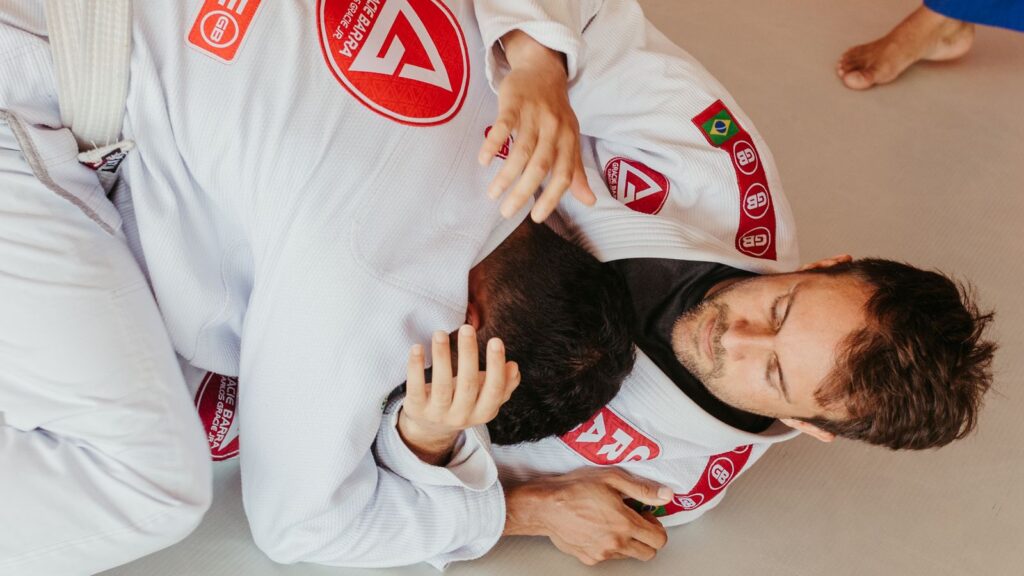
Featured photo: illustrative BJJ grappling; no Grappling Industries event is identified. Photo by Jonathan Borba on Pexels.
How many matches do you get?
Round robin means a loss does not automatically end your weight division. You face several opponents within your bracket or group; larger divisions add a knockout stage. The exact format depends on how many competitors are in the division, so the old shorthand “everyone gets four matches” is too broad.
Free every Tuesday
The Grappler Brief
The week’s biggest stories from BJJ, judo, wrestling, and submission grappling—curated for people who train.
Sent out weekly.Opt out anytime.
| Competitors | Format | Published matches per competitor |
|---|---|---|
| 2 | Best of three | 2–3 |
| 3 | Round robin | 2 |
| 4 | Round robin | At least 3 |
| 5 | Round robin | 4 |
| 6–9 | Groups; top two advance to a final | At least 4; up to 5 |
| 10 or more | Groups; top four advance to semifinals and final | At least 4; up to 6 |
Source: the organizer’s Round Robin Format section. These describe the published bracket formats, not a promise that every registered athlete will complete every match regardless of withdrawals or disqualification.
In a five-person round robin, you have four opponents. Losing the first match still leaves the other scheduled matches to work through. That changes how you plan your day: keep track of your next match and leave your equipment accessible after each result.
Absolutes work differently: the open-weight absolute division is single elimination. Do not transfer the round-robin expectation to it.
Which age and skill division should you enter?
Grappling Industries uses your age on event day. The general divisions page lists men’s Adult 18+, Master 30+ and Senior 40+; the women’s section lists Adult 18+ and Master 30+. Event offerings can vary, so confirm the actual options rather than assuming every age group exists at every tournament.
Adult gi divisions use white, blue, purple, brown and black belts. Adult no-gi groups are Beginner (white), Intermediate (blue) and Advanced (purple, brown and black). Registration is not just a count of years trained: a ranked athlete must enter the correct level, and significant experience in other grappling sports can require a higher division. The registration guidelines spell out those exceptions.
For example, a blue belt entering no-gi should look at Intermediate or a permitted higher level, rather than entering Beginner because it is their first no-gi tournament. Ask the organizer about an unusual background before paying; do not decide eligibility from a gym nickname for your skill level.
Youth age bands run 4–5, 6–7, 8–9, 10–11, 12–13, 14–15 and 16–17. The general page separates boys and girls at 12–13 and older and notes that events may split genders at all ages. Youth gi groups are white, grey, yellow/orange and green. Youth no-gi levels also follow a different belt mapping: Beginner/white, Intermediate/grey, Advanced/yellow or orange, and Expert/green. Adult and youth labels should not be mixed.
Grappling Industries weight classes: adults and masters
The tables reproduce the pound limits on the official divisions page. The minus sign denotes a capped class; the plus or “over” category has no upper cap in that listing. Check the registration page for the exact divisions and official unit used at your event. Some events use kilograms, and a rounded conversion of a pound limit is not an official kilogram bracket.
| Official label | Weight limit |
|---|---|
| −135 | 135 lb or below |
| −145 | 145 lb or below |
| −155 | 155 lb or below |
| −170 | 170 lb or below |
| −185 | 185 lb or below |
| −200 | 200 lb or below |
| −215 | 215 lb or below |
| −230 | 230 lb or below |
| Over 230 | Over 230 lb |
| Official label | Weight limit |
|---|---|
| −105 | 105 lb or below |
| −115 | 115 lb or below |
| −125 | 125 lb or below |
| −135 | 135 lb or below |
| −145 | 145 lb or below |
| −155 | 155 lb or below |
| −170 | 170 lb or below |
| −185 | 185 lb or below |
| +185 | Over 185 lb |
Worked example: an adult male whose event offers this pound chart and who weighs 174 lb cannot make −170 at that weight. −185 is the next listed cap. Register for the class you can actually make under the event’s weighing procedure; an over-limit weigh-in does not buy you a move into the next bracket.
The general page supplies one men’s and one women’s weight list rather than separate gi/no-gi charts. Confirm the options in each format when registering for both. These are not interchangeable with the IBJJF weight charts.
Kids and teens weight classes
The organizer lists the following youth caps separately from its age bands. They are a menu of weight divisions, not a pairing in which every 4–5-year-old belongs at −45 or every 6–7-year-old at −55. Select age, rank and weight together on the event registration page.
| Capped classes | Highest listed class |
|---|---|
| −45, −55, −65, −75, −85, −95, −105, −115, −125, −135, −145, −155, −170, −185, −210 | +210 |
If a child is alone in a division, the organizer’s merger guidelines matter. The rules describe possible changes in weight, age or skill level, and youth mergers are optional. Parents and coaches should review any proposed match-up with staff rather than treating the existence of a nearby weight bracket as automatic approval.
Weigh-ins: clothes, timing and missed weight
Complete check-in and weigh-in at least 60 minutes before your scheduled division start, following the event’s instructions. If the posted start is 1 p.m., that means being weighed in by noon at the latest under the general rule; it does not mean arriving at the venue at noon and joining the queue.
- Gi competition: you may weigh in without wearing the gi.
- Both formats: an athlete entering gi and no-gi only needs one weigh-in.
- No allowance: the scale weight must be at or below the registered class limit.
- Missing the limit: the rules specify disqualification, no transfer into a heavier division and no refund.
- Changing class beforehand: meet your event’s change deadline. There is no universal deadline date for every city and tournament.
- Absolute or uncapped class: you still must check in at the weigh-in desk.
This differs from IBJJF’s official procedure, which weighs athletes in their competition uniform before the first fight. Use the organizer’s own procedure for each entry. A plan based on another federation’s uniform or allowance can put your registration at risk.
Points, match times and tied matches
The main positional values look familiar if you know BJJ’s points system, but Grappling Industries has its own scoring details.
| Action or position | Points |
|---|---|
| Mount or back control | 4 |
| Guard pass | 3 |
| Takedown, sweep or knee on belly | 2 |
| Strong submission attempt stopped out of bounds | 2, subject to the referee’s assessment |
Positions must meet the rulebook’s criteria and be controlled for three seconds. Back control with a body triangle does not earn the listed back-control points. The out-of-bounds submission score also does not make deliberate escape from a submission legal: intentionally forcing that reset can cause disqualification.
| Division | Time limit |
|---|---|
| Adult, Master and Senior | 5 minutes |
| Youth ages 14–17 | 4 minutes |
| Youth ages 13 and under | 3 minutes |
There are no advantage scores. A match tied on points goes to the athlete with fewer penalties, then to a referee decision if still tied. Group standings have a separate tie-breaking order: wins, submissions, head-to-head result, points scored, then least points conceded. A single-match tie and a tied group table are different decisions.
Are heel hooks, kneebars and wrist locks legal?
Check the actual format and division. The February 2026 chart separates under-18 athletes from adult white belts, adult blue/purple gi, and the remaining adult gi/no-gi groups. The summary below expands those groups into practical adult gi/no-gi columns.
On a small screen, scroll the table sideways to see every division.
| Technique | Under 18 | Adult white / Beginner | Adult blue+ gi | Adult blue+ no-gi |
|---|---|---|---|---|
| Straight/rotational ankle lock | Illegal | Legal | Legal | Legal |
| Wrist lock | Illegal | Legal | Legal | Legal |
| Kneebar, toe hold, knee reap | Illegal | Illegal | Legal | Legal |
| Heel hook | Illegal | Illegal | Illegal | Legal |
| Neck/spinal crank | Illegal | Illegal | Blue/purple: illegal; brown/black: legal | Legal |
| Slam | Illegal | Illegal | Illegal | Illegal |
Source: rulebook printed page 21 (PDF page 23), visually checked October 2. This is a selection, not the complete technique list. “Legal” describes competition permission, not suitability for every training partner.
Do not import a blanket “blue belts cannot kneebar” rule from another organization. Equally, an adult no-gi permission does not extend to youth. For under-18 divisions, referees may stop even a legal submission to protect the competitor. Bring questions about a specific technique to the event officials before competing.
What can you wear?
The general rules allow gi and no-gi uniforms of any color, including mismatched tops and bottoms. A close-fitting rashguard may be worn under the gi. The gi still needs to be clean, intact and properly fitted; color freedom is not an exemption from inspection.
No-gi requires a rashguard and suitable shorts without pockets or hard fittings. Shorts must reach at least halfway down the thigh and no farther than the knee. Spats may be worn under shorts; women may wear spats instead of shorts. Check the full uniform section for prohibited accessories and equipment. For a different organizer, refer to its own requirements—our IBJJF gi guide describes a separate standard.
Finding an event and checking your entry
Use the official Grappling Industries event calendar to open the registration listing for your city. Check the venue, available divisions, official weight unit, entry deadline, correction deadline and competition schedule there. This page is a rules reference, rather than a duplicated city-by-city calendar that becomes stale.
- Confirm your event-day age and eligible skill level.
- Choose gi, no-gi or both; check each entry’s actual weight options.
- Confirm the official unit before comparing your weight to the limit.
- Read the change deadline and resolve a wrong division beforehand.
- Review the allowed-technique chart for your age and format.
- Pack compliant clothing, footwear for off the mat, and a spare gi if needed.
- Recheck the posted division schedule and leave time to finish weigh-in.
- After each round-robin match, check the next assignment rather than assuming the day is over.
Frequently asked questions
Do you weigh in with the gi at Grappling Industries?
The current general rules permit gi competitors to weigh in without their gi. Follow the event’s check-in instructions.
Is there a weight allowance?
No. The general rules require the athlete to weigh at or below the registered class limit. Missing weight does not qualify you for a move to the next division.
Does everyone get four matches?
No. A three-person weight division has two round-robin matches per competitor; a five-person division has four. Larger divisions add group and knockout stages. Absolute divisions use single elimination.
How long are the matches?
Adult, master and senior matches are five minutes. Ages 14–17 have four-minute matches, and ages 13 and under have three-minute matches.
Are heel hooks legal in gi?
No. The current chart permits heel hooks only in eligible adult blue-belt-and-above no-gi divisions. They are prohibited in gi, adult white/Beginner and under-18 divisions.
Is Grappling Industries the same as IBJJF?
No. The organizers differ in bracket format, weigh-in procedure, uniform requirements and technique permissions. Verify each tournament’s rules separately.
Related federation guides
If you compete across organizations, use our IBJJF rules guide, JJWL rules guide and NAGA rules and divisions guide to compare the event you are entering. Keep the weight charts and legal-technique rules attached to the correct organizer.