Quick answer: the green belt is the highest belt in BJJ’s separate youth system for athletes aged 13 to 15. Under the IBJJF graduation system the “green group” has three steps — green-and-white, solid green, and green-and-black — and it is the final youth rank before a child moves onto the adult ladder at 16, where a green belt can convert to an adult blue or purple belt at the professor’s decision. IBJJF sets no minimum time a child must stay in a green belt. Below, we cover the green age band, what teens learn, stripes and degrees, and the green-to-adult transition.
Last updated: November 10, 2026 (Pacific). Sources checked November 11, 2026 UTC.
Belt rules vary by organisation and academy. This guide reflects the IBJJF graduation system as of June 2026; your child’s school may use a similar or different structure. Ask the head coach how their youth program runs belts before assuming national or IBJJF rules apply.
Green belt at a glance
| Detail | What to know |
|---|---|
| Which system | The separate youth/kids belt system for athletes aged 4 to 15, not the adult white-to-red order |
| Green group steps | Three belts: green-and-white, solid green, green-and-black |
| Official age band | Ages 13 to 15 (IBJJF “green group”, Teen 1 to Teen 3) |
| Where it sits | The highest youth belt, reached through orange in the teen years |
| Minimum time in belt | None for ages 4 to 15; promotion is the professor’s discretion |
| Stripes / degrees | Set by the academy’s chosen system (monthly, triannual or quarterly); not an adult 4-stripe rule |
| At 16 | Green converts to adult blue or purple, at the professor’s decision |
What is the green belt?
The green belt is the top colour in Brazilian jiu-jitsu’s youth rankings. The IBJJF youth system for ages 4 to 15 lists 13 belts — white, three grey, three yellow, three orange and three green belts — and each colour group has a white version, a solid version and a black version. A “green belt” therefore usually means one step inside the three-belt green group: green-and-white, solid green, or green-and-black.
Free every Tuesday
The Grappler Brief
The week’s biggest stories from BJJ, judo, wrestling, and submission grappling—curated for people who train.
Sent out weekly.Opt out anytime.
Green is not an adult or senior rank. It is the last youth grade before the child turns 16 and joins the adult white-to-red ladder. None of the youth belts carry the weight of the adult system, so a youth green belt is not a comparison point for an adult green belt — in fact, the adult system has no green belt at all. If you want the full side-by-side order, our BJJ belt order guide covers both progressions.
The green belt group and its age band
The IBJJF graduation document gives each youth colour group a minimum starting age and a shared upper bound at 15:
| Youth colour group | Official age range (IBJJF) | Typical place in a youth program |
|---|---|---|
| Grey (grey/white, grey, grey/black) | Ages 4 to 15 | Entry coloured belt for the youngest children |
| Yellow (yellow/white, yellow, yellow/black) | Ages 7 to 15 | Early childhood group, roughly after grey |
| Orange (orange/white, orange, orange/black) | Ages 10 to 15 | Older pre-teen group |
| Green (green/white, green, green/black) | Ages 13 to 15 | Teen group; the top of the youth ladder, entered via orange |
The green group is the only youth colour that lines up with the teen years, and it is the range reserved for athletes a school usually labels its Teen 1 to Teen 3 classes. Thirteen is the minimum starting age, not a promise that every 13-year-old is placed there; the professor decides. A green-and-white belt usually means the teen just entered the group, with solid green and green-and-black as the later steps inside it.
The youth belts are also sized for kids: IBJJF says belts for ages 4 to 15 run about 2.5 to 3.5 cm wide (adults are 3.5 to 4.5 cm), with a black bar around 10 cm long at one end. That is a sizing detail, not a rank rule. Belt-and-uniform rules matter most at competition; our IBJJF gi rules guide covers the uniform side.
Where the green belt sits in the kids’ order
Here is the full IBJJF youth belt order (ages 4 to 15), with the green group highlighted:
| Position | Belt | Colour group |
|---|---|---|
| 1 | White | White |
| 2 | Grey-and-white | Grey group (4+) |
| 3 | Solid grey | |
| 4 | Grey-and-black | |
| 5 | Yellow-and-white | Yellow group (7+) |
| 6 | Solid yellow | |
| 7 | Yellow-and-black | |
| 8 | Orange-and-white | Orange group (10+) |
| 9 | Solid orange | |
| 10 | Orange-and-black | |
| 11 | Green-and-white | Green group (13+) — top of the youth ladder |
| 12 | Solid green | |
| 13 | Green-and-black |
What teenagers actually learn at the green belt
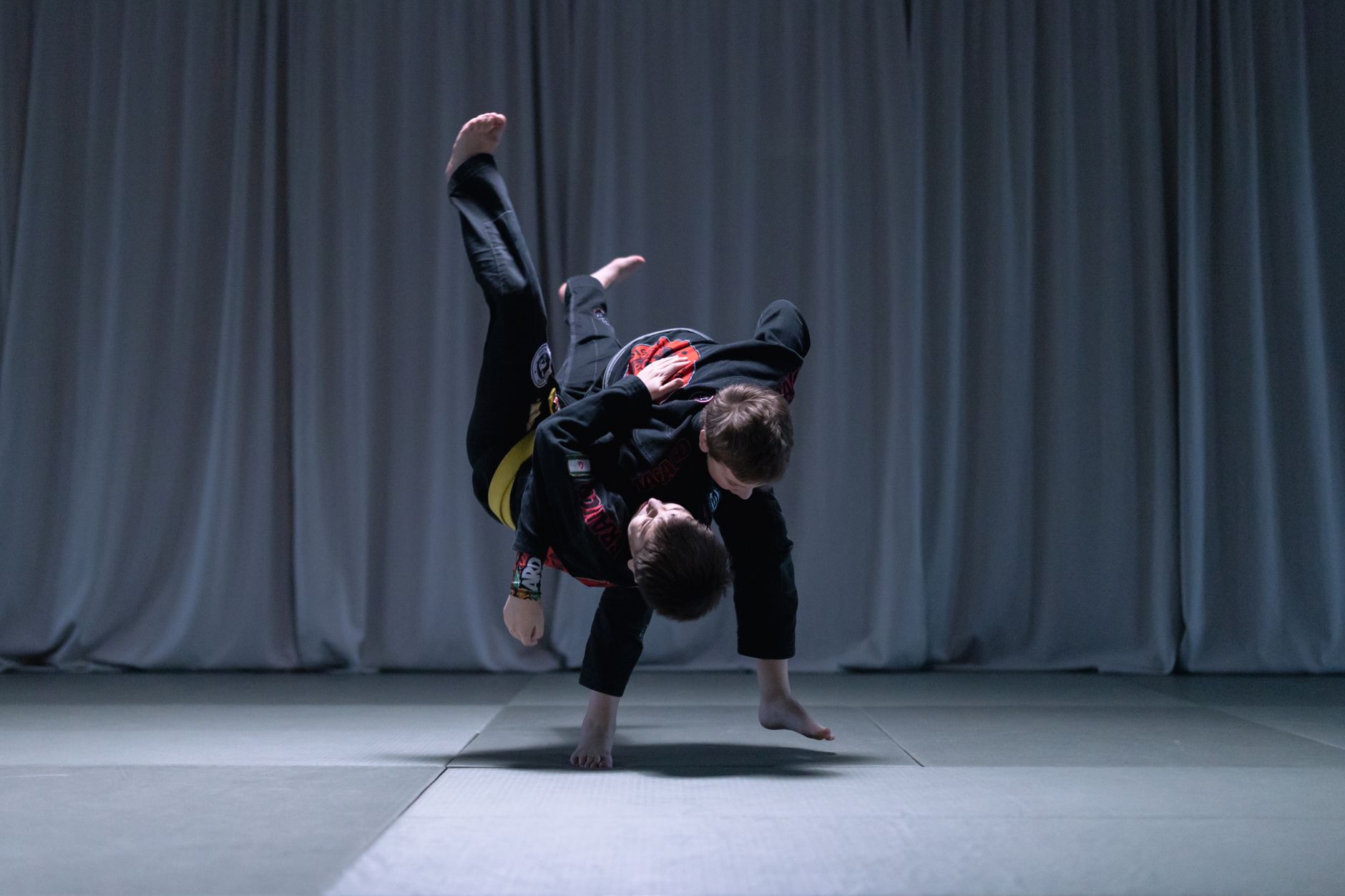
There is no single IBJJF-mandated green-belt curriculum, so it varies by academy. Compared with the youngest grey-belt and yellow-belt classes, a teen green program usually moves past games and toward more structured work: fundamentals under pressure, positional escapes, guard and passing concepts, takedown basics, and controlled live rounds geared to competition if the teen wants to compete. Older youth classes also start to treat the sport more like the adult sport — with safety rules adapted for the age band.
Belt colour still does not tell you a teen’s “skill level” the way an adult black belt does. Green means the child has moved through the youth system and is close to the adult ladder, not that they are equivalent to any adult rank. Before signing up, ask the head coach what the teen curriculum covers at the green stage, how promotion is decided, and what safety rules the class enforces. Our BJJ open mat guide walks through the training and rolling format you will see at many schools.
Teen workouts tend to be more intense than the youngest kids’ classes: warm ups are longer, drilling is more technical, and live rounds are closer to adult sparring with age-specific restrictions. Watch your child’s comfort and check in with the coach on pacing.
Stripes and degrees on a green belt
This is the part that confuses parents most. Adult white-to-brown belts use four stripes, or “degrees,” before the next belt; kids’ belts follow no such fixed rule.
IBJJF suggests that academies divide each youth belt (including the green group) into degrees, and it offers three accepted ways to do it, at the professor’s discretion:
| System | Cadence | How many marks before the next colour |
|---|---|---|
| Monthly | One mark per month | 11 degrees; the 12th graduates the child |
| Triannual | Every four months | 2 degrees; the 3rd graduates the child |
| Quarterly | Every three months | 3 degrees; the 4th graduates the child |
The marks a teen earns are internal progress markers inside the green group, not a promise of promotion on a set date. Two teens can hold the same green belt with very different stripe counts purely because their clubs use different systems. Watch for consistency and enjoyment, not tape count.
How promotion works in youth programs
Under the IBJJF system, athletes aged 4 to 15 have no required minimum time in any youth belt. The professor decides when a teen is ready, and that is the single most important fact for parents: there is no IBJJF-mandated clock for a green belt.
Three things govern how it is recognised:
- The professor’s call. IBJJF leaves how long a practitioner stays in each belt to the head coach, and the same leeway applies to the youth belts.
- An affiliated black-belt professor signs off. A child’s graduation (white through brown) must be approved by an IBJJF-affiliated black-belt professor to be registered with the federation, so do not assume a rank from a non-IBJJF club is recognised at IBJJF events.
- Movement through the group. A teen typically rises green-and-white → solid green → green-and-black before leaving the youth system, but nothing forces a strict schedule. Ask the professor where your child sits.
What happens when a green belt turns 16
At 16 a youth athlete leaves the kids’ system for the adult ladder. The IBJJF rule is:
- Grey, yellow or orange belt → turns blue in the adult system.
- Green belt → blue or purple, at the professor’s decision.
- White belt → may stay white.
Green is the only youth belt that carries a possible purple promotion. IBJJF gives the same responsibility to the professor in the adult blue-belt rules, where no minimum period applies if the athlete was previously registered as a green belt. That recognition separates green from the grey, yellow and orange groups, which IBJJF credits toward adult blue only with a reduced one-year minimum.
Green belt vs the other youth belts
| Youth belt | Age band | What’s different from green |
|---|---|---|
| Grey | 4–15 | Entry rank; the youngest beginners; no direct launch to a higher adult belt |
| Yellow | 7–15 | Early childhood group, not the teen top of the ladder |
| Orange | 10–15 | Pre-teen group; the usual step before green |
| Green | 13–15 | Highest youth rank; converts to blue or purple at 16 |
Green belt FAQs
Is there an adult BJJ green belt?
Not in the IBJJF system. The adult ladder is white, blue, purple, brown, black and the senior red belts. Green exists only in the youth system for ages 4 to 15.
How long does a kid stay at the green belt?
There is no required minimum time for ages 4 to 15. How long a teen stays green depends on the professor and the academy’s promotion style. For many teens the green group is the last stop before 16, when they convert to the adult ladder.
Is the green belt the same as an adult purple belt because of the 16-year-old rule?
No. Converting to purple at 16 means the teen enters the adult belt system at purple; it does not make them an experienced purple belt.
Do green belts compete?
Yes, and the green age band matches the teen divisions in many youth events. Always check the specific event: youth divisions use belt (or colour group) alongside age and weight and can vary between organisations. Look at the event page you registered for, not a general rule.
Why does my teen’s green belt count more stripes than an adult belt?
Youth belts can carry many marks because IBJJF lets academies choose a monthly, triannual or quarterly degree system, while adults use a fixed four-stripe system through brown. The counts are not directly comparable.
Bottom line
The green belt is the top of BJJ’s youth ladder — a three-step group (green-and-white, green, green-and-black) for athletes aged 13 to 15 that usually sits right before the adult system. There is no minimum time in the belt, promotion is the professor’s decision, and at 16 a green belt converts to adult blue or purple. For a parent, the useful measures are that the teen is training safely at higher intensity and still enjoying the mat.
Sources
- IBJJF Graduation System — official page linking the June 2026 graduation document; primary source for age bands, belt order, minimum periods and the suggested youth degree systems. The PDF pages carry “VERSION 3.1 2025©” while the final page prints “VERSION 3.3”; document date June 2026. Inspected November 11, 2026.
- IBJJF Graduation System Poster (2026 InfoPoster, Belts_EN PDF) — linked from the same page; corroborates belt order and minimum-age hierarchy. Inspected November 11, 2026.
- BJJ Belts System (BJJ World) — secondary corroboration for the 13-belt youth order, the green group age entry of 13, and the no-minimum-time point for kids; updated August 2025. Used only as corroboration, not for belt-age rulings. Checked November 11, 2026.