Quick answer: gi and no-gi are the same sport under one IBJJF rule book — the scoring is identical (4 points for mount or back control, 3 for a guard pass, 2 for a takedown, sweep or knee-on-belly) and so are the match times. Three things genuinely change. Of the 26 techniques on the IBJJF’s illegal-moves table, exactly four are legal in no-gi but banned in the gi: heel hooks, knee reaping, locks twisting the knee, and toe holds applying outward pressure — and all four only for adult brown and black belts. No-gi weight limits sit 2 to 3 kg (about 4.4 to 6.6 lbs) below the gi limits, because you weigh in wearing your uniform and the gi counts against you. And grabbing clothing — your own or your opponent’s — is a penalty in no-gi, while in the gi it is the entire game.
Last updated: July 28, 2026. This comparison is built from the official IBJJF Rule Book (version 6.1, June 2024) rather than from gym opinion, so the rule differences below are the ones that actually appear in the book. Rules change: always confirm the current rule book and the rules listed on your specific event page before you compete.
Ask ten training partners about gi versus no-gi and you get ten opinions about pace, athleticism and “which is more realistic.” Almost none of it comes from the rule book. The honest version is narrower and more useful: the two formats share a scoring system, a set of penalties and a match clock, and they differ in a short, specific list of ways — the uniform, the grips, the weight limits, and one significant block of leg attacks. Everything else people argue about is style, not law.
Gi vs no-gi at a glance
| Question | Gi | No-gi |
|---|---|---|
| Uniform | Kimono and belt — white, royal blue or black | Fitted rash guard and shorts or spats |
| Grips | Collar, sleeve, lapel and pant grips are the core of the game | Grabbing clothing at all is a penalty — control comes from the body |
| Scoring | Identical: mount 4, back control 4, guard pass 3, takedown 2, sweep 2, knee-on-belly 2 | |
| Match length | Identical: one table for both — adult black belt 10 minutes, brown 8, purple 7, blue 6, white 5 | |
| Heel hooks & knee reaping | Illegal at every belt | Legal for adult brown and black belts only |
| Weight limits | Higher — the gi and belt count toward your limit | 2–3 kg lower at every division |
| Pace | Usually slower — cloth grips create friction and stalemates | Usually faster — fewer handles, more scrambles |
| Governing body | IBJJF runs both under the same rule book | |
Gi vs no-gi: the core difference
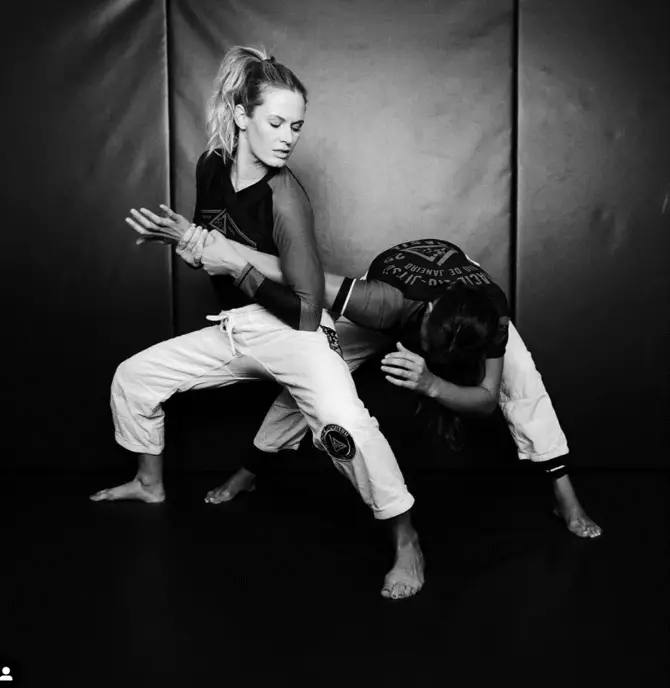
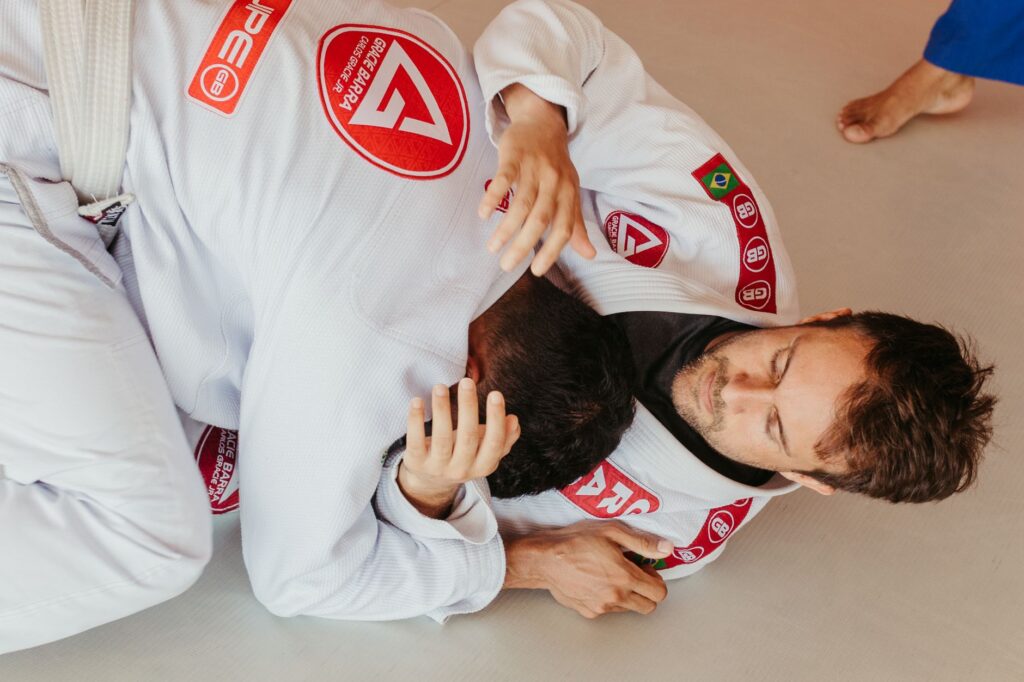
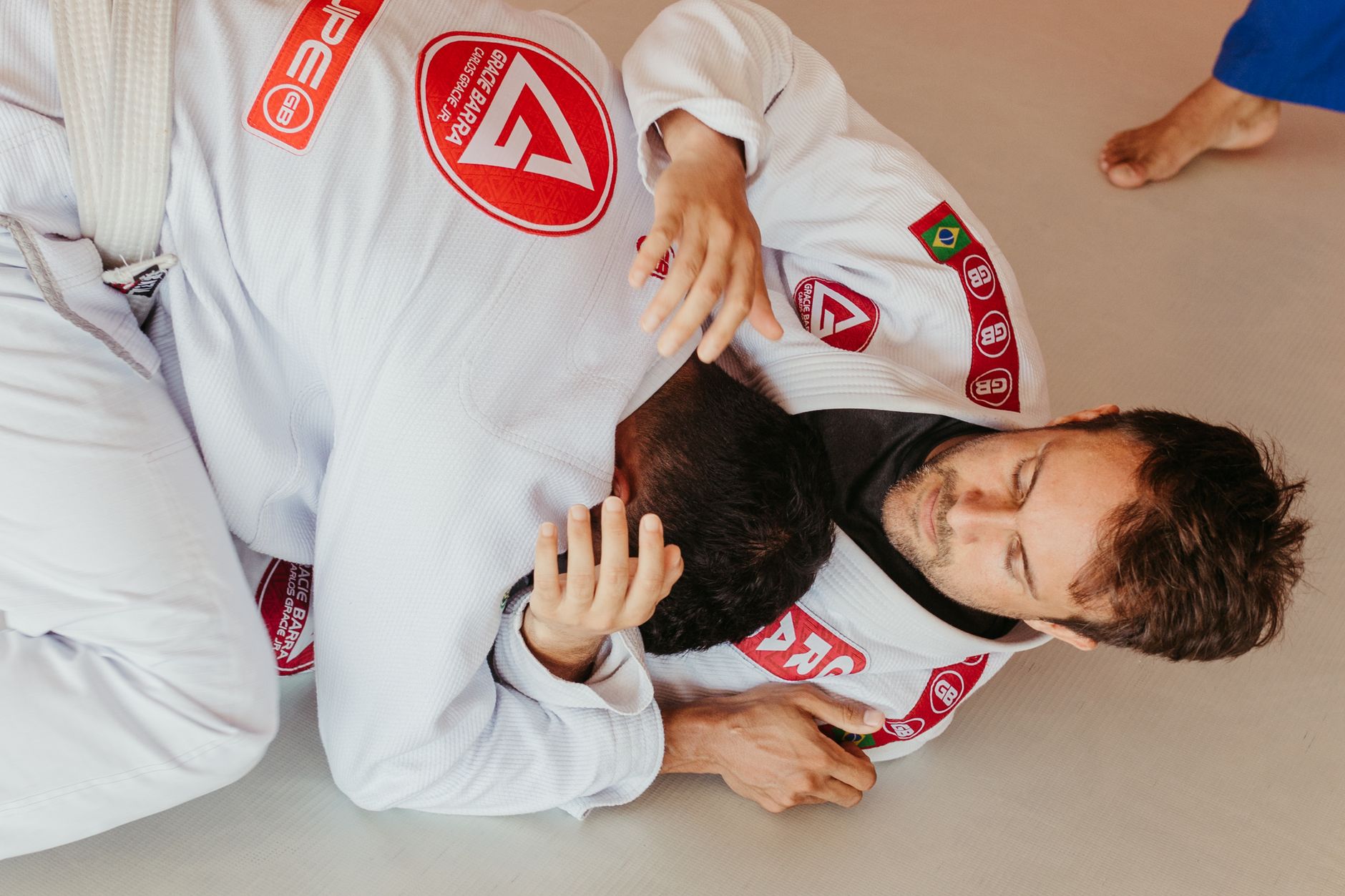
The gi gives both athletes handles. A collar, a sleeve, a lapel and a pant leg are all legal anchor points, and once you have one, you can hold a position with grip strength rather than with body position. That single fact explains most of what people describe as the “feel” of gi jiu-jitsu: it is slower, more positional, harder to escape from, and enormously rewarding of technical precision. Chokes that need cloth — the collar chokes, the bow-and-arrow, the loop choke — only exist here.
Free every Tuesday
The Grappler Brief
The week’s biggest stories from BJJ, judo, wrestling, and submission grappling—curated for people who train.
Sent out weekly.Opt out anytime.
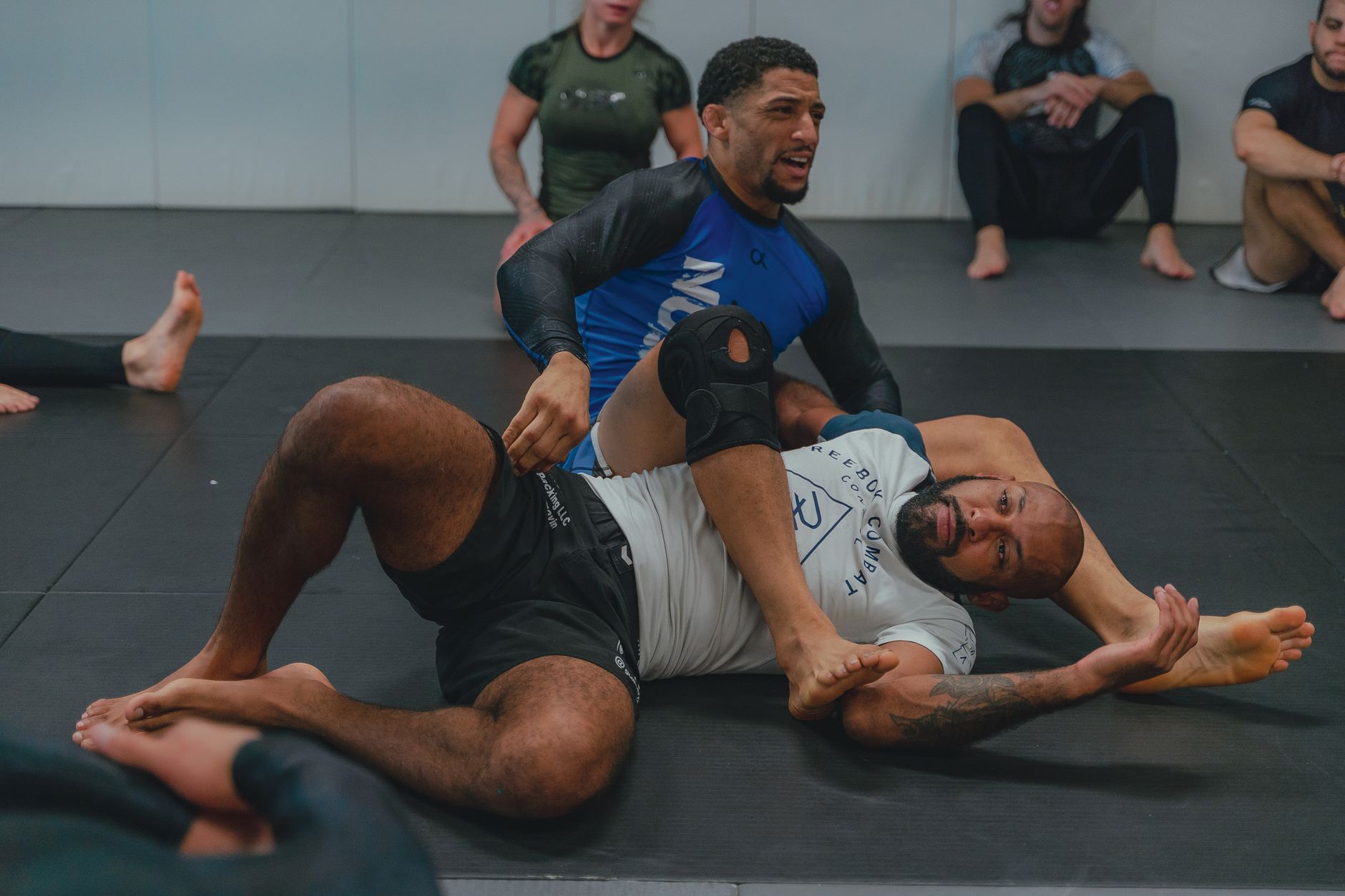
No-gi removes the handles, and the rule book removes them deliberately: grabbing hold of a uniform, yours or your opponent’s, in any way is a listed penalty. Control has to come from underhooks, head position, wrist control, body locks and hooks. Without friction, positions are harder to hold, so matches move faster and scrambles decide more of them. It is not a more athletic sport by nature — it is a sport where losing a position is easier, which rewards people who scramble well.
That is the honest core of it. The gi rewards holding on; no-gi rewards moving. Everything below is the rule book putting numbers on that.
What the rule book actually changes
1. Leg locks: the one real difference in what you can do
This is the biggest legal difference between the two formats, and most comparisons miss it entirely. The IBJJF’s illegal-moves table lists 26 techniques against six age-and-belt columns, and the last two columns are the ones that matter here: brown and black belts except adult no-gi, and adult brown and black belts in no-gi. Exactly four entries fall between them — the only techniques in the entire table whose legality depends on whether you are wearing a gi. The change took effect on 1 January 2021.
| Technique | Gi (adult) | No-gi (adult) |
|---|---|---|
| Heel hook | Illegal at every belt | Brown & black only |
| Knee reaping | Illegal at every belt | Brown & black only |
| Locks twisting the knee | Illegal at every belt | Brown & black only |
| Toe hold applying outward pressure | Illegal at every belt | Brown & black only |
| Knee bar, toe hold, calf slicer, bicep slicer | Brown & black only | Brown & black only |
| Straight foot lock | Legal at all adult belts | Legal at all adult belts |
| Slam, spinal lock without choke, scissor takedown | Illegal for everyone | Illegal for everyone |
Read the table the other way and the point sharpens: the straight foot lock is legal for every adult in both formats, knee bars and toe holds open up at brown belt in both formats, and only that top block of four rotational attacks is genuinely gi-versus-no-gi. The “leg-lock revolution” is, in IBJJF terms, four table rows.
The practical consequence is that a brown belt’s no-gi game and gi game are legally different sports below the waist. It also means the most common piece of gym advice — “don’t worry, heel hooks are legal in no-gi now” — is only true if you are an adult brown or black belt. A purple belt entering an IBJJF no-gi division is under exactly the same leg-lock restrictions as they are in the gi.
Note that this is IBJJF-specific. Other no-gi rule sets draw the line in completely different places — ADCC rules and NAGA rules both permit leg attacks the IBJJF does not, which is why “is it legal in no-gi?” is never a complete question. Legal under which rule set, at which belt, in which division?
2. Weight limits: your gi is worth 2 to 3 kg
IBJJF weight limits are maximums measured with your competition uniform on. Because a gi and belt weigh something and a rash guard and shorts weigh almost nothing, the federation publishes a separate, lower set of limits for no-gi. Across the adult and master men’s divisions the gap runs from 2.0 kg at Rooster to 3.0 kg at Super Heavy.
| Division (adult & master men) | Gi max | No-gi max | Difference |
|---|---|---|---|
| Rooster | 57.5 kg | 55.5 kg | 2.0 kg |
| Light Feather | 64.0 kg | 61.5 kg | 2.5 kg |
| Feather | 70.0 kg | 67.5 kg | 2.5 kg |
| Light | 76.0 kg | 73.5 kg | 2.5 kg |
| Middle | 82.3 kg | 79.5 kg | 2.8 kg |
| Medium Heavy | 88.3 kg | 85.5 kg | 2.8 kg |
| Heavy | 94.3 kg | 91.5 kg | 2.8 kg |
| Super Heavy | 100.5 kg | 97.5 kg | 3.0 kg |
| Ultra Heavy | No maximum | No maximum | — |
This catches people out constantly. Registering for the same-named division in both formats at one tournament means making two different weights, and the no-gi number is the harder one. You get one weigh-in attempt before your first match, and coming in over your registered limit is an immediate disqualification with no move to a higher division. Full charts for men, women, juvenile and kids, in kilograms and pounds, are in our IBJJF weight classes guide.
3. Grips: opposite penalties
Both formats penalise grips — just opposite ones. In no-gi, the rule book penalises grabbing hold of a uniform, your own or your opponent’s, in any way. Riding a shorts hem or pinching a rash guard is not a clever workaround; it is a foul.
In the gi, grabbing cloth is the point, but not all of it is legal. Reaching inside the opponent’s jacket or pants is a penalty, as is stepping inside the jacket or passing a hand through the inside of the gi to grip the outside of it. The distinction is about the trapped hand: outside grips release, inside grips do not.
4. Uniform checks
Both formats fail people at the inspection table, for different reasons. A gi must be completely white, royal blue or black — mixed-colour jackets and pants are rejected — and the collar is measured, with a maximum thickness of 1.3 cm and width of 5 cm.
No-gi has its own list: a skin-tight shirt long enough to cover the torso to the waistband, coloured black, white, or black and white, carrying at least 10% of your rank colour (a shirt entirely in your rank colour is also allowed). Shorts must have no pockets — or pockets stitched fully shut — no buttons, no exposed drawstrings, no zippers, and must reach at least halfway down the thigh, within 15 cm of the knee, without passing it. Undergarments are mandatory in both formats. Our IBJJF gi rules and IBJJF no-gi rules guides cover each inspection in full, and the federation’s own uniform page is the final word.
One rule worth knowing if you enter both at the same event: a disciplinary disqualification in the gi event also disqualifies you from the no-gi event.
What is the same
It is worth being explicit about this, because the internet tends to oversell the gap. Scoring is identical — the same 4-3-2 structure and the same advantages, covered in our BJJ points system guide and BJJ rules and scoring guide. Penalties, stalling rules and the referee’s authority are the same. Match durations come from a single table that does not split by format: adult black belt 10 minutes, brown 8, purple 7, blue 6, white 5, with masters divisions shorter. Age divisions are the same. The belt system is the same, and time on the mat in one counts toward promotion in the other.
How training feels
Gi classes usually run slower and more technically. Grip fighting starts every exchange, positions hold longer, and a bad grip can cost you five minutes of the round. Most people find the gi more frustrating early — you get stuck a lot — and more rewarding later, because the extra friction gives you time to think and to feel a technique working.
No-gi rounds are sweatier and faster. Positions slip, scrambles are constant, and beginners often feel more immediately capable because they can explode out of bad spots that a gi grip would have held. The trade-off is that bad habits hide better: strength and speed cover technical gaps in no-gi far longer than they do in the gi.
Practical differences matter too. A gi costs more up front but lasts years; rash guards and shorts are cheaper but you need several. Gi burn and finger injuries come with the kimono; skin infections and cauliflower ear are the more common no-gi complaints, since more skin is in contact more of the time. Wash everything after every session either way.
Which is better for beginners?
In most gyms, starting in the gi is the more common recommendation, and there is a reasonable argument behind it: the slower pace gives a beginner time to recognise positions, and the extra control means you have to solve problems with technique rather than by ripping free. Gi players also tend to develop tighter defensive fundamentals, because escaping a good grip requires actual mechanics.
That said, the argument is weaker than its confidence suggests. If your goal is MMA or wrestling-adjacent grappling, no-gi is more directly relevant and there is no rule saying you must earn it. And the real deciding factor is usually mundane: train whichever your gym runs at times you can actually attend, with the coach you like. Consistency beats format choice by a wide margin at white belt. Our beginner’s FAQ covers the rest of the first-six-months questions.
Which is better for self-defense, MMA, or competition?
Self-defense: a mild edge to the gi, for the unglamorous reason that people wear clothes. Jacket and sleeve control transfers to a hoodie or a denim jacket in a way that pure body control does not. The counter-argument is real though — no-gi teaches you to control someone you cannot hold onto, which is the harder skill.
MMA: no-gi, clearly and without much debate. Nobody wears a kimono in a cage, grips are sweat-slick, and the positions that survive under strikes are body-lock and head-control positions rather than lapel positions. Fighters with a gi base still do well, but they adapt their game rather than transplant it — see our UFC statistics study for how grappling actually decides fights.
Competition: depends on what you want out of it. The gi has the deeper IBJJF competitive structure and the clearer path through the belts. No-gi has the faster-growing professional scene and the higher-profile events. Money and attention have moved toward no-gi over the last decade; tradition and depth of field still favour the gi.
Can you train both?
Yes, and most serious practitioners do. The transfer is asymmetric but genuinely two-way: the gi sharpens defence, patience and detail, because you cannot muscle out of a good grip; no-gi sharpens scrambling, wrestling and the leg-lock game the gi rule set forbids. Athletes who only train one usually show the hole — gi-only players get overwhelmed by pace, no-gi-only players get held down and cannot escape.
If you can only do two sessions a week, pick one format and get good at it before splitting. From three or more, doing both is the stronger long-term plan. Match your emphasis to your goal: competing in IBJJF gi divisions, weight your training to the gi; chasing ADCC-style events or MMA, weight it to no-gi.
Choosing a no-gi outfit? Check rash-guard sizing and fit alongside spats and layering requirements; use each garment’s chart and the rules for your actual session.
FAQ
Are heel hooks legal in no-gi?
Under IBJJF rules, only for adult brown and black belts in no-gi divisions, a change effective 1 January 2021. They are illegal in every gi division at every belt, and illegal for white, blue and purple belts in no-gi. Other organisations set their own thresholds, so always check the rule set of the specific event.
Is gi or no-gi better for beginners?
Most coaches suggest the gi first, because the slower pace and stronger grips force you to solve positions technically rather than athletically. It is a preference, not a rule — if your goal is MMA, starting no-gi is perfectly sensible. Attendance matters more than format.
Do gi and no-gi have different weight classes?
Yes. IBJJF no-gi limits are 2 to 3 kg lower than the gi limits at every division, because you weigh in wearing your uniform and the gi counts. An adult male Feather is 70.0 kg in the gi and 67.5 kg in no-gi.
Is the scoring different in no-gi?
No. IBJJF gi and no-gi use the same points: 4 for mount or back control, 3 for a guard pass, 2 for a takedown, sweep or knee-on-belly, plus advantages. Match durations are the same too.
Does gi training help your no-gi?
Yes, mostly in defence and detail. Escaping under gi grips builds mechanics that hold up when the grips disappear. The transfer is weakest for anything grip-dependent — lapel guards and collar chokes have no no-gi equivalent, so those hours do not carry over.
Can you grab shorts or a rash guard in no-gi?
No. The IBJJF rule book penalises grabbing hold of a uniform — your own or your opponent’s — in any way during no-gi competition.
Bottom line
Gi and no-gi are one sport with two uniforms, and the rule book proves it: same points, same clock, same belts, same age divisions. What genuinely changes is the uniform inspection, which grips are legal, a weight allowance worth 2 to 3 kg, and one block of leg attacks that opens up for adult brown and black belts in no-gi only. Pick the gi if you want depth, defence and the IBJJF competitive ladder; pick no-gi if you want MMA relevance, scrambling and the modern professional scene. Train both if you can — and before you compete in either, read the IBJJF rules hub and the rules on your event page.
Sources
- IBJJF Rule Book, version 6.1 (June 2024) — scoring, penalties, uniform requirements, match durations
- IBJJF Technical Fouls & Illegal Moves poster (v4.0, January 2024) — the 26-technique illegal-moves table by age and belt category, including the adult no-gi brown and black belt column
- IBJJF: New Rules Updates — heel hooks and knee reaping for adult brown and black belt no-gi, effective 1 January 2021
- IBJJF: Uniform requirements
Jacket rules shape a grappling art more than anything else. For a sharper example, sambo wears a jacket too but bans chokes entirely while allowing leg locks at every level — the opposite trade to the one BJJ makes.