Last reviewed: October 26, 2026.
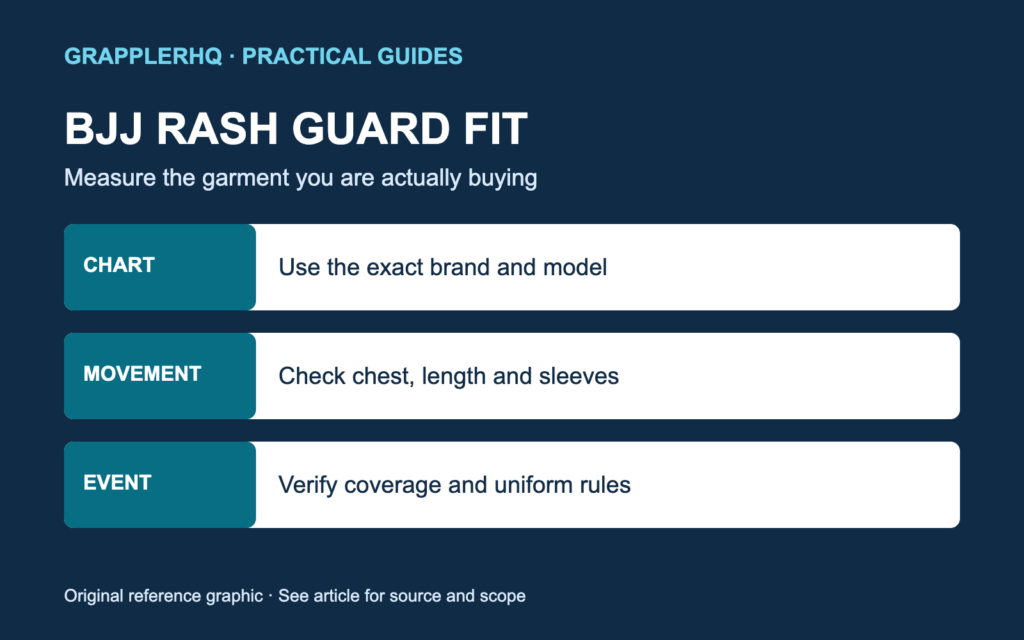
Quick answer: a BJJ rash guard should sit close to the body while allowing the movement you need for training. Use the exact brand and model’s size chart, then check chest, length and movement. Do not automatically size down from a T-shirt or assume every brand’s medium is equivalent. A close fit should not mean fighting the garment every time you reach, turn or sit.
This guide answers a fit question, not which product is “best.” For the sport’s broader clothing differences, see the gi versus no-gi guide. For an event, its current uniform requirements are a separate check from personal comfort.
Start with the right size chart
Find the chart attached to the product you are buying. Check whether it applies to that model, cut and range. A men’s, women’s or youth label is not an exact conversion into another range, even if both use S, M and L.
Free every Tuesday
The Grappler Brief
The week’s biggest stories from BJJ, judo, wrestling, and submission grappling—curated for people who train.
Sent out weekly.Opt out anytime.
The Fuji Sports Australia chart page, for example, publishes a rash-guard chart with a chest column. Its listed medium band is 38–40 inches, and large is 42–44 inches. Those are examples from that chart, not a universal BJJ rash-guard size standard.
| What you see | What to check | Common mistake |
|---|---|---|
| A chest measurement | The product’s stated measuring method and unit | Using a flat garment width as though it were the same measurement |
| A garment length | The marked starting point and intended fit | Assuming it is a body-height recommendation |
| A size you already wear elsewhere | The new model’s chart | Buying the same label without comparing its dimensions |
| A gap between listed bands | The maker’s between-size advice | Inventing an unlisted size recommendation |
How to check the fit before training
Try the garment as the seller permits while keeping return conditions in mind. Check the fit with the shorts or other training clothing you expect to wear, rather than judging it only while standing still in front of a mirror.
- Check the chest and shoulders. Follow the chart’s measurement method. Notice whether the fabric or seams feel restrictive through normal reaching.
- Check length and coverage. Reach overhead, turn and sit. Look at whether the hem keeps the coverage you need or repeatedly rides away from the waistband.
- Check the sleeves. Make sure the intended sleeve length works without pulling the rest of the shirt out of place.
- Check the seams and waistband area. Look for obvious twisting, uncomfortable pressure or excess loose folds that make the fit unsuitable for your use.
- Recheck the return policy before wearing or washing. Do not turn an uncertain fit into a used garment before you know your options.
These are practical fit observations, not a performance test or a medical measurement. If the model’s chart and your try-on result disagree, the seller can clarify whether the cut is wrong for you or a different size is appropriate.
What if you are between two sizes?
Keep the actual numbers in the conversation. “My chest measurement is between your listed bands” gives a maker something specific to answer. “I normally wear medium” does not tell them which chart you used or how you measured.
Consider two hypothetical examples using the Fuji chest chart above. A 39-inch input falls inside its listed medium band. A 41-inch input sits between the published medium and large bands. The first has a direct chart match; the second needs the product’s between-size guidance. Do not present the second as an officially listed medium or large recommendation when the chart does not say that.
Also check whether you are comparing body measurements with garment measurements. A shirt laid flat, measured across the chest, is a different starting point from a tape placed around a person. Use the source’s diagram or instructions; ask if the method is not stated clearly enough.
Should a BJJ rash guard be very tight?
A fitted cut is different from choosing the smallest garment you can put on. Start with the intended fit, chart and movement checks. If a fit is uncomfortable or restricts the movement you need, change the sizing decision rather than treating discomfort as evidence that the garment is working.
No size label guarantees how a particular person will find a particular cut. Product-specific construction matters, which is why replacing measurements with “always size down” or “always buy your T-shirt size” is unreliable advice.
Training fit and competition legality are separate
The IBJJF no-gi uniform requirements call for an elastic, close-fitting shirt that covers the torso to the shorts’ waistband, with specific rank-color conditions. A rash guard that feels comfortable for ordinary training can still fail the event’s color or coverage requirements.
Wearing a rash guard under a gi is another separate question. The official IBJJF page distinguishes male and female gi-division requirements. Do not apply a no-gi shirt rule to a gi division, or one gym’s everyday dress policy to every tournament.
The IBJJF no-gi guide and gi inspection guide provide the wider context. Confirm the current rules for the actual event before buying a competition uniform.
Long sleeve or short sleeve?
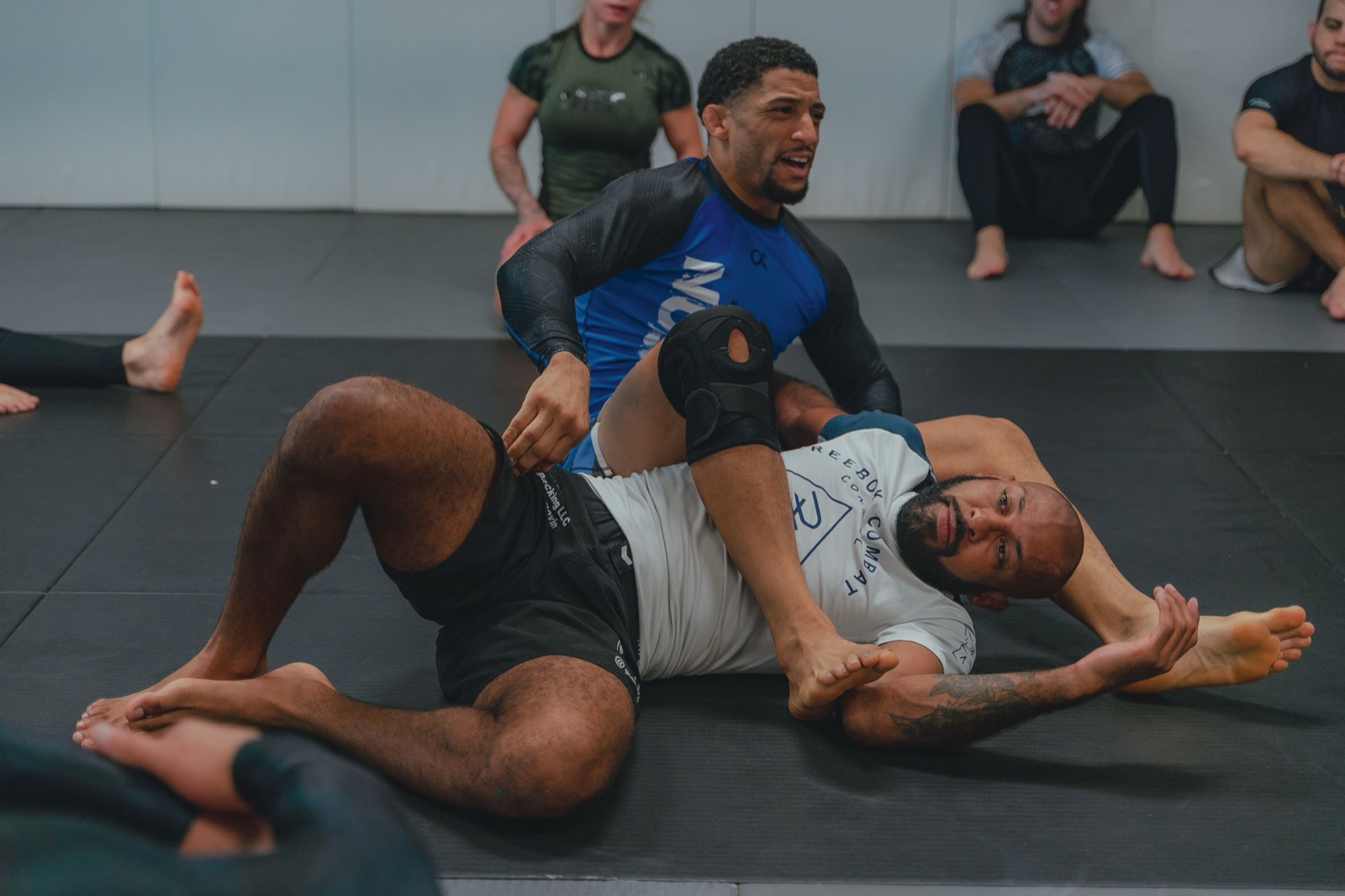
Choose the permitted option that fits your training needs and the host’s requirements. Compare coverage, how the garment feels with your other equipment and whether the cut works when you move. Sleeve length alone does not establish quality, comfort or event legality.
If you are trying your first no-gi session, ask the gym what clothing it expects before purchasing a full set. Our beginner FAQ covers the broader first-class questions.
Keep the fit by following the right care instructions
Read the label on the rash guard itself. Do not assume a gi’s care process applies to synthetic training wear. Close or separate fasteners as the maker directs, and keep rough hook-and-loop surfaces away from delicate fabric where the care instructions call for that.
Check drying instructions too. The Fuji rash-guard chart shown on its source page allows a low tumble dry, while other products may specify a different process. Do not turn one model’s instructions into a rule for every rash guard.
Choosing lower-body gear too? The BJJ spats guide explains fit, shorts and layering decisions for a different part of the uniform.
Fit questions
Can I just order my normal T-shirt size?
Use it only as background information. Compare the exact rash guard’s chart and intended fit before deciding.
Does every large rash guard fit the same?
No. The label does not standardize measurements across brands, cuts and models.
What if it fits standing up but rides up during movement?
Check the garment’s length, cut and intended coverage with your other equipment. Discuss the mismatch with the seller before wearing or washing it beyond the return conditions.
Sources checked
Primary references: Fuji size charts and IBJJF uniform requirements, checked October 2026. This guide does not claim firsthand product testing or rank particular brands.