Quick answer: IBJJF weight classes are maximum weights measured with your competition uniform on, so gi divisions include the weight of your gi and belt. For 2026, adult and master male gi divisions run from Rooster at 57.5 kg (127.0 lbs) to Super Heavy at 100.5 kg (222.0 lbs), plus Ultra Heavy with no upper limit. Women’s gi divisions run from Rooster at 48.5 kg (107.0 lbs) to Super Heavy, which has no upper limit. No-gi limits sit roughly 2 to 3 kg below the gi limits because the no-gi uniform is lighter. Masters divisions use the same weight limits as adult. You get one weigh-in attempt before your first match, and weighing in over your registered limit is an immediate disqualification with no division change. The tables below use the official IBJJF 2026 weight charts in both kilograms and pounds; always confirm the chart linked on your specific event page before registering.
Last updated: July 15, 2026. This guide covers the official IBJJF weight classes for 2026 — adult, master, juvenile, and kids, in gi and no-gi, with limits in both kilograms and pounds taken from the official IBJJF weight charts published on 2026 event pages. It is a planning guide, not a replacement for the official IBJJF rule book or the weight chart on your tournament page.
IBJJF weight classes 2026 chart (adult and master men)
Adult and master men share the same weight table. The pounds values below are IBJJF’s own official pounds chart, used at U.S. events — not conversions. Every limit is the maximum allowed with the uniform on.
Free every Tuesday
The Grappler Brief
The week’s biggest stories from BJJ, judo, wrestling, and submission grappling—curated for people who train.
Sent out weekly.Opt out anytime.
| Division | Gi max (kg) | Gi max (lbs) | No-gi max (kg) | No-gi max (lbs) |
|---|---|---|---|---|
| Rooster | 57.5 kg | 127.0 lbs | 55.5 kg | 122.6 lbs |
| Light Feather | 64.0 kg | 141.6 lbs | 61.5 kg | 136.0 lbs |
| Feather | 70.0 kg | 154.6 lbs | 67.5 kg | 149.0 lbs |
| Light | 76.0 kg | 168.0 lbs | 73.5 kg | 162.6 lbs |
| Middle | 82.3 kg | 181.6 lbs | 79.5 kg | 175.6 lbs |
| Medium Heavy | 88.3 kg | 195.0 lbs | 85.5 kg | 188.6 lbs |
| Heavy | 94.3 kg | 208.0 lbs | 91.5 kg | 202.0 lbs |
| Super Heavy | 100.5 kg | 222.0 lbs | 97.5 kg | 215.0 lbs |
| Ultra Heavy | No maximum | No maximum | No maximum | No maximum |
IBJJF women’s weight classes 2026 (adult and master)
Women’s divisions follow the same structure but end at Super Heavy, which has no upper limit. There is no women’s Ultra Heavy division on the official chart.
| Division | Gi max (kg) | Gi max (lbs) | No-gi max (kg) | No-gi max (lbs) |
|---|---|---|---|---|
| Rooster | 48.5 kg | 107.0 lbs | 46.5 kg | 103.0 lbs |
| Light Feather | 53.5 kg | 118.0 lbs | 51.5 kg | 114.0 lbs |
| Feather | 58.5 kg | 129.0 lbs | 56.5 kg | 125.0 lbs |
| Light | 64.0 kg | 141.6 lbs | 61.5 kg | 136.0 lbs |
| Middle | 69.0 kg | 152.6 lbs | 66.5 kg | 147.0 lbs |
| Medium Heavy | 74.0 kg | 163.6 lbs | 71.5 kg | 158.0 lbs |
| Heavy | 79.3 kg | 175.0 lbs | 76.5 kg | 169.0 lbs |
| Super Heavy | No maximum | No maximum | No maximum | No maximum |
What weight class am I in for a 2026 IBJJF tournament?
Work backward from scale weight in your competition uniform, not from your walking-around weight. A typical adult competition gi and belt add roughly 1.5 to 2 kg (about 3 to 4.5 lbs), while a no-gi uniform adds almost nothing.
Worked example: a male competitor who weighs 175 lbs without a gi will step on the scale at roughly 178 to 180 lbs in the gi, which fits Middle (181.6 lbs max) with only a small buffer. In no-gi, the same athlete weighs in at about 175 to 176 lbs, which is right at the Middle no-gi limit of 175.6 lbs — so Medium Heavy (188.6 lbs max) is the safer registration. If the buffer is that thin, register the heavier division or plan your weight well before tournament week.
How IBJJF weigh-ins work
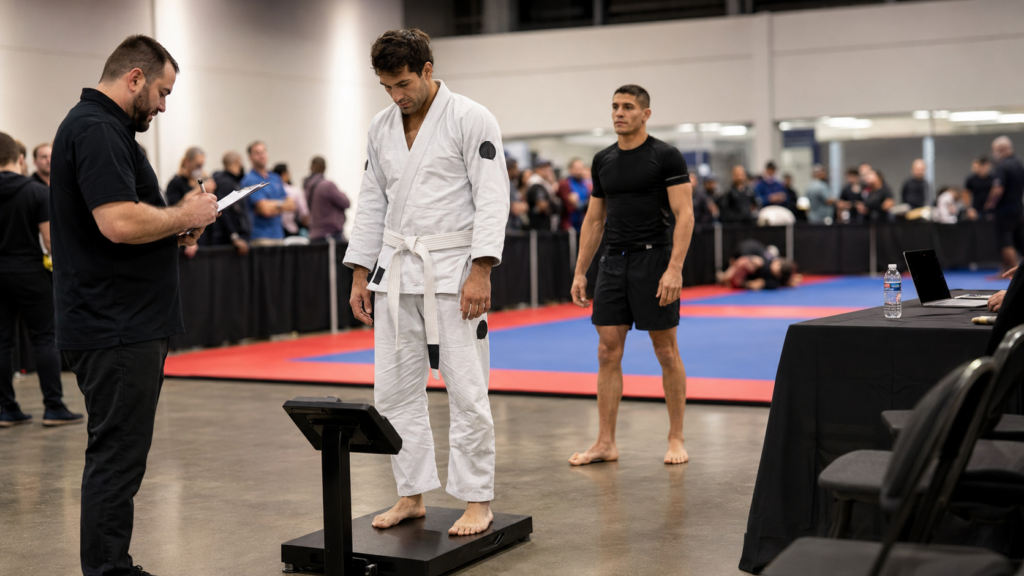
IBJJF’s official weigh-in rules state that athletes weigh in before their first match, wearing the gi at gi tournaments and the no-gi uniform at no-gi tournaments. You get one attempt on the scale for your registered division. Athletes who weigh in over the limit are immediately disqualified — there is no moving to a heavier division at the scale and no refund.
IBJJF’s first-championship guidance adds that the weights on the event chart are the highest allowed weight for each division with the uniform on, and that being under the limit is never a problem — only being over is. Registration can usually be edited up to the event’s correction deadline, so fixing a division choice early costs nothing, while missing weight on the day costs the whole tournament.
Gi vs no-gi weight classes
Each no-gi limit is set 2 to 3 kg (roughly 4.5 to 6.5 lbs) below the matching gi limit because athletes weigh in without the gi. For example, adult male Light is 76.0 kg (168.0 lbs) in the gi but 73.5 kg (162.6 lbs) in no-gi. The two charts are not interchangeable: an athlete who comfortably makes Light in the gi can miss Light in no-gi despite weighing less on the day.
If you compete in both formats, check both columns before registering, and weigh yourself in the exact uniform you will wear at the event. For uniform requirements, see GrapplerHQ’s IBJJF gi rules and IBJJF no-gi rules guides.
IBJJF weight classes in pounds
The pounds values in the tables above come from IBJJF’s official pounds weight charts, which U.S. event pages link directly. They are worth using instead of converting kilograms yourself, because the official pounds chart rounds slightly differently: adult male Rooster gi is listed at 127.0 lbs even though 57.5 kg converts to 126.8 lbs, and no-gi Light is listed at 162.6 lbs while 73.5 kg converts to 162.0 lbs. The number printed on the chart for your event is the number the scale is checked against.
IBJJF juvenile weight classes 2026
Juvenile athletes (age 16 to 17 by the birth-year calculation) have their own gi table — one division ladder lighter than the adult table. Juvenile male divisions run through Super Heavy at 89.3 kg (197.0 lbs) with an open-ended Ultra Heavy, and juvenile female divisions end at an open-ended Super Heavy.
| Division | Juvenile male gi | Juvenile female gi |
|---|---|---|
| Rooster | 53.5 kg (118.0 lbs) | 44.3 kg (98.0 lbs) |
| Light Feather | 58.5 kg (129.0 lbs) | 48.3 kg (106.6 lbs) |
| Feather | 64.0 kg (141.6 lbs) | 52.5 kg (116.0 lbs) |
| Light | 69.0 kg (152.6 lbs) | 56.5 kg (125.0 lbs) |
| Middle | 74.0 kg (163.6 lbs) | 60.5 kg (133.6 lbs) |
| Medium Heavy | 79.3 kg (175.0 lbs) | 65.0 kg (143.6 lbs) |
| Heavy | 84.3 kg (186.0 lbs) | 69.0 kg (152.0 lbs) |
| Super Heavy | 89.3 kg (197.0 lbs) | No maximum |
| Ultra Heavy | No maximum | — |
No-gi juvenile tables vary by event type: IBJJF majors split boys into separate Juvenile 1 and Juvenile 2 charts (Juvenile 2 limits run one division heavier), while opens use a combined juvenile no-gi table from Rooster at 51.5 kg through Super Heavy at 86.5 kg for boys and 42.5 kg through an open-ended Super Heavy for girls. This is exactly the situation where the chart linked on your event page is the only safe source.
IBJJF kids weight classes 2026
Kids divisions (Mighty Mite through Teen, ages 4 to 15) use a separate 2026 Kids Weight List. Instead of one table, it has a column for each birth year from 2022 (Mighty Mite I) to 2011 (Teen III), and weights are measured in a single-weave gi. The limits scale up with age: for example, the Rooster division is 26.0 lbs for a Mighty Mite I born in 2022 but 98.0 lbs for a Teen III born in 2011, and every age column runs Rooster through Super Heavy plus an open-ended Ultra Heavy. Find the official 2026 Kids Weight List linked on kids event pages such as Pan Kids 2026, and match your child’s birth-year column — not their grade or their age on tournament day. For how kids age divisions work, see GrapplerHQ’s IBJJF age divisions guide.
Masters weight classes
There is no separate masters weight table: Master 1 through Master 7 use the same adult limits shown in the charts above, in both gi and no-gi. What changes with masters is the age division, not the weight division. Use GrapplerHQ’s IBJJF age divisions guide to find your age bracket, then pick your weight class from the adult table.
What is absolute or open class?
Absolute, or open class, is a bracket without weight separation. On the official charts it is listed as free for adult and master divisions, while juvenile and kids absolutes depend on the tournament rules. Entry requirements vary by event — some restrict absolute by belt, placement, or registration — so check the event page. Open class experience is valuable, but large size gaps are real; smaller athletes and beginners should talk to a coach first.
How to choose your IBJJF weight class
- Start with the event page: register from the weight chart linked on your specific tournament page, not a screenshot or another federation’s chart.
- Weigh in the right uniform: test your weight in the exact gi and belt (or no-gi uniform) you will compete in.
- Leave a buffer: travel, food, hydration, and a heavier backup gi can all move the number; a 1 to 2 lb margin is cheap insurance against a one-attempt weigh-in.
- Avoid extreme cuts: IBJJF weighs you right before your first match, so there is no rehydration window.
- Ask your coach: the right division depends on your skill level, training schedule, and goals, not just the scale.
Weight cutting for BJJ
Most BJJ athletes, especially at white and blue belt, should compete close to their normal training weight. Because IBJJF weigh-ins happen just before your first match, an aggressive cut leaves you grappling depleted with no recovery time. If you are considering a cut anyway, treat it as a coaching and health decision — GrapplerHQ’s water loading and weight cutting guide explains the mechanics, but safety comes first.
Weight class is only half of registration
Your bracket is defined by weight, age, belt, sex, and uniform format together. After picking a weight class, confirm your age division with the IBJJF age divisions guide, review the rules and scoring and points system, and make sure your gi passes inspection with the BJJ gi size chart.
Common mistakes
- Forgetting the gi counts: gi limits are checked with the gi and belt on, which adds roughly 1.5 to 2 kg.
- Using converted pounds instead of the official pounds chart: the official lbs values round differently (127.0 lbs, not 126.8 lbs, for male Rooster gi).
- Assuming you can move up at the scale: missing weight is an immediate disqualification, not a division change.
- Applying the adult chart to juveniles or kids: both have their own lighter tables, and kids charts go by birth year.
- Mixing up federations: ADCC weight classes, local circuits, and other federations use different limits and different weigh-in rules.
Bottom line
IBJJF weight limits are absolute maximums with the uniform on, checked once, right before your first match. For 2026, adult male gi divisions run from Rooster at 57.5 kg (127.0 lbs) to an open-ended Ultra Heavy, women’s from 48.5 kg (107.0 lbs) to an open-ended Super Heavy, and no-gi limits sit 2 to 3 kg lighter across the board. Plan with the official charts above, leave a buffer, and treat the chart on your event page as the final word.
FAQ
How many weight classes does the IBJJF have?
Nine male divisions (Rooster through Ultra Heavy) and eight female divisions (Rooster through Super Heavy, which has no upper limit), in both gi and no-gi.
Do you weigh in with the gi at IBJJF tournaments?
Yes. At gi tournaments you weigh in wearing the gi, and at no-gi tournaments you weigh in wearing the no-gi uniform. The listed limit already accounts for the uniform.
What happens if you miss weight at IBJJF?
You are immediately disqualified. There is one weigh-in attempt, no moving to a heavier division at the scale, and no refund.
Are IBJJF gi and no-gi weight classes different?
Yes. Each no-gi limit is 2 to 3 kg lower than the matching gi limit because athletes weigh in without the gi. Adult male Light, for example, is 76.0 kg in the gi and 73.5 kg in no-gi.
Do masters divisions have different weight limits?
No. Master 1 through Master 7 use the same weight limits as the adult divisions. Only the age division changes.
Is there a weight allowance or tolerance at IBJJF weigh-ins?
No. The chart weight is an absolute maximum with the uniform on. Even slightly over the limit means disqualification from your registered division.
The no-gi limits above sit 2 to 3 kg below the gi limits because you weigh in wearing your uniform. Our gi vs no-gi comparison works through that gap division by division, alongside the other rule differences between the two formats.