Quick answer: IBJJF age divisions use your competition-year age, calculated as the event year minus your birth year, rather than your age on the exact tournament date. For a 2026 event, an athlete born in 1996 is treated as 30 for division purposes even if their birthday has not happened yet. Adult competition begins before the master brackets, while Master 1 starts at competition-year age 30 and later master divisions advance in five-year bands. Juvenile and kids divisions use their own age, belt, and weight combinations, so parents and younger athletes should not apply the adult chart. Always confirm the Belt Age Divisions table on the specific event page before registering because available divisions can depend on the tournament. This guide includes the 2026 birth-year math, adult and master brackets, juvenile context, and a quick way to check where you belong.
Last updated: June 28, 2026. This guide explains IBJJF age divisions for kids, juveniles, adults, and masters in 2026, including how the birth-year calculation works and how masters registration differs from kids and juvenile registration. It is a planning guide, not a substitute for the official IBJJF rule book or your event page.
IBJJF age divisions 2026 chart
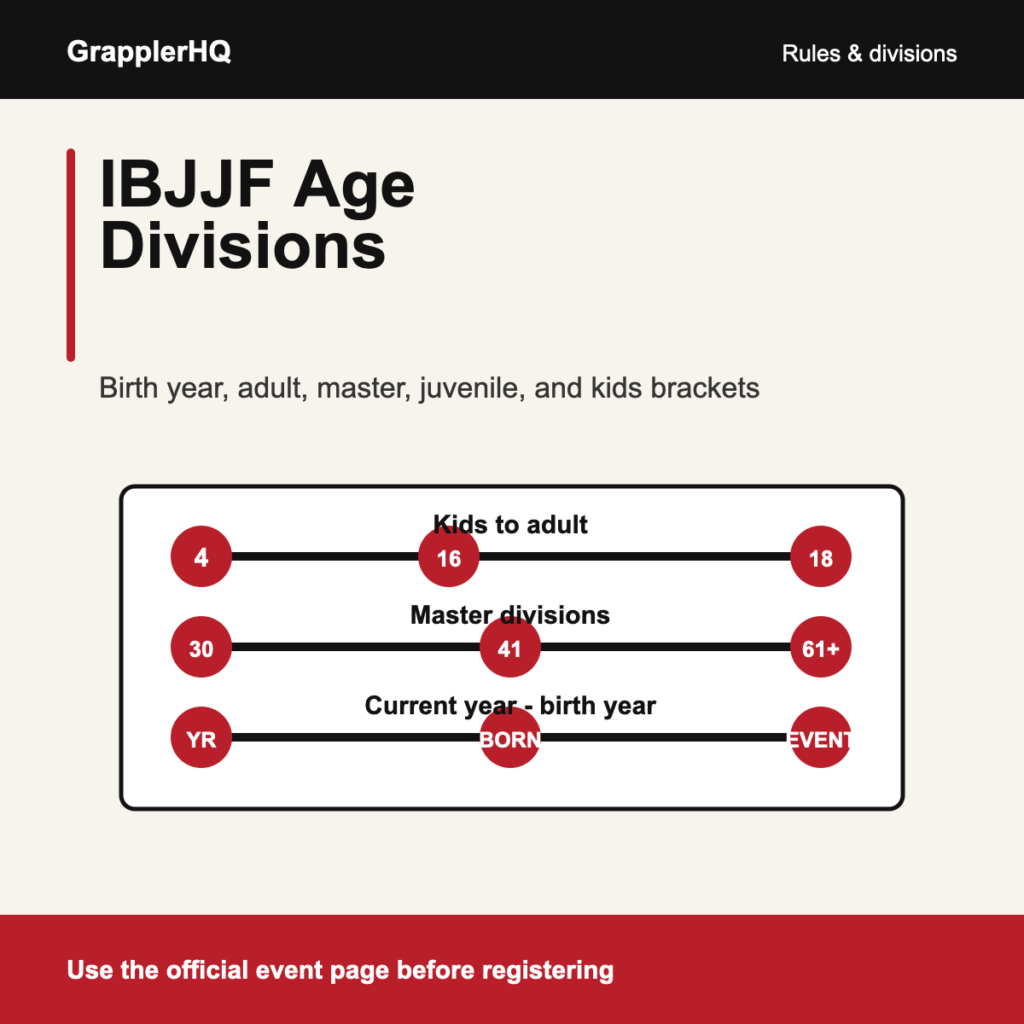
The IBJJF rule book defines age divisions using this formula: current year minus birth year. The table below follows the official division names and age thresholds from the IBJJF rule book.
Free every Tuesday
The Grappler Brief
The week’s biggest stories from BJJ, judo, wrestling, and submission grappling—curated for people who train.
Sent out weekly.Opt out anytime.
| IBJJF age division | Age calculation | Plain-English planning note |
|---|---|---|
| Mighty Mite I | Current year – birth year = 4 | Kids division |
| Mighty Mite II | Current year – birth year = 5 | Kids division |
| Mighty Mite III | Current year – birth year = 6 | Kids division |
| Pee Wee I | Current year – birth year = 7 | Kids division |
| Pee Wee II | Current year – birth year = 8 | Kids division |
| Pee Wee III | Current year – birth year = 9 | Kids division |
| Junior I | Current year – birth year = 10 | Kids division |
| Junior II | Current year – birth year = 11 | Kids division |
| Junior III | Current year – birth year = 12 | Kids division |
| Teen I | Current year – birth year = 13 | Teen/kids division |
| Teen II | Current year – birth year = 14 | Teen/kids division |
| Teen III | Current year – birth year = 15 | Teen/kids division |
| Juvenile I | Current year – birth year = 16 | Juvenile division |
| Juvenile II | Current year – birth year = 17 | Juvenile division |
| Adult | Current year – birth year >= 18 | Adult division |
| Master 1 | Current year – birth year >= 30 | First masters division |
| Master 2 | Current year – birth year >= 36 | Masters division |
| Master 3 | Current year – birth year >= 41 | Masters division |
| Master 4 | Current year – birth year >= 46 | Masters division |
| Master 5 | Current year – birth year >= 51 | Masters division |
| Master 6 | Current year – birth year >= 56 | Masters division |
| Master 7 | Current year – birth year >= 61 | Oldest listed masters division |
What age division am I in for a 2026 IBJJF tournament?
For a 2026 IBJJF event, subtract your birth year from 2026. Someone born in 2008 is calculated as 18, so they fall into Adult by the age formula. Someone born in 1990 is calculated as 36, so they meet the Master 2 age threshold. Always check the event page before registering, because available divisions can vary by championship, belt, and format.
| Birth year | 2026 IBJJF age calculation | Likely age division threshold |
|---|---|---|
| 2022 | 4 | Mighty Mite I |
| 2019 | 7 | Pee Wee I |
| 2016 | 10 | Junior I |
| 2013 | 13 | Teen I |
| 2010 | 16 | Juvenile I |
| 2009 | 17 | Juvenile II |
| 2008 | 18 | Adult |
| 1996 | 30 | Master 1 |
| 1990 | 36 | Master 2 |
| 1985 | 41 | Master 3 |
| 1980 | 46 | Master 4 |
| 1975 | 51 | Master 5 |
| 1970 | 56 | Master 6 |
| 1965 | 61 | Master 7 |
How the birth-year rule works
IBJJF does not sort athletes by the age they are on the exact tournament date. It uses the age the athlete is or will be during the year of the tournament. That is why the rule book uses the formula current year minus birth year.
This matters most for athletes near a cutoff. In a 2026 event, a competitor born in 2008 is calculated as 18 because 2026 – 2008 = 18. A competitor born in 1996 is calculated as 30 because 2026 – 1996 = 30. The exact birthday month does not change that division calculation.
IBJJF adult and master age brackets
Adult starts at 18 by birth-year calculation. Master 1 starts at 30, then the IBJJF master age brackets move in roughly five-year bands: Master 2 at 36, Master 3 at 41, Master 4 at 46, Master 5 at 51, Master 6 at 56, and Master 7 at 61. Adult black belt is where world titles are decided — our list of every BJJ world champion since 1996 covers all of them.
IBJJF’s first-championship guidance says masters athletes may register in lower age divisions. For example, a Master 2 athlete may be able to register in Master 2, Master 1, or Adult. The reverse does not work: a Master 1 athlete cannot register up into Master 2 or higher.
IBJJF kids and juvenile age divisions 2026
Kids and juvenile divisions are stricter. IBJJF’s first-championship guidance says kids and juveniles can only register for the specific division related to their birth year, with possible exceptions if they remain alone in the division on registration checkday.
For 2026, the kids and juvenile cutoff is still birth-year based. A child born in 2016 calculates as 10 for 2026, a teen born in 2013 calculates as 13, and a juvenile born in 2010 calculates as 16. Parents can use the official event page to confirm whether the athlete’s belt and age combination is offered before finalizing registration.
That makes the event page especially important for parents and coaches. Before registering a child or juvenile athlete, check the Belt & Age Divisions table on the official event page, then confirm the athlete’s birth year, belt, weight class, and uniform format.
How to choose your IBJJF age division
- Start with the event page: IBJJF tells athletes to use the Belt & Age Divisions table on the event page.
- Use birth year math: subtract your birth year from the event year.
- Check belt eligibility: age division and belt division work together, especially for kids, juveniles, and masters.
- Confirm weight class next: age division does not replace weight division; you still need the right weight class.
- Ask your coach before dropping age divisions: masters athletes may have options, but the best competitive choice is not always the youngest eligible bracket.
Age divisions, weight classes, and match planning
Age division is only one part of tournament registration. A competitor also needs the correct belt, sex, weight class, uniform format, and rule set. After confirming age, use GrapplerHQ’s IBJJF weight classes guide to plan the weight side of registration.
If you are registering for the gi, review the IBJJF gi rules. If you are registering no-gi, review the IBJJF no-gi rules. For scoring and match outcomes, start with GrapplerHQ’s BJJ rules and scoring guide.
Common mistakes
- Using birthday instead of birth year: IBJJF uses the tournament year minus birth year formula.
- Assuming masters can move both directions: masters may be able to register in younger divisions, but younger masters cannot move into older divisions.
- Using an old chart: treat the event page as the current source for that tournament.
- Ignoring registration deadlines: IBJJF correction periods and registration checkday can limit what changes are possible.
Bottom line
IBJJF age divisions are calculated by birth year, not birthday. Adult begins at 18 by that calculation, Master 1 begins at 30, and the official rule book lists masters through Master 7 at 61 and older. Use this guide to understand the system, then verify the event page before registering.
FAQ
How does IBJJF calculate age divisions?
IBJJF calculates age divisions by subtracting birth year from the tournament year. The exact birthday date does not control the division calculation.
What age is Adult in IBJJF?
Adult starts when current year minus birth year is at least 18.
What age is Master 1 in IBJJF?
Master 1 starts when current year minus birth year is at least 30.
Can masters athletes compete in Adult?
IBJJF says masters athletes may be eligible to register in lower age divisions. For example, a Master 2 athlete may be able to register in Master 2, Master 1, or Adult, but event registration rules still apply.
Can kids or juveniles move age divisions?
IBJJF says kids and juveniles can only register for the specific division tied to their birth year, with possible exceptions if they remain alone in the division on registration checkday.