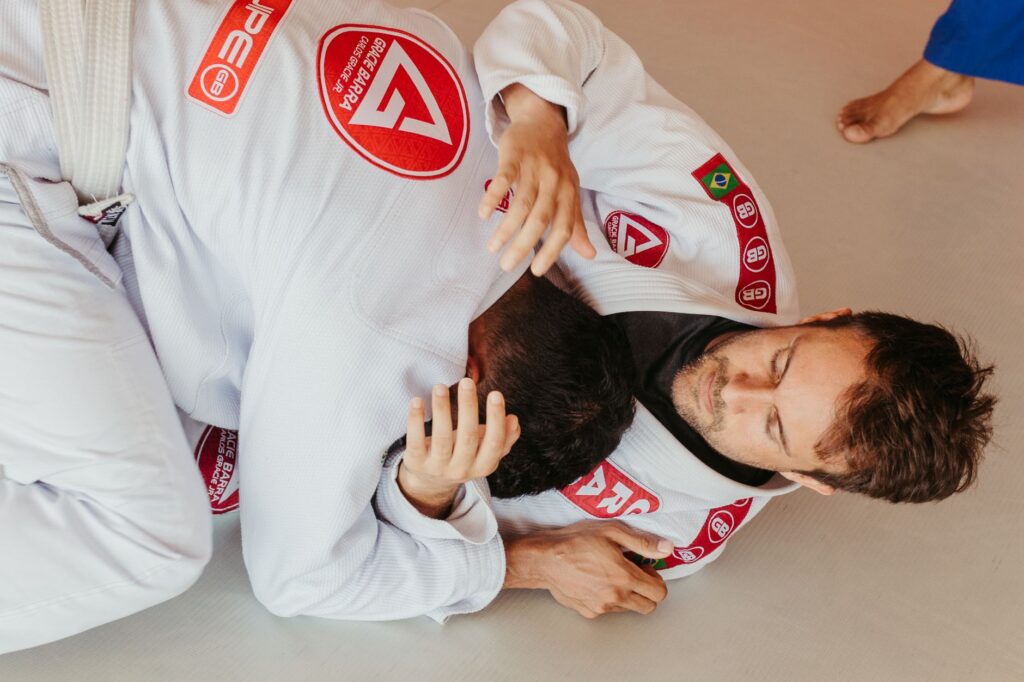
Quick answer: the baseball bat choke is a gi-only collar choke finished with a baseball-bat grip — two hands side by side on the collar, a four-finger grip on the same-side lapel plus a second grip on the opposite lapel. In Magid Hage’s BJJ Fanatics demonstration, it is thrown from the bottom of a pressure pass: you build the first collar grip while the passer is committed to driving forward, add the second grip as he passes, then roll to your side and finish like a cross choke. It is a fast blood choke, and under the IBJJF documents checked for this guide it is legal in gi at every belt — provided it stays a clean choke rather than a neck crank.
Last updated: November 10, 2026 (Pacific). Sources checked November 11, 2026 UTC.
This guide is educational. Practice under qualified coaching, apply pressure gradually, tap early, and release immediately when a partner taps or cannot communicate clearly.
Two things decide whether this choke works: can you build both collar grips without losing position, and is your exact version legal in your division? The first is grip fighting; the second is a rules problem most guides skip.
Free every Tuesday
The Grappler Brief
The week’s biggest stories from BJJ, judo, wrestling, and submission grappling—curated for people who train.
Sent out weekly.Opt out anytime.
Baseball bat choke at a glance
| Detail | What to know |
|---|---|
| Technique family | Gi collar (lapel) choke, finished like a cross choke |
| Grip | Baseball-bat grip: two hands side by side on the collar — four fingers in on the same-side lapel, second grip on the opposite lapel |
| First control priority | Build the first collar grip while the passer is committed to a slow pressure pass; add the second as he lands |
| Worked entries | From bottom vs the over-under pass (Magid Hage); from top knee-on-belly and side control (Bernardo Faria) |
| IBJJF adult baseline | Legal in gi at every belt as a collar choke; illegal if applied as a choke with spinal lock or by blocking the airway with the hands |
| Format | Gi only for the classic version — it needs lapels |
What is the baseball bat choke?
The baseball bat choke is a collar choke. You grip the defender’s gi collar with both hands in the same orientation you would hold a baseball bat, then flex your wrists and roll so the lapels close on the neck. The name comes from the hand position — once both grips are connected, the movement is basically a cross choke.
It is a control-first submission that belongs in the wider techniques library, in the same family as the kimura — the grip does the work, and the choke is only one of the things it buys you. Hage built his game around it and first used the collar grip as a guard-recovery tool, which is why it is usually taught from the bottom against a passer rather than as a top-position finish.
Everything rests on one awkward habit: a four-finger grip on the same-side lapel. Most gi players learn cross-collar grips; the baseball bat choke uses four fingers on the mirror/same side, which feels wrong at first. With that grip connected you can sit in guard, stay lazy on that side, and wait for the pass — then add the second grip and it is live.
Common entries: from guard and from top
1. From the bottom, against a pressure pass (Magid Hage)
This is the classic version, and it works best against a pressure passer: pressure passes are slow and keep the passer’s hands busy. Hage’s sequence against the over-under pass:
- Frame as if escaping. While the passer stuffs a leg and clamps your belt, push and frame as if recovering guard — the movement feeds your hand to the collar.
- Connect the four-finger same-side grip while the passer is still driving forward. It reads as guard recovery, not an attack.
- Open the hand and make slack. Take a shallow grip high on the lapel to pull slack out of the collar.
- Add the second grip as he passes. When the passer wraps his leg and lands toward side control, connect the opposite-lapel grip.
- Roll and squeeze. Head up, elbow across, roll to your side — the partner taps quickly.
There is also a rescue version: if the pass completes and the passer hugs your head from side control, bump for space, bring the elbow across, and it becomes a straight cross choke — the pass grips are still connected. Our side control guide covers that top position.
2. From the top, knee-on-belly and side control (Bernardo Faria)
Faria shows the choke as the last option in his knee-on-belly sequence, after the armbar threats are defended. He controls the lapel and belt, settles the knee on the belly, slides the grip palm-up with both forearms on the neck, jumps to north-south, plants both feet and pushes until the tap, moving quickly so the opponent cannot defend. From side control the same choke works with one warning: keep the knee on the belly to block the armbar, then switch the hand and finish.

How to finish
The finish is small. Hage compares it with a cross choke: flex the wrist, let the lapels tighten, and stop — no large arm pull. Three cues:
- Roll to your side, don’t crank. The body turn drives the collar across the neck; the wrist flex tightens it.
- Keep both grips on the collar. This protects you too — if the opponent attacks an armbar while the choke is on, both hands gripping the collar make it hard to extend your arm.
- Stop at the tap. The choke closes on the carotid arteries, so a partner can lose consciousness quickly without much warning.
Common mistakes and better cues
| Mistake | Why it causes trouble | Better cue |
|---|---|---|
| Chasing the finish before both grips are settled | The choke has no structure without both collar grips | Build the first grip during the pass; add the second as the pass completes |
| Using a big arm pull | Creates a neck crank instead of a clean choke | Flex the wrists and roll to the side; the movement is small |
| Ignoring the passer’s commitment | A fast, leg-swinging passer gives no time to build the grip | Use it against slow pressure passes, or reset |
| From side control, staying heavy on the hips | The opponent can lift and attack an armbar | Place the knee on the belly to block the arm, then finish |
| Treating every version as legal | As a neck crank or an airway block it stops being legal | Check the exact movement against your event’s current rules |
Defensive priorities
Defense starts before the choke does. Hage’s stated principle is blunt: to defend, you have to break the grip, and nothing else matters.
- Fight the second grip hardest. One collar grip is not a choke. The moment the passer’s arm comes across for the opposite lapel, hand-fight it — that is when you still have room.
- Break the first grip before the pass lands. Pulling the near lapel out of a four-finger grip is easier while you can still move your hips.
- Do not trade position to break the grip. People in side control hesitate to break the grips because releasing both hands gives up the position — exactly what Hage counts on. A gripped collar is the bigger threat.
- If the choke is on, tap early. There is no reliable late escape under pressure. The choke also stays on if you turn to your stomach and give up the back — do not bet on escaping by turning.
Is the baseball bat choke legal in BJJ?
As a collar choke, yes — under the IBJJF documents checked for this guide it is legal in gi at every belt and age category, because it is not on the federation’s prohibited-techniques list. Two rules change that answer:
The checked IBJJF illegal-moves poster is labelled v4.0, and the June 2024 rulebook carries conflicting version identifiers: the front cover and running headers say v6.1, the final page also says “VERSION 6.2,” and the download index calls it v6.0. All three are disclosed rather than selecting one. The rules that matter here:
| Rule area | What the checked documents say |
|---|---|
| Baseball bat choke as a collar choke | Not on the 26-technique illegal-moves list; legal in gi at every belt and age |
| Choke with spinal lock | Prohibited — the choke must not be applied as a neck crank |
| Forearm choke using the sleeve (Ezequiel) | Prohibited and separate — the baseball bat choke uses two collar grips, not a forearm through the sleeve |
| Blocking the airway with the hands | Technical foul — keep the pressure on the neck, not the nose and mouth |
| Gi grips | No grabbing inside the gi or lapel; keep fingers on the lapel edge |
| Belt-assisted chokes | Foul to use the (untied) belt to assist a choke — the standard choke does not use the belt |
Other organizations set their own rules, and event pages can override the general picture — check both before competing. The classic version is also a gi technique because it needs lapels: our gi vs no-gi guide explains which submissions change between formats.
How to train it safely
The baseball bat choke is a blood choke, and it is efficient. Keep the risk down with a few habits:
- Drill the grip first, without pressure. Practice connecting the same-side four-finger grip and the second grip while your partner can speak freely.
- Drill the finish slowly. Flex the wrist gradually and stop at the first real pressure — demos finish fast on camera; training should not.
- Never chase the finish from a neck crank. If you are twisting the neck instead of closing the collar, reset.
- Watch your partner, not the move. A blood choke can drop a partner fast; release the moment the tap comes or communication stops.
- Follow club rules. Legality for one division does not make it appropriate for every class, partner or belt level.
Baseball bat choke FAQs
Is the baseball bat choke a blood choke or an air choke?
Applied properly it is a blood choke — the lapels close on the sides of the neck and restrict blood flow, which is why people can go unconscious quickly. Covering the nose and mouth instead is both a technical foul under the checked IBJJF rules and a worse way to train.
Can you do the baseball bat choke in no-gi?
Not the classic version, because it needs gi lapels. No-gi players use similar hand positions for different chokes, and calling one of those a baseball bat choke usually confuses the mechanics. Check what your coach teaches and what the event allows.
Is the baseball bat choke illegal at white belt?
No. As a collar choke it is not on the checked IBJJF illegal-moves list, so it is legal for white belts in gi. What stays illegal is applying it as a neck crank or blocking the airway.
Why do people compare the baseball bat choke to the kimura?
Both are grip-first submissions — the grip is the weapon, and the finish is one option among several. The mechanics differ (two collar grips versus a figure-four arm lock), but the defensive problem is the same: break the grip early.
Bottom line
Learn the baseball bat choke as a collar-grip problem before you chase the finish. Build the first four-finger grip while the passer is committed to the pass, add the second grip as he lands, then flex the wrists and roll — and release the instant the tap comes, because it is a fast blood choke. Under the IBJJF documents checked for this guide it is legal in gi at every belt, but only as a clean choke, never a neck crank. For other collar work, our triangle choke guide and guillotine choke guide cover the rest of the gi-choke family.
Sources
- Magid Hage, “The Best Jiu Jitsu Baseball Choke In The World,” Bernardo Faria BJJ Fanatics (published July 19, 2021) — mechanics, over-under entry, grip principles and defense; video inspected November 11, 2026.
- Bernardo Faria, “Baseball Bat Choke From Knee on Belly,” BJJ Fanatics (published June 25, 2019) — knee-on-belly and side-control entries; video inspected November 11, 2026.
- IBJJF Books and Videos — linked June 2024 rulebook (v6.1 on the front cover and running headers; “VERSION 6.2” also appears on the final page; the index calls it v6.0) and illegal-moves poster v4.0; poster and rulebook inspected November 11, 2026.