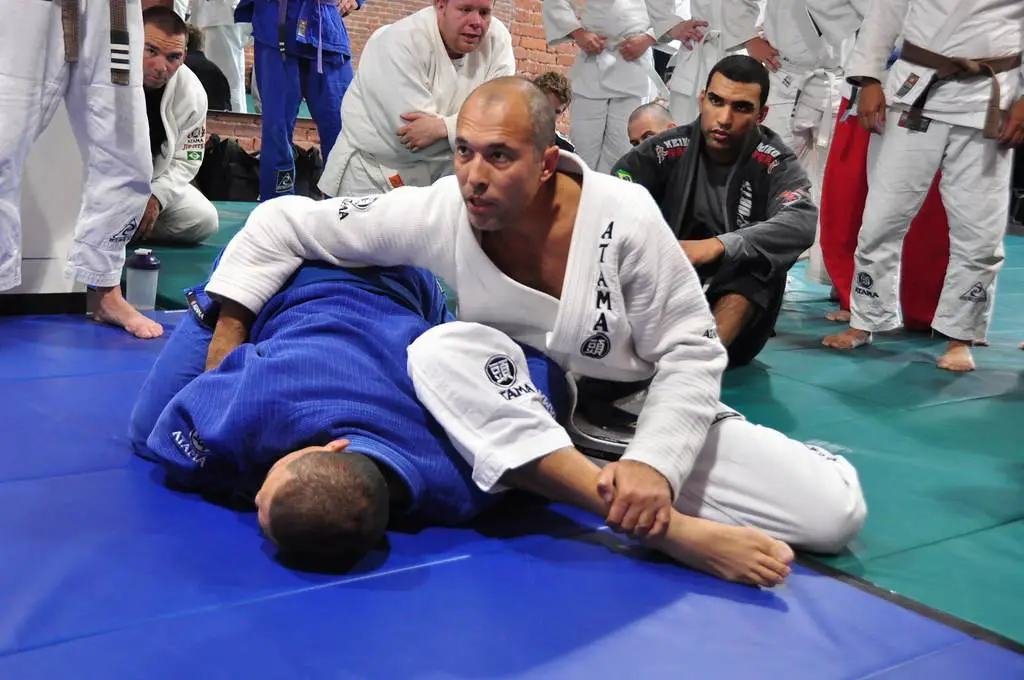
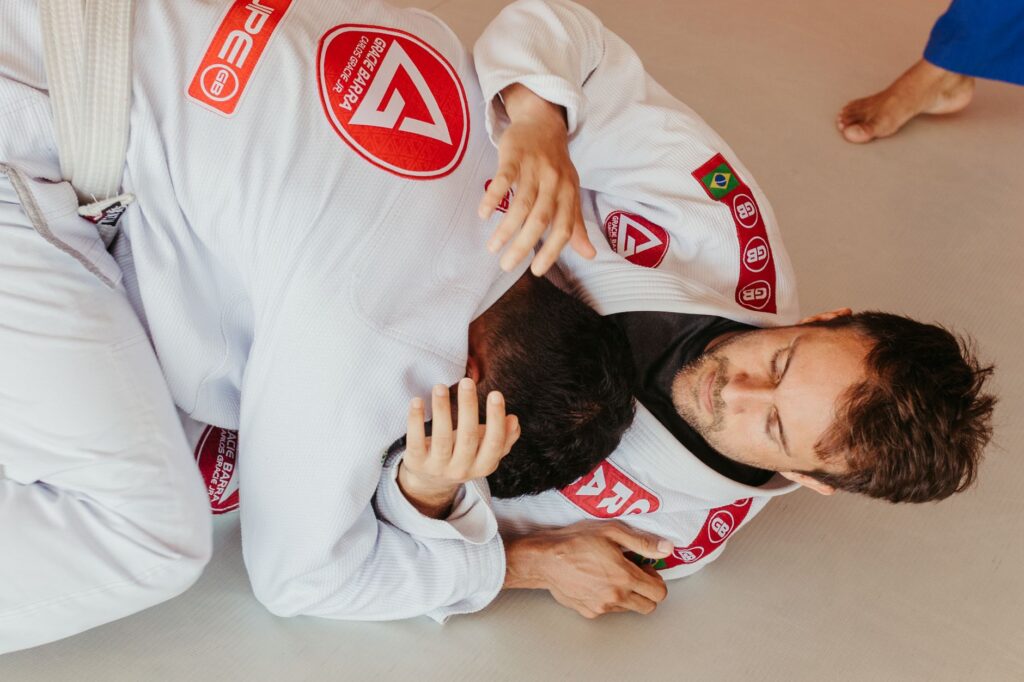
Quick answer: the triangle choke is a blood choke applied with the legs in a figure-four, trapping the opponent’s head and one arm. It works by closing both carotid arteries at once — their own trapped shoulder compresses one side, your hamstring and calf compress the other — which is why it finishes even when it feels loose. In GrapplerHQ’s dataset of 8,591 UFC bouts, the triangle accounts for 114 of 1,659 submission finishes (6.9%), making it the fifth most common submission in UFC history. It is legal at every IBJJF belt in both gi and no-gi.
Last updated: July 29, 2026. The UFC figures on this page come from our own analysis of 8,591 bouts (1994–2026) — methodology in the UFC statistics study. Legality is taken from the official IBJJF rule book and illegal-moves table.
The triangle is the submission most people attempt badly for years before it starts working. The mechanics are not intuitive: it looks like you are squeezing with your legs, and you are mostly not. Understanding what actually closes the arteries is the difference between a triangle that gets stacked and passed, and one that finishes in four seconds.
Triangle choke at a glance
| Question | Answer |
|---|---|
| Type | Blood choke (strangle) — not an air choke |
| What closes the artery | Their own shoulder on one side, your leg on the other |
| Japanese name | Sankaku-jime — “triangle strangle” in judo |
| UFC finishes | 114 — 6.9% of all UFC submissions, 5th most common |
| Primary positions | Closed guard, open guard, mount, side control (variations) |
| IBJJF legality | Legal at every belt, gi and no-gi |
| Common failure | Finishing straight-on instead of changing the angle |
How the triangle choke actually works
The triangle is a blood choke: it stops blood reaching the brain through the carotid arteries, rather than stopping air through the windpipe. That distinction matters because it tells you where the pressure has to go — the sides of the neck, not the front.
Free every Tuesday
The Grappler Brief
The week’s biggest stories from BJJ, judo, wrestling, and submission grappling—curated for people who train.
Sent out weekly.Opt out anytime.
The configuration is what makes it unusual. One of the opponent’s arms is inside the triangle and one is out. The trapped arm is not a bystander — it is half the choke. Their own shoulder is pressed into one side of their neck, and your hamstring and calf close the other. You are not squeezing a neck between two legs; you are closing a vice where one jaw is made of their own body.
This explains the single most common beginner error. If both arms are inside, or both are outside, there is nothing pressing the far carotid and the choke will not work no matter how hard you squeeze. It also explains why a triangle that feels loose can still finish: correct structure beats effort.
How common is the triangle choke? UFC data
We analysed the finishing technique of every submission in a snapshot of 8,591 UFC bouts covering March 1994 to March 2026. Submissions ended 1,659 bouts — 19.3% of all fights. Here is where the triangle sits.
| Rank | Submission | UFC finishes | Share of submissions |
|---|---|---|---|
| 1 | Rear-naked choke | 648 | 39.1% |
| 2 | Guillotine choke | 293 | 17.7% |
| 3 | Armbar | 195 | 11.8% |
| 4 | Arm-triangle choke | 126 | 7.6% |
| 5 | Triangle choke | 114 | 6.9% |
| 6 | D’Arce choke | 47 | 2.8% |
| 7 | Kimura | 43 | 2.6% |
| 8 | Anaconda choke | 38 | 2.3% |
Two things are worth pulling out. First, the triangle and the arm-triangle together account for 14.5% of UFC submissions — one in seven — despite being different techniques that beginners routinely confuse. Second, the triangle is the highest-ranked submission on this list that is attacked primarily from the bottom. Everything above it is a top-position or back attack.
Types of triangle choke
| Variation | Where from | Notes |
|---|---|---|
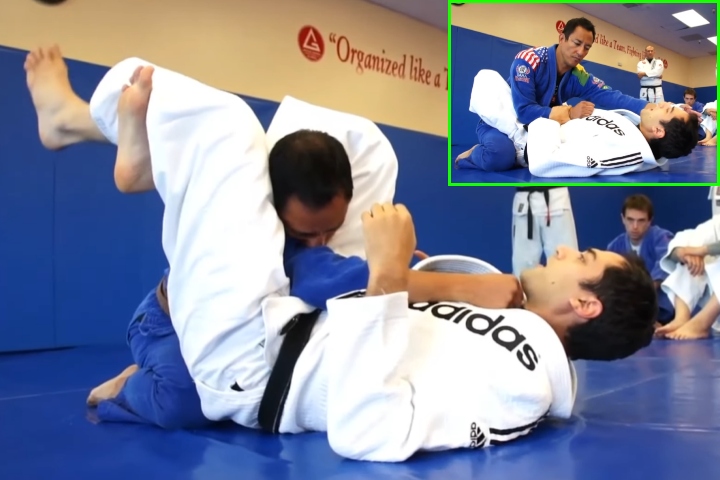
| Classic (front) triangle | Closed or open guard | The standard version; opponent’s head and one arm trapped from the bottom |
| Side triangle | Side control, top | Applied from the top with the legs configured across the body |
| Reverse triangle | Side control, back | Legs reversed relative to the classic; often a transitional finish |
| Mounted triangle | Mount | Locked from mount, very hard to escape; often paired with an armbar threat |
| Inverted triangle | Back control | Attacked while taking or holding the back |
Judo classifies the family as sankaku-jime and distinguishes front, side and rear entries in the same way. The arm-triangle choke is a different technique despite the similar name — it is applied with the arms from top position, not with the legs.
Finishing the triangle: the five details
- One arm in, one arm out. Non-negotiable. If you cannot get the configuration, you do not have a triangle.
- Change the angle. This is the detail that separates finishers from attempters. Pivot perpendicular to the opponent rather than finishing square — the choke tightens enormously and the stack defence stops working.
- Pull their trapped arm across. Dragging the arm over the centreline puts their shoulder onto their own carotid. Most “loose” triangles are missing only this.
- Lock properly. Knee-over-ankle, not ankle-over-ankle. The figure-four is a structure, not a squeeze.
- Break their posture and pull the head. Posture is the escape. Head control plus a curled hamstring finishes it.
Why triangles fail
| Symptom | Cause | Fix |
|---|---|---|
| They posture up and stack you | Finishing square-on | Change the angle before squeezing |
| Choke feels loose, no reaction | Trapped arm not pulled across | Drag the arm past the midline |
| Your legs tire and it slips | Squeezing instead of structuring | Lock knee-over-ankle, curl the hamstring |
| They pull the trapped arm free | No control on the wrist or head | Grip the arm and the head together |
| They pass while you hold it | Chasing the finish over position | Re-guard or switch to the armbar |
Note the last row. The triangle, armbar and omoplata form a natural attack chain from the same starting configuration — if they defend one by extending or turning, another opens. Treating them as a system rather than three separate submissions is the standard progression from blue belt onward.
Gi vs no-gi
The triangle transfers between formats better than almost any other submission because it uses no cloth at all — the choke is made of legs and their own shoulder. What changes is the setup. In the gi, grips slow the opponent down and give you time to build the position; in no-gi, sweat makes the entry faster but the head easier to pull free, so the angle change matters more.
Legally nothing changes at all. The triangle does not appear on the IBJJF’s 26-technique illegal-moves table, so it is available at every adult belt in both formats — one of the short list of submissions with no rank restriction whatsoever. Our gi vs no-gi guide covers exactly which techniques do change between the two.
Defending the triangle
- Prevent it: do not leave one arm in and one arm out. Either both hands on the hips, or both arms inside.
- Early: posture up immediately and drive the trapped elbow across to your own side before the lock is complete.
- Locked but not angled: stack — drive forward over them and walk your hips up. This is why the attacker must change the angle first.
- Deep and angled: tap. A well-applied triangle closes both carotids and unconsciousness follows quickly; there is no reward for waiting.
FAQ
Is the triangle choke effective?
Yes — it is the fifth most common submission in UFC history, with 114 finishes across our 8,591-bout dataset (6.9% of all submissions). It is also the highest-ranked submission on that list attacked primarily from the bottom, which makes it the most reliable finish available to a guard player.
Does a triangle choke hurt?
A correctly applied triangle should not be painful — it is a blood choke, so the sensation is pressure and rapidly fading consciousness rather than sharp pain. Pain usually means it is being applied badly, often as a neck crank on the spine instead of a strangle on the arteries. Tap either way.
What is the strongest choke in BJJ?
By competition results, the rear naked choke — 648 UFC finishes, 39.1% of all submissions, nearly four times the triangle. It has no cloth requirement and comes from the most dominant position in grappling. The triangle’s advantage is that it works from underneath, which the rear naked choke does not.
Why can’t I finish my triangle?
Almost always the angle or the trapped arm. Finishing square-on lets the opponent stack and pass; leaving their arm on the centreline means their shoulder is not compressing their own carotid. Change the angle, pull the arm across, then squeeze.
Is the triangle choke legal in competition?
Under IBJJF rules, yes — at every adult belt in both gi and no-gi. It does not appear on the illegal-moves table, unlike knee bars and toe holds (brown and black belts only) or heel hooks (adult brown and black, no-gi only).
What is a triangle choke called in judo?
Sankaku-jime, meaning “triangle strangle.” Judo recognises the same family of front, side and rear entries, and judo’s ground-work restrictions are the main reason the technique is developed further in BJJ than in judo competition.
Bottom line
The triangle finishes because of structure, not strength: one arm in, one arm out, their shoulder on one carotid and your leg on the other. Change the angle and pull the trapped arm across, and it works on people much stronger than you. It is the fifth most common submission in UFC history and the best finish available from the bottom — and it is legal at every belt in both formats. Pair it with the armbar and the kimura to build a complete guard attack.
Sources
- GrapplerHQ UFC submissions dataset — 8,591 bouts (1994-03-11 to 2026-03-28), 1,659 submission finishes classified by technique from the UFC-DataLab raw details field. Methodology and limitations in our UFC statistics study.
- IBJJF Rule Book and Technical Fouls & Illegal Moves table — submission legality by belt