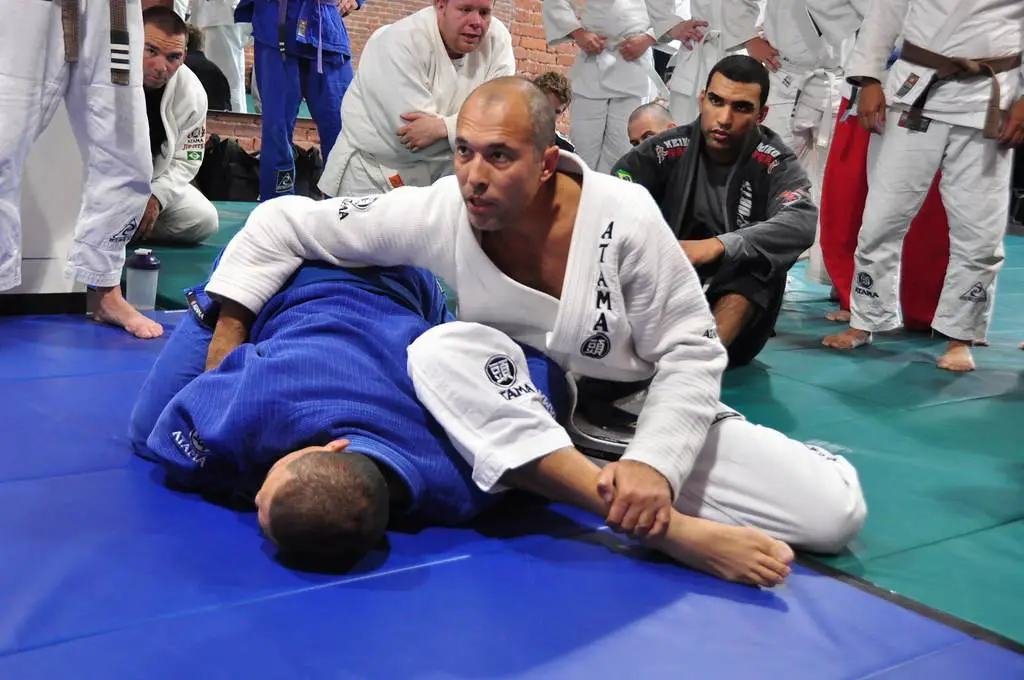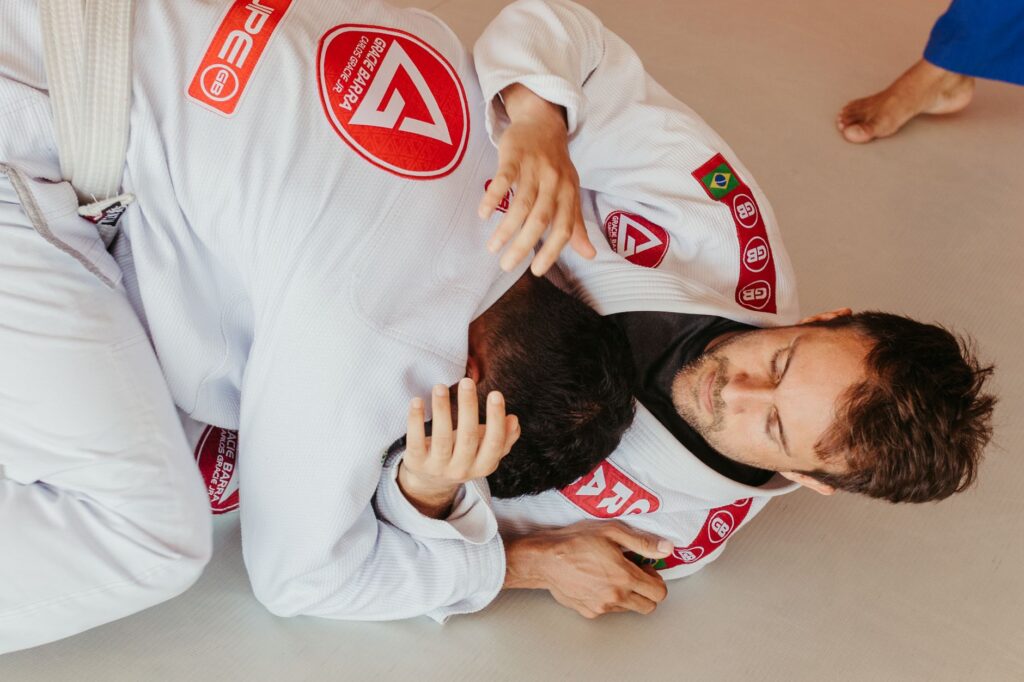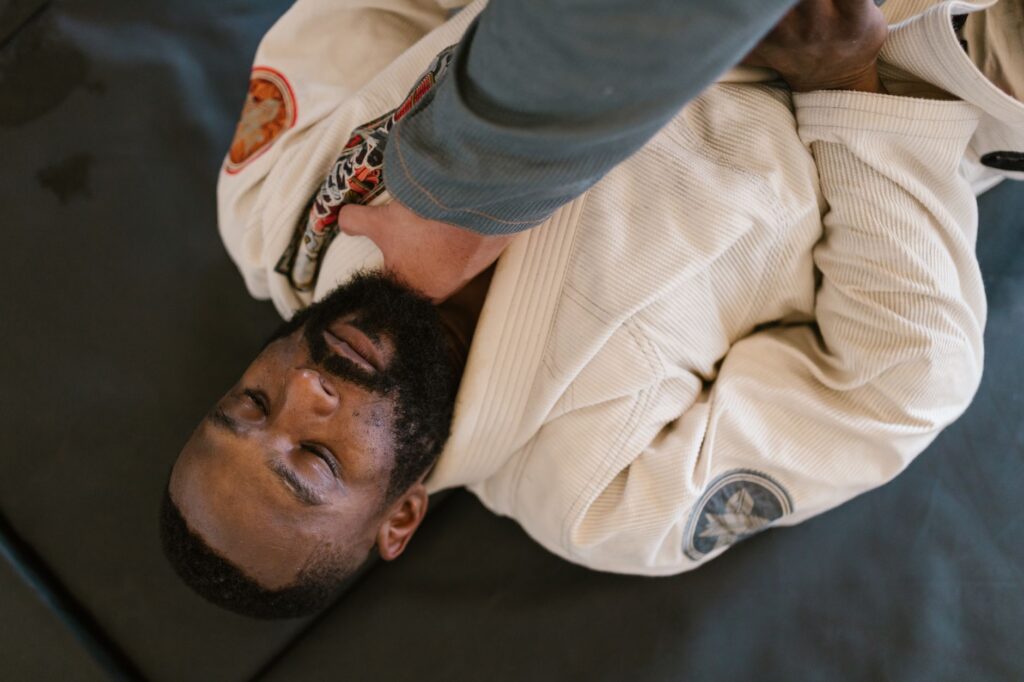
Quick answer: The pendulum sweep uses the swinging momentum of your own legs to reverse an opponent from closed guard: one leg swings down and under like a pendulum’s weight while the other rises over their shoulder line, converting the swing’s energy into the roll that puts you in mount. It thrives on an opponent whose weight is pressing forward, and it lives one motion away from the armbar — most pendulum sweeps in live rolling begin as armbars that met resistance.
This guide is educational. Drill with qualified coaching, apply pressure gradually, tap early, and release immediately when a partner taps or cannot communicate clearly.
| Detail | Pendulum sweep summary |
|---|---|
| Technique family | Closed guard sweep (momentum-based) |
| Trigger | Forward pressure, or resistance to your armbar |
| Engine | Leg swing momentum + hip elevation, more than grips |
| Scoring | 2 points once reversed and stabilized (IBJJF-style) |
What is the pendulum sweep?
The pendulum sweep is the momentum member of the closed guard sweep family. Where its sibling the flower sweep removes the opponent’s posts with grips (sleeve plus pant leg), the pendulum generates so much rotational energy with the legs that a partially-based opponent gets carried over anyway. One leg swings down toward the mat and under your own body; the opposite leg rises across their shoulder line; your hips lift on an underhooked thigh or armpit — and the accumulated swing tips them over the corner where their trapped arm cannot post.
The naming overlaps: many gyms call this exact movement a flower sweep, and nothing of substance hangs on the label. What matters is recognizing the two engines — grips versus momentum — because they suit different moments and different rulesets. Sweaty no-gi rounds, where pant grips do not exist, are pendulum territory.
Free every Tuesday
The Grappler Brief
The week’s biggest stories from BJJ, judo, wrestling, and submission grappling—curated for people who train.
Sent out weekly.Opt out anytime.
How the pendulum sweep works, step by step
- Control the arm on the sweep side — sleeve, wrist, or an overhook. As with every guard sweep, the falling-side post must already be spoken for.
- Underhook the far thigh or armpit with your other arm to connect your swing to their body — without this connection the momentum stays yours.
- Swing the pendulum: open the guard, drop the sweep-side leg down and under your body in an arc, and let your hips follow it upward. The swing and the hip lift are one motion, not two.
- Rise over the top: your opposite leg climbs their shoulder line as they tip, and you ride the rotation into mount — or, if their arm surfaced during the roll, straight into the armbar.
The armbar connection
The pendulum’s leg path is the armbar’s leg path. Swing the leg over the face instead of across the shoulder and the same momentum finishes an armbar; meet too much resistance mid-armbar and letting the swing continue turns the failed submission into the sweep. This is why coaches drill them as one technique with two exits: the opponent’s posture decides which one you keep. Attack the arm when they lean back, sweep when they drive in — the pendulum makes the choice for you at the moment their weight commits.
Common mistakes
| Mistake | Why it fails | Better cue |
|---|---|---|
| Swinging with the hips glued to the mat | The pendulum has no pivot; energy goes nowhere | Hips rise with the swing — think “legs throw the hips” |
| No connection to their body | You rotate beautifully, alone | Underhook the thigh or armpit before the swing starts |
| Sweeping against backward lean | Their weight is moving exactly against your rotation | Backward lean is hip-bump territory — swap sweeps, not effort |
| Half-hearted swing | Momentum techniques scale badly at 60% | Commit fully or set it up again — the pendulum is all-or-nothing |
How opponents defend it
- Posture and base back — kills the rotation, and hands you the hip-bump’s trigger instead.
- Wide knee on the sweep side — blocks the roll’s exit lane; the flower sweep’s pant grip exists precisely to prevent this in the gi.
- Pulling the trapped arm free early — the correct defense, and the reason arm control comes first in the sequence, not mid-swing.
- Stacking your hips down — smothers the pendulum, but parks their weight forward where the armbar and triangle live. Nothing is free.
Scoring and competition context
The pendulum scores like any guard sweep under the IBJJF-style points system: 2 points for the reversal once stabilized, with mount’s 4 usually available on landing. Because it needs no cloth, it translates cleanly to no-gi and MMA — and because it doubles as an armbar entry, referees and judges see it as offense even when the sweep itself is defended. Check event specifics in the BJJ rules and scoring guide.
Safety and training notes
- The swinging leg passes near the opponent’s head — control the arc in drilling; heel-to-face contact is the pendulum’s classic training-room accident.
- Armbar exits arrive with momentum — extend the elbow gradually when the sweep converts, because the swing has already loaded the joint.
- Full-commitment reps tire the hip flexors fast — rotate partners and sides rather than grinding one hip.
Stop if a partner reports unusual pain, numbness, or trouble breathing beyond normal positional discomfort. This article does not diagnose injuries; seek qualified medical care for concerning or persistent symptoms.
Examples to study
- Classic Brazilian closed-guard stylists in gi competition: the pendulum-armbar pairing was a defining weapon of the old-school game — watch how the swing begins before the opponent’s defense chooses which ending they get.
- No-gi closed guard exchanges: when pant grips vanish, watch how the underhooked-thigh pendulum replaces the flower sweep entirely — same family, different engine.
Related GrapplerHQ guides
Sources and further reading
- IBJJF Books and Videos — current rules materials
- ADCC Rules and Regulations
- Injury prevalence among BJJ practitioners — PubMed
FAQ
Is the pendulum sweep the same as the flower sweep?
Many gyms use the names for the same technique. Where a line is drawn: the flower sweep removes posts with a pant grip, the pendulum relies on leg-swing momentum — which is why the pendulum is the no-gi version of the pair.
When does the pendulum sweep work best?
Against forward pressure — an opponent driving into your guard feeds the rotation. Against backward lean, switch to the hip-bump sweep instead of forcing it.
Why does my pendulum sweep only move them halfway?
Usually grounded hips or a missing underhook. The swing must lift your hips off the mat, and your arm must connect the rotation to their body — momentum without connection is just kicking.
Should I learn the armbar or the pendulum sweep first?
Together — they are one leg movement with two endings. Drilling them as a pair teaches the posture read that decides between them, which is the actual skill.
Bottom line
The pendulum sweep is stored energy: legs swing, hips rise, opponent rides the arc you built. Connect to their body first, commit to the full swing, and aim it at forward pressure — and remember it shares a skeleton with the armbar, so every defended sweep is a submission attempt in progress, and every stuffed armbar still has a sweep inside it.