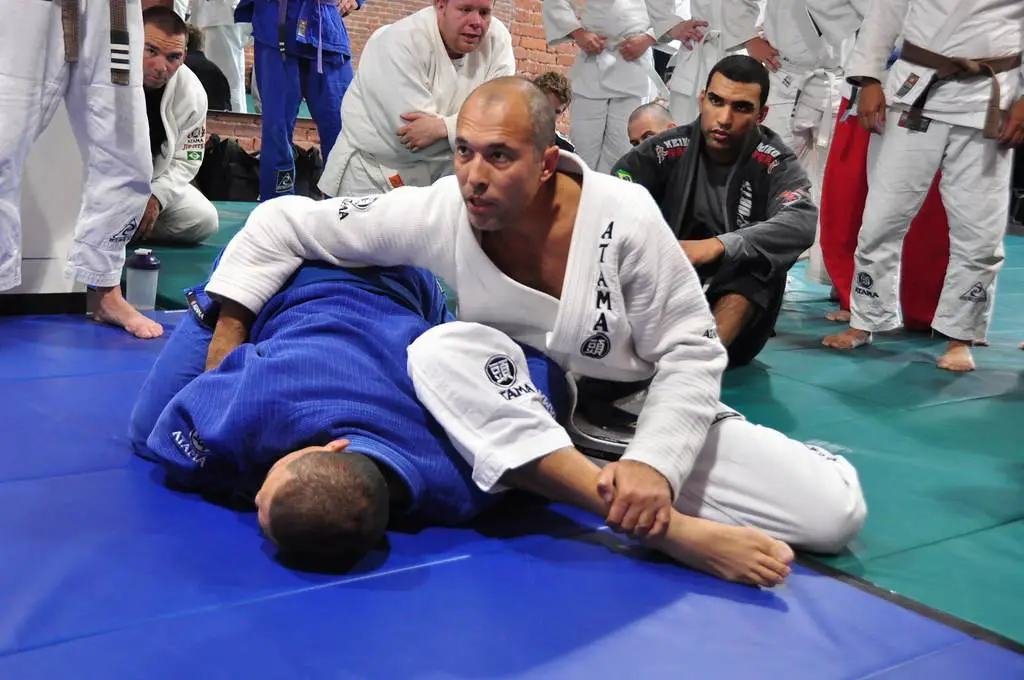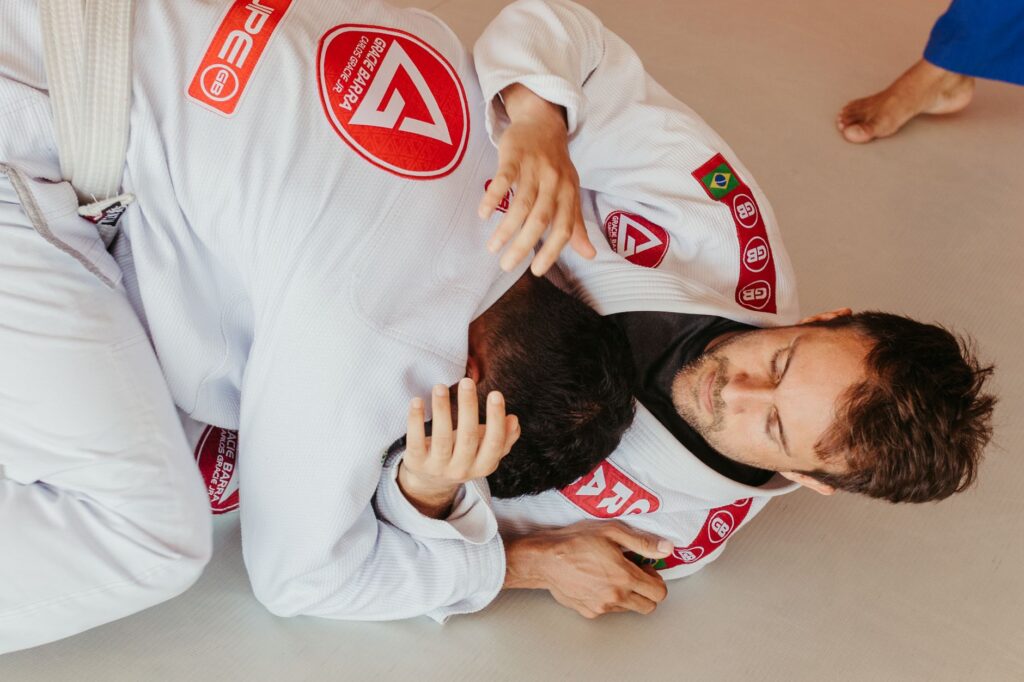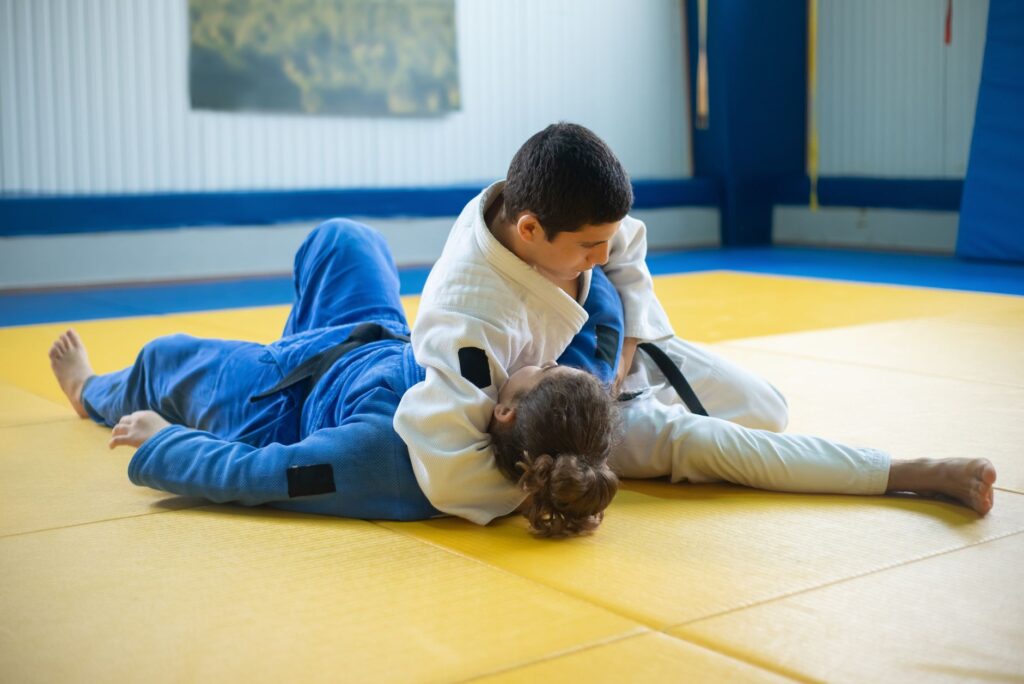
Quick answer: The flower sweep reverses an opponent from closed guard by controlling one sleeve and the opposite pant leg at the knee, then swinging your leg up toward their far shoulder to tip them diagonally over the shoulder line where they have no post. It scores 2 points, usually lands in mount, and shares its finishing angle with the armbar — which is why the two are taught as a pair. Many gyms use “flower sweep” and “pendulum sweep” interchangeably; the useful distinction is the grip on the pant leg versus the momentum swing.
This guide is educational. Drill with qualified coaching, apply pressure gradually, tap early, and release immediately when a partner taps or cannot communicate clearly.
| Detail | Flower sweep summary |
|---|---|
| Technique family | Closed guard sweep |
| Key grips (gi) | Sleeve on one side + pant grip at the opposite knee |
| Sweep direction | Diagonal, over the shoulder on the sleeve side |
| Built-in partner | The armbar — same angle, same leg swing |
What is the flower sweep?
The flower sweep is a closed guard reversal built on a simple insight: an opponent kneeling in your guard has posts at four corners — two hands, two knees — but nothing guarding the diagonal lines between them. Capture a sleeve (removing one hand post) and the opposite pant leg at the knee (removing the diagonal knee post), and the lane between those two corners is open. Your legs then tip them along it.
On naming: this sweep overlaps heavily with the pendulum sweep, and plenty of respected coaches use the names for the same movement. Where a distinction is drawn, it is usually this: the flower sweep emphasizes the pant grip that removes the knee post, while the pendulum emphasizes the swinging leg momentum — often without the pant grip, and often arriving from a failed armbar. This page covers the grip-based version; the momentum version has its own guide.
Free every Tuesday
The Grappler Brief
The week’s biggest stories from BJJ, judo, wrestling, and submission grappling—curated for people who train.
Sent out weekly.Opt out anytime.
How the flower sweep works, step by step
- Grip the sleeve on the side you will sweep toward — their hand must not be able to post.
- Grip the opposite pant leg at the knee, palm down. This is the sweep’s signature: that knee can no longer step out to base.
- Open the guard and swing: the leg on your sleeve side swings high toward their far shoulder — up and across, not sideways — while your other leg chops into the gripped knee’s thigh.
- Tip along the diagonal: they fall over the shoulder where the sleeve is trapped, and your swing carries you up into mount.
The direction matters more than the power. Straight sideways runs into their knee; straight backward runs into their base. The line that works is the diagonal from their trapped knee through their trapped shoulder — the “corner” with nothing left to catch them.
When the moment appears
- When they reach across your body — the crossing arm hands you the sleeve grip and the angle at once.
- When they kneel wide for base — a wide knee is an easy pant grip and an already-compromised post.
- Off the armbar threat: when they pull the arm back and lean away from your armbar attempt, their weight moves exactly onto the flower sweep’s line. This armbar-sweep pairing is the position’s classic dilemma.
Common mistakes
| Mistake | Why it fails | Better cue |
|---|---|---|
| Sweeping straight sideways | Their free knee catches everything on that line | Swing toward their far shoulder — diagonal, not lateral |
| Forgetting the pant grip | The knee steps out and rebuilds base mid-sweep | No pant grip, no flower sweep — that grip is the technique |
| Swinging with a closed guard | Your own locked ankles kill the leg swing | Open the guard as the swing starts — the timing is one beat |
| Staying flat on your back | No hip elevation means no tipping force | Get your hips off the mat and under the swing |
How opponents defend it
- Posting the head or free hand far side — which extends them and feeds the armbar and triangle on the trapped side.
- Pulling the gripped knee back and posturing — which reopens your guard game at neutral; nothing lost.
- Driving forward into you to smother the swing — which loads their weight onto your hips, the exact condition the pendulum-style momentum version punishes best.
- The pattern: every defense concedes either the arm, the posture battle, or forward pressure. The sweep is one prong of a fork, and it is the fork that scores.
Scoring and competition context
A completed flower sweep scores 2 points under the IBJJF-style points system — reversal from guard, stabilized on top for roughly 3 seconds — and its natural landing in mount sets up 4 more. It is primarily a gi technique in its full form, since the pant grip is the signature; no-gi versions substitute a knee cup or inside-thigh control, trading security for slipperiness. Event rules vary; see the BJJ rules and scoring guide.
Safety and training notes
- Partners fall diagonally and fast when the sweep lands clean — clear the landing zone before drilling reps.
- The pant-grip knee takes lateral force — sweep with the chop against the thigh, not a yank against the joint line.
- Drilling the armbar-sweep pairing means arms get extended — swap slow, controlled reps between both attacks and tap early on the armbar side.
Stop if a partner reports unusual pain, numbness, or trouble breathing beyond normal positional discomfort. This article does not diagnose injuries; seek qualified medical care for concerning or persistent symptoms.
Examples to study
- Classic gi closed-guard matches at black belt: watch for the armbar-flower fork — the sweep almost never appears alone, and the best players sell the armbar hard enough that the sweep feels like a gift.
- Instructional breakdowns of the diagonal line: the detail that separates working flower sweeps from failing ones is always where the swing points — far shoulder, every time.
Related GrapplerHQ guides
Sources and further reading
- IBJJF Books and Videos — current rules materials
- ADCC Rules and Regulations
- Injury prevalence among BJJ practitioners — PubMed
FAQ
What is the difference between the flower sweep and the pendulum sweep?
Often nothing — many schools use the names interchangeably. Where they are distinguished, the flower sweep uses a pant grip at the knee to remove the base post, while the pendulum relies on leg-swing momentum and commonly arrives out of a failed armbar.
Does the flower sweep work in no-gi?
Partially. The sleeve becomes wrist control and the pant grip becomes a knee cup or inside-thigh block, which slips more under sweat. The diagonal principle still applies, but no-gi players often prefer the momentum-based pendulum version.
Why do I fall short and end up in half guard instead of mount?
Your swing is stopping instead of carrying you up. The same leg that tips them is supposed to ride the rotation onto top — swing through the sweep, not just at it. Landing in half guard still scores the 2, though.
What submissions pair with the flower sweep?
The armbar above all — same grips, same angle, opposite direction of their resistance. The triangle appears when they posture out of both.
Bottom line
The flower sweep is geometry: two posts captured, one diagonal lane open, legs to carry them down it. Grip the sleeve and the opposite knee, swing at their far shoulder, and arrive in mount with 2 points banked. And never sell it alone — the armbar on the same grips is what makes opponents fall into it.