Quick answer: an IBJJF masters division is an age band for competitors aged 30 and up, calculated by subtracting your birth year from the tournament year, not by your birthday. Master 1 starts at 30 and the brackets run Master 1 through Master 7 at 61 or older in five-year bands. Masters use the same weight limits as adult, and masters matches are 5 minutes regardless of belt (Master 1 runs 6 minutes for purple, brown and black). Masters athletes can register in a younger division, so a Master 2 can enter Master 2, Master 1 or Adult. Check the Belt & Age Divisions table on your specific event page before registering.
Last updated: November 11, 2026 (Pacific). Sources checked November 11, 2026.
This guide explains the IBJJF Masters age divisions in depth: the birth-year math, the seven Master brackets, how masters competition differs from adult, and the belt and rule caveats that trip people up. It complements — not duplicates — GrapplerHQ’s IBJJF age divisions guide (which covers kids, juveniles and adult in one chart) and your IBJJF weight classes guide.
IBJJF masters divisions at a glance
| Question | Answer |
|---|---|
| Who is a masters athlete? | Anyone aged 30 or older by the competition-year calculation |
| How is age counted? | Tournament year minus birth year, not your birthday or the match date |
| How many masters divisions? | Seven: Master 1 (30+) through Master 7 (61+) |
| Weight classes | Same adult weight limits — there is no separate lighter masters chart |
| Match length | 5 minutes for all masters belts; Master 1 runs 6 minutes for purple, brown and black. Finals run double. |
| Can masters register younger? | Yes, down to Adult. The reverse (registering older) is not allowed |
| Where to confirm | The Belt & Age Divisions table on your event page |
What is an IBJJF masters division?
In the official IbJJF rule book, age divisions are defined by the age an athlete is or will be during the year of a given tournament — the rule book’s formula is (Current Year) − (Birth Year). There is no maximum age for the adult and master divisions, but there is a minimum. Adult starts at 18, and the first masters division starts at 30.
Free every Tuesday
The Grappler Brief
The week’s biggest stories from BJJ, judo, wrestling, and submission grappling—curated for people who train.
Sent out weekly.Opt out anytime.
Today’s IbJJF rule book and event registration call these brackets Master 1 through Master 7. Older event documents and some other promotions have used the word “senior” for the 30-and-up bracket, but the current IbJJF rule book uses “Master,” so you are not looking at a different rule if you see both terms — the two describe the same idea.
Masters is about your age band, not your belt or your skill level. Belt, weight, sex, and gi or no-gi format are chosen separately, layered on top of your master age division.
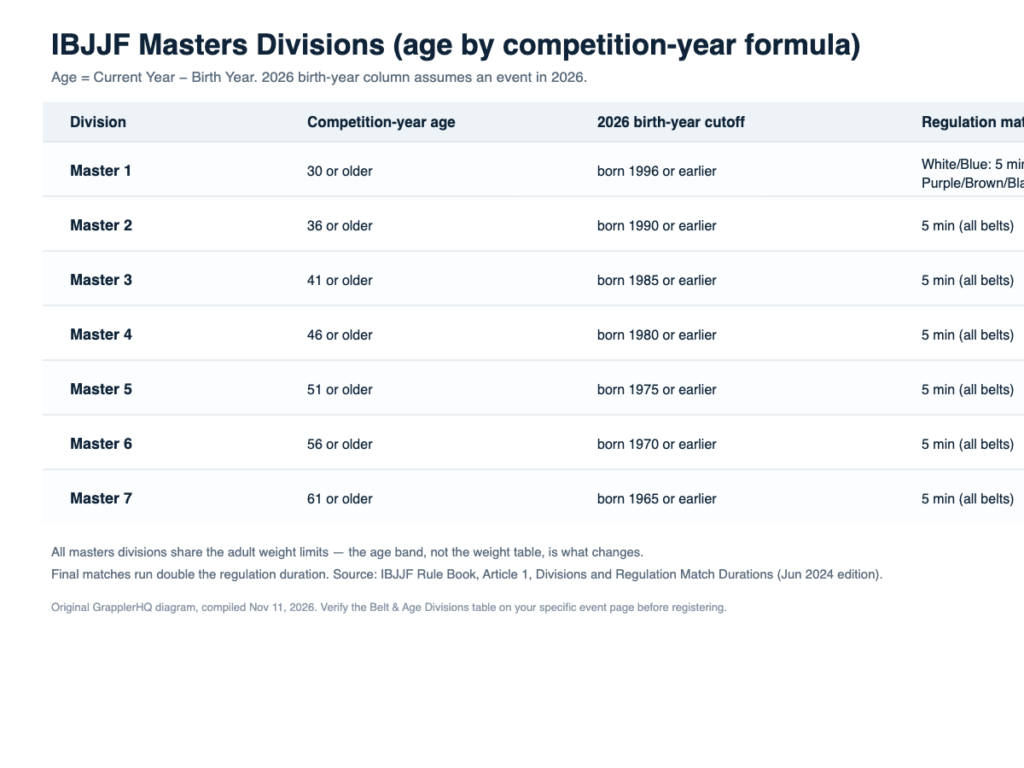
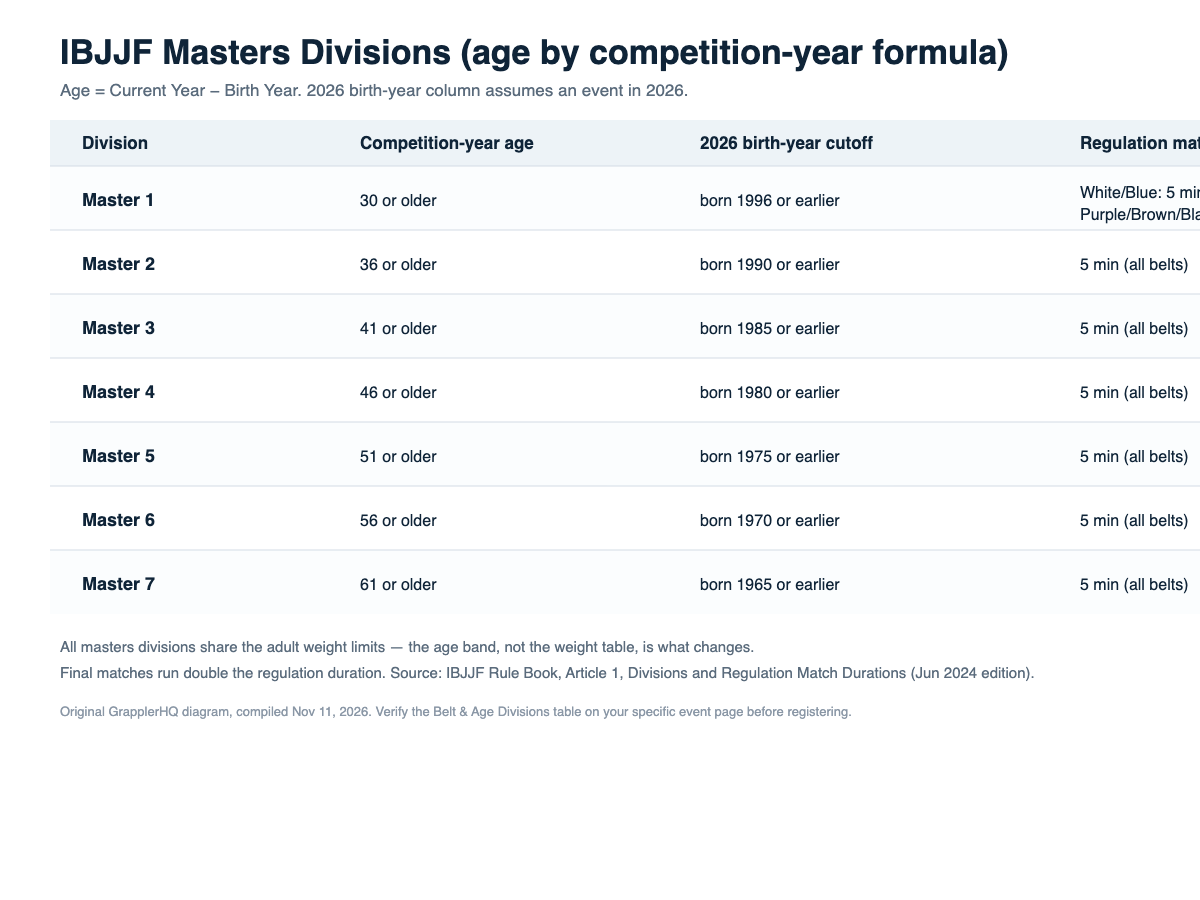
IBJJF masters divisions chart (Master 1 to Master 7)
The table below follows the official IbJJF rule book division table, with the birth-year cutoff computed for a 2026 event.
| Division | Competition-year age | 2026 birth-year cutoff | Regulation match (up to semifinals) |
|---|---|---|---|
| Master 1 | 30 or older | Born 1996 or earlier | White/Blue: 5 min; Purple/Brown/Black: 6 min |
| Master 2 | 36 or older | Born 1990 or earlier | 5 min (all belts) |
| Master 3 | 41 or older | Born 1985 or earlier | 5 min (all belts) |
| Master 4 | 46 or older | Born 1980 or earlier | 5 min (all belts) |
| Master 5 | 51 or older | Born 1975 or earlier | 5 min (all belts) |
| Master 6 | 56 or older | Born 1970 or earlier | 5 min (all belts) |
| Master 7 | 61 or older | Born 1965 or earlier | 5 min (all belts) |
The weights you register in come from the adult chart, not a separate masters table — see IBJJF weight classes, where masters and adult share identical limits. Your age band and your weight class are two separate choices.
How to find your IBJJF masters age division
Work backward from the competition year. For a 2026 event, subtract your birth year from 2026. If the result is 30 or more, you are eligible for a masters division:
- Born 1996 → 2026 − 1996 = 30 → Master 1
- Born 1990 → 2026 − 1990 = 36 → Master 2
- Born 1985 → 2026 − 1985 = 41 → Master 3
- Born 1980 → 2026 − 1980 = 46 → Master 4
- Born 1975 → 2026 − 1975 = 51 → Master 5
- Born 1970 → 2026 − 1970 = 56 → Master 6
- Born 1965 → 2026 − 1965 = 61 → Master 7
Your exact birthday does not change the result: IbJJF uses the age you are (or will be) during the tournament year, not the date of the match. A competitor born in December 1996 still counts as 30 for any 2026 event.
If the lowest master division a competitor fits (Master 1 at 30) does not exist for their belt or event, or they want a different experience, read the register-younger rule below before assuming they are stuck.
Masters vs Adult: what actually changes
Three things matter most when you leave the adult division for masters:
1. Matches are shorter and belt-based differences shrink
Adult matches scale by belt — the rule book lists white, blue, purple, brown and black at 5, 6, 7, 8 and 10 minutes up to semifinals. Masters is flatter: every master division runs 5 minutes for all belts, except Master 1, which runs 5 minutes for white/blue and 6 minutes for purple/brown/black. Semifinals use these durations; final matches run double.
2. You can register in a younger division
IbJJF’s official championship guidance says masters athletes can register in lower age divisions. A Master 2 can register in Master 2, Master 1 or Adult; a Master 1 can register in Master 1 or Adult. The reverse does not work — a Master 1 cannot move up into Master 2 or higher. Event availability can still vary, so the event page is the final word.
3. Weight classes stay the same
Masters athletes weigh in on the same adult limits, so there is no lighter masters weight chart to learn. If you are boundary close to a limit, the worked examples in GrapplerHQ’s IBJJF weight classes guide apply exactly.
Belts in masters divisions
Masters divisions are offered across the adult belt range — white, blue, purple, brown and black each have their own master brackets in most IbJJF events. Belt and age work together, so a 45-year-old blue belt competes in the Master 3 blue-belt bracket, not a combined “master” free-for-all.
The one belt-related caveat to know is on the official illegal-moves poster. Its most permissive column is labelled “Adult (brown & black belts)”, while masters are grouped in the earlier columns (for example, “white belts [Adult to Master 7]” and “Adult to Master 7 [blue & purple belts]”). Because the brown/black column names Adult rather than Master, a masters brown or black belt should not assume they automatically get every allowance from the adult brown/black column. Check how the tournament applies the current poster to masters before relying on an adult brown/black permission.
Masters rules caveats to keep handy
- White-belt rules still apply. Any masters white belt is grouped with white belts in every age group for rules such as the ban on jumping into closed guard against a standing opponent.
- Technique legality is belt-, age- and format-specific. For adults, the highest permissiveness sits in the brown/black column; masters are named in the lower columns, so do not extrapolate an adult brown/black allowance to masters.
- Gi vs no-gi matters. The illegal-moves poster separates gi and no-gi columns, and no-gi divisions weigh in under the lighter no-gi limits on the adult chart.
- Only one division per championship. IbJJF allows a single division registration per event, so pick the age, belt, weight and format combination once.
Common masters registration mistakes
| Mistake | Why it causes trouble | Better approach |
|---|---|---|
| Using your birthday instead of birth year | The birth-year formula can put you in a younger or older band than you expected | Subtract birth year from the tournament year, not from today |
| Assuming masters have their own weight chart | Masters use adult limits, so you register by the same chart | Check the adult/master weight chart on the event page and link the weight guide |
| Registering up instead of down | Masters can move to younger divisions, not older ones | A Master 1 cannot enter Master 2; a Master 2 may enter Master 2, Master 1 or Adult |
| Extrapolating the adult brown/black rules column to masters | The poster’s most permissive column names Adult, not Master | Confirm how the tournament applies the poster to your masters belt |
| Skipping the event page | Available divisions vary by championship and belt | Always read the Belt & Age Divisions table on your specific event page |
How to choose your IBJJF masters division
- Confirm your age band. Use the birth-year math above and find Master 1 through Master 7.
- Decide whether to register younger. If lower age divisions are available for your belt, weigh the competitive tradeoff with your coach — younger brackets are not automatically easier or wiser.
- Pick your weight class. Use the adult/master weight chart and GrapplerHQ’s weight classes guide.
- Confirm belt, format and legality. Review the IBJJF rules overview and the illegal-moves poster for your belt and age.
- Read the event page. Registration deadlines, available divisions and the Belt & Age Divisions table are the final authority for that event.
New to IBJJF registration entirely? Start with the IBJJF age divisions guide for the full picture, then use the IBJJF competition planner to lock down your birth-year lookup.
IBJJF masters divisions FAQ
What age is IBJJF Master 1?
Master 1 starts at competition-year age 30. For a 2026 event, that means born in 1996 or earlier.
Can a masters athlete compete in the adult division?
Yes. IbJJF says masters athletes may register in lower age divisions. A Master 2, for example, may enter Master 2, Master 1 or Adult. A Master 1 may enter Master 1 or Adult, but cannot move up into Master 2 or higher.
Do IBJJF masters divisions have different weight classes?
No. Masters use the same weight limits as adult in both gi and no-gi. Only the age band changes.
How long are IBJJF masters matches?
5 minutes for masters matches up to the semifinal, with finals running double. Master 1 is the one exception in the rule book: white/blue run 5 minutes and purple/brown/black run 6 minutes up to semifinals, with finals doubled.
Do masters get the same rule privileges as adult black belts?
Not automatically. The official illegal-moves poster labels its most permissive column “Adult (brown & black belts)” and groups masters in earlier columns. A masters brown or black belt should confirm how the tournament applies the current poster, not assume the adult brown/black column.
Bottom line
IBJJF masters is an age band, not a weight system. Use the tournament-year-minus-birth-year formula to find Master 1 through Master 7, register on the adult weight chart, and remember you can move to a younger division but not an older one. Verify the Belt & Age Divisions table on your specific event page — that is where the registration actually happens.
Sources
- IBJJF Books and Videos — links the official rule book and the Technical Fouls & Illegal Moves poster; page labels the rule book v6.0. Checked November 11, 2026.
- IBJJF Rule Book (Jun 2024) — Article 1 divisions and regulation match durations. The PDF pages carry “VERSION 6.1”; the final page also shows 6.2. Visually and text-inspected November 11, 2026; matches the v6.0 label on the Books and Videos page.
- IBJJF Technical Fouls & Illegal Moves poster (v4.0, Jan 2024) — illegal-moves columns by age and belt; checked November 11, 2026.
- IBJJF My First Championship — age-division rules and the masters register-younger rule; checked November 11, 2026.