Quick answer: stretching for BJJ is worth doing, but the honest version is modest. A short dynamic warm-up that includes movement through the hips, shoulders and spine does the most for a training session, and longer static stretches are better placed after class or on rest days than right before hard rounds. The evidence supports stretching for range of motion, but it does not support stretching as a reliable way to prevent injuries or reduce muscle soreness — that is mostly where strength training and sensible training load come in. This guide sets out what the research shows, where grapplers tend to feel tight, a simple mobility routine, and when to stretch around your schedule.
Last updated: November 11, 2026. Sources checked November 11, 2026 (UTC).
This article is educational and is not medical advice. It does not diagnose or treat any condition, and no stretch in this guide is a treatment for pain or injury. If you have symptoms, a diagnosed condition, a recent injury, or pain that does not settle, speak with a qualified healthcare professional and your coach before changing your training.
Stretching advice for grapplers usually comes in two flavors: the pre-class routine that never changes, and the everyone-must-touch-their-toes warm-up. Both miss the actual question, which is what you are stretching for and when it helps.
Free every Tuesday
The Grappler Brief
The week’s biggest stories from BJJ, judo, wrestling, and submission grappling—curated for people who train.
Sent out weekly.Opt out anytime.
BJJ stretching at a glance
| Question | What to know |
|---|---|
| Does stretching prevent injuries? | Mixed to none as a standalone tool; the best evidence favors strength training over stretching for injury prevention |
| Does stretching stop muscle soreness? | No meaningful effect in the Cochrane review on stretching before or after exercise |
| Best time for dynamic stretching / movement | Before class or competition, as part of a warm-up, within minutes of training |
| Best time for longer static holds | After class or on rest days, when you are not about to sprint or roll on them |
| Long static holds before training | Can cause small, temporary dips in power — not a reason to flush your routine, but a reason not to camp in one |
| Range of motion | All forms of stretching improve range of motion, typically for under 30 minutes per session |
| Where grapplers load most | Knees and shoulders top the injury data; hips, hamstrings and the lower back are where most people feel tight |
What the evidence actually says
Three reliable sources carry most of the weight here. The picture they paint is more useful and more practical than the old “stretch everything before you roll” advice.
The first is a 2016 systematic review in Applied Physiology, Nutrition, and Metabolism covering the acute effects of stretching on performance, range of motion and injury. Its numbers are specific: static stretching produced a small average performance drop (−3.7%), dynamic stretching a small average improvement (+1.3%), and the drop grew when static holds ran 60 seconds or more per muscle group. Range of motion improved with all forms, but the effect typically lasted less than 30 minutes. The review’s practical recommendation was to include dynamic movement after stretching within a warm-up.
The second is the Cochrane review on stretching and muscle soreness. Across 12 studies, stretching before, after, or before and after exercise did not produce a clinically important reduction in delayed-onset muscle soreness. The cooldown stretch that “prevents next-day soreness” is doing less than its reputation suggests — useful to wind down, but not a soreness treatment.
The third is a 2014 sports-injury meta-analysis in the British Journal of Sports Medicine with a striking result for grapplers. In 25 trials covering 26,610 athletes, stretching alone showed no meaningful injury-prevention effect, while strength training roughly halved overuse injuries and cut overall injuries to about a third of baseline. That is the single strongest reason this guide sits next to the site’s BJJ strength training guide: stretch for range of motion and mobility, and let quality strength work carry most of the injury-prevention load.
None of this means stretching is pointless. The honest pitch is modest: stretching builds range of motion, prepares you to move through the positions BJJ asks for, and feels good done well — it just is not “prevents ACLs.”
Where grapplers tend to feel tight
Grappling puts unusual demands on the body. You spend time in deep angles, folded hip positions, frames on the shoulder and spine, and long holds near the limits of joint range. The coach Steve Kesting has made the point directly on Grapplearts: the studies that poured cold water on stretching mostly came from runners moving through a small range of motion, while grapplers live at the limits of their range and can end up in contorted positions whether their own game needs flexibility or not.
The injury data points in the same direction for the areas that take the most load. A 2025 global survey of 881 BJJ practitioners found most injuries happen during training and sparring, with knees (about 25%) and shoulders (about 13%) the most commonly affected body regions. Tightness and injury are different things — the survey describes injuries, not stiffness — but it is a reasonable map of where grapplers should pay attention: hips, hamstrings and the lower back for the tightness most people feel, knees and shoulders for the load the sport actually dishes out.
Crucially, none of this converts into a claim that stretching a tight hip prevents a knee injury. If a joint, muscle or tendon genuinely hurts, is swollen, or fails to settle, that is a conversation for a healthcare professional, not a longer stretch.
A simple mobility routine
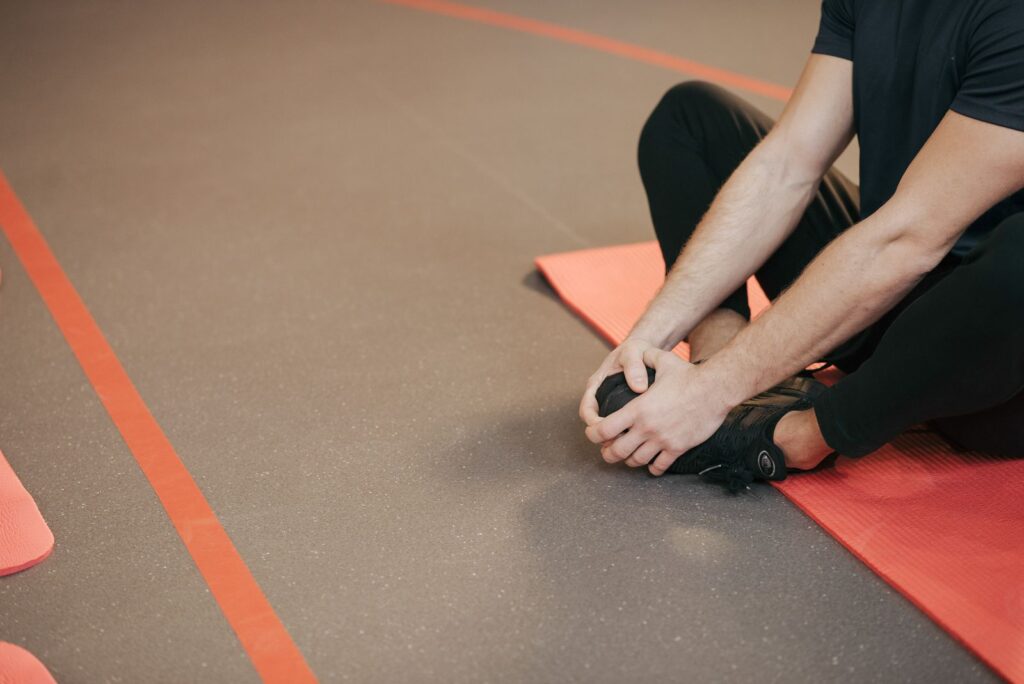
This is a plain, do-anywhere routine, not a prescription. It uses common positions most gyms already cycle through; the point is to move comfortably inside your range, not to force the deepest version of each position. A reasonable shape is 5–8 minutes before class (lighter, moving) or after class as a cooldown (longer holds, easier breathing). Stop before pain — mild stretch is normal, sharp or pinching sensation is not.
| Target | Movement | Cue |
|---|---|---|
| Hips | 90/90 or deep lunge stretch | Keep the front shin vertical-ish, sink gently, don’t bounce; switch legs |
| Hips / glutes | Figure-four or pigeon-style position | Square the hips when you can; breathe out to soften |
| Hamstrings | Seated or standing forward fold, soft knee | Bend the knees slightly so the back stays long; hinge from the hips |
| Lower back / spine | Cat–cow or a gentle seated twist | Move slowly with the breath; no forced rotation in the spine |
| Shoulders / chest | Overhead reach with a band or door-frame chest opener | Light traction, arm at a comfortable angle, no neck strain |
| Neck | Slow side-to-side and chin-tuck holds | Tiny, controlled ranges — the neck gets plenty of load in BJJ |
If you only take one thing from the routine, take the hip and shoulder work. Those are the two families the sport loads hardest, and they are the ones most people let stiffen up fastest.
When to stretch: before or after?
The before/after answer depends on what you want the stretch to do.
Before class: make it dynamic and brief. Walk tall, open the hips, swing the arms, do a few unloaded squats, then move straight into warm-up drilling. The evidence for dynamic stretching right before movement is positive and small; the evidence for long static holds before explosive or power work is a small, temporary dip. If you love a long static stretch before training, you do not have to delete it — the review’s numbers are small — but placing it after training usually costs you less.
After class or on rest days: longer static holds are easier to enjoy when you are not about to sprint, climb on the mats or roll. The soreness-prevention expectation is what the evidence weakens; the relaxation and range-of-motion value is what stays.
Breathing while you stretch
Breathing is the cheapest lever in the routine, and it is the part most people skip. The simple pattern, which Steve Kesting credits to yoga practice: breathe deeply and slowly; as you inhale, think of lengthening the spine; as you exhale, relax and settle a little deeper into the stretch. Repeat the cycle and stop before pain.
The breathing does two practical things for a grappler. It keeps you from holding tension in your neck and shoulders while you stretch, which is the exact habit BJJ rewards breaking. And it trains the slow, controlled exhale and relaxed posture under mild stress that carries straight into rolling.
How stretching and strength training fit together
The strongest finding in this whole topic is that strength training, not stretching, is the standout injury-prevention tool in the meta-analysis. The companion BJJ strength training guide makes the same point from the other side: combat-sport athletes show strength, power and flexibility gains from structured resistance training, and BJJ’s injury data puts knees and shoulders at the top of the list — the same regions where coaches use strength work to build capacity.
So the practical pairing is: stretching and mobility maintain your range of motion and prepare your warm-up; strength work builds the tissue capacity around the joints the sport loads. One does not replace the other, and the evidence does not give stretching the injury-prevention job.
If conditioning is the actual gap in your schedule rather than mobility, the site’s stamina for hard sparring guide separates that from strength and stretching work. And if you are brand new to training structure, the BJJ basics guide covers what a normal training week looks like before you start adding extra sessions.
What beginners should do
- Keep it short at first. Five to eight minutes of easy movement before class is plenty; do not turn your warm-up into a second workout.
- Do not force range. Today’s depth is enough. Range improves slowly over weeks and months, and forcing it in a session is how mild stiffness becomes a real problem.
- Breathe on purpose. Exhale to soften into positions instead of holding tension all over your body.
- Prioritize hips and shoulders. The sport loads them hardest, and the injury data agrees on which joints need the capacity.
- Do not skip your strength work for stretching. The evidence points the other way for injury prevention; keep both if you can.
When to stop and get help
Stop the stretch and speak with a qualified healthcare professional if you feel sharp or pinching pain, pain that does not settle after a session, swelling, numbness or weakness, or pain in a joint that does not behave like normal stiffness. The same applies before starting if you have a diagnosed condition, a recent injury, or a professional has told you to avoid certain movements. Pain that needs treatment is not a stretching problem, and no position in this guide is a substitute for medical care.
Sources
- Behm, Blazevich, Kay, McHugh — Acute effects of muscle stretching on physical performance, range of motion, and injury incidence in healthy active individuals: a systematic review, Applied Physiology, Nutrition, and Metabolism, 2016. Abstract checked November 11, 2026.
- Herbert, de Noronha, Kamper — Stretching to prevent or reduce muscle soreness after exercise, Cochrane Database of Systematic Reviews, 2011 (update of 2007 review). Abstract checked November 11, 2026.
- Lauersen, Bertelsen, Andersen — The effectiveness of exercise interventions to prevent sports injuries: a systematic review and meta-analysis of randomised controlled trials, British Journal of Sports Medicine, 2014. Abstract checked November 11, 2026.
- Stegerhoek et al. — Injury prevalence among Brazilian Jiu-Jitsu practitioners globally: a cross-sectional study in 881 participants, BMJ Open Sport & Exercise Medicine, 2025. Abstract checked November 11, 2026.
- Steve Kesting, “Isn’t Stretching Supposed to Prevent Injuries?” — Grapplearts (published 2005): runners’ range-of-motion vs grapplers’ full-range context; page read November 11, 2026.
- Steve Kesting, “Breathing and Stretching and Yoga” — Grapplearts (published 2004): breathe-in-lengthen, breathe-out-deepen cue; page read November 11, 2026.
BJJ stretching FAQs
Should I stretch before or after BJJ?
Short dynamic movement before training works best as part of the warm-up; longer static holds are usually better placed after class or on rest days. Stretching before a session is not harmful, but long static holds just before explosive work can carry a small, temporary dip in power.
Does stretching prevent BJJ injuries?
The strongest available evidence says stretching alone does not meaningfully prevent sports injuries, while strength training does. Stretching still earns its place for range of motion and warm-up preparation; it just is not the main injury-prevention tool.
How long should I hold a stretch?
There is no single number that applies to everyone. Evidenced guidance points to shorter, repeated holds (under 60 seconds per muscle group) before activity and longer, comfortable holds after training; the review’s data showed the performance dip from static stretching grew with holds of 60 seconds or more per muscle group.
Will stretching make me more flexible?
Yes — all forms of stretching increased range of motion across the reviewed studies, typically for under 30 minutes per session, which is why regular practice matters more than one long session.
Can I stretch a sore or injured muscle?
Stretching is not a treatment for pain or injury. If a muscle or joint is genuinely sore, swollen, or not settling, speak with a qualified healthcare professional before stretching or training on it.
Bottom line
Stretching for BJJ is real but modest: it maintains range of motion, builds a good warm-up, and pairs naturally with strength training rather than replacing it. Keep the before-class work dynamic and brief, put the long static holds after training or on rest days, breathe into the positions instead of forcing them, and let strength work carry the injury-prevention load.