Quick answer: a good BJJ warm-up moves from a light general raise, into dynamic (moving) movement, then into grappling-specific drills like the shrimp, forward and backward rolls, breakfalls and the granby, and finally into positional work or low-intensity sparring. A 2010 meta-analysis of 32 studies found warm-ups improved performance in about four out of five measures examined, and the evidence generally separates a warm-up from static stretching. This guide gives a structure you and your coach can adapt; it does not prescribe a fixed schedule or make medical claims.
Last updated: November 10, 2026 (Pacific). Sources checked November 11, 2026 UTC.
This guide is educational and is not medical advice. Practice under qualified coaching, start every drill light, and stop if a movement is sharp or painful rather than just uncomfortable. Learn falling, rolling and breakfalling with a coach and complete beginner, not at speed with a resisting partner.
Most BJJ warm-ups share the same bones: raise the body temperature, move the joints, then rehearse the specific movements you will actually use that day. If your instructor runs a different order, it is not a mistake — gyms vary — but the logic below is why the parts hang together.
Free every Tuesday
The Grappler Brief
The week’s biggest stories from BJJ, judo, wrestling, and submission grappling—curated for people who train.
Sent out weekly.Opt out anytime.
BJJ warm-up at a glance
| Stage | What it involves | Why it is there |
|---|---|---|
| General raise | Light jog, jumping jacks, shin taps | Raise heart rate and body temperature before harder work |
| Dynamic movement | Leg swings, arm circles, hip opens, lunges | Move joints through range; the research links dynamic (moving) work to small pre-activity performance gains |
| Grappling-specific drills | Shrimp, rolls, breakfall, technical stand-up, granby | Rehearse the exact body positions and falls used in BJJ at low speed |
| Positional work | Guard retention, passing or escapes at light resistance | Carry the raised body into the real positions of the class before full effort |
| Escalation (if sparring follows) | Short, light rounds that build in pace | Add resistance and complexity in steps rather than all at once |
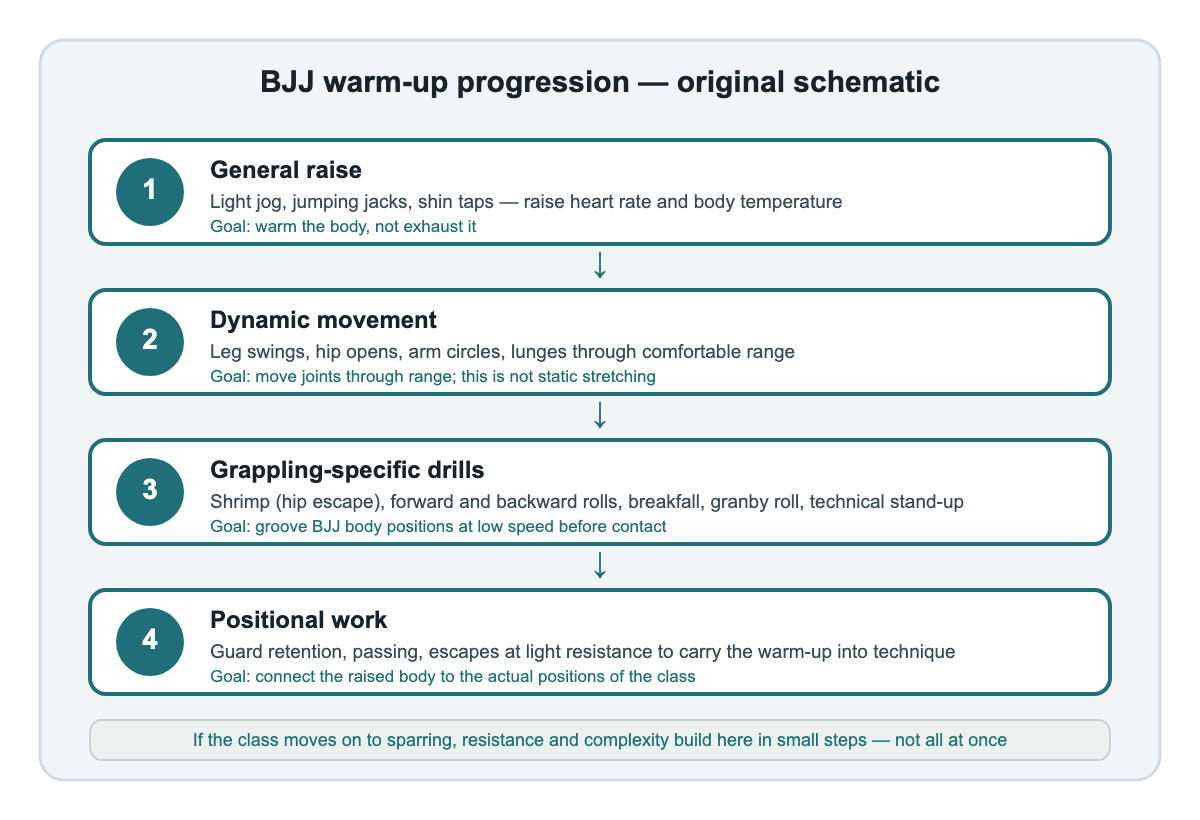
Here is the same structure as a diagram:
Start with a general raise, not a sprint
The first minutes are about raising your heart rate and body temperature without burning yourself out before the day’s real work. Something light — a few minutes of jogging on the spot or around the mat, jumping jacks, or the “shin tap” walk that shifts you side to side — does this job well. The point is a warm body, not a red face.
The evidence behind warming up is modest but consistent: the 2010 Fradkin meta-analysis across 32 higher-quality studies found warm-up improved performance in roughly 79% of the criteria measured, and found little sign it hurt anyone. Note what it does not prove. An earlier 2006 review of randomised trials could not firmly establish that warming up prevents injury. So treat warm-up as a performance and readiness habit, not a medical treatment you can rely on to keep you safe.
Dynamic movement beats holding a stretch
This is where the warm-up page and a stretching page part company. Static stretching — reaching and holding a position for a while — has a different purpose and a different pre-activity profile. A 2016 systematic review found dynamic stretching produced small-to-moderate performance improvements when done shortly before activity, while static stretching held for 60 seconds or more per muscle group was associated with small, likely transient performance dips.
The practical read for a warm-up: move joints through a comfortable range rather than park them in a held stretch. Leg swings, arm circles, slow lunges, and hip openers (the same hip-creating shapes BJJ loves) are dynamic. Many gyms also pepper in light static stretching early; the point is not that static work is useless — it has its own place outside the live warm-up — but that a warm-up should lean moving.
Grappling-specific drills: rehearse the movements you will use
Once you are warm, tie the movement to the sport. These are the drills most BJJ warm-ups lean on, and they are worth naming so the beginner knows what the terms mean:
- Shrimp (hip escape). On your back, drive your hips and shoulders the opposite way to pull your knees to one side and make space. It is the base of most guard-recovery and escape work.
- Forward and backward rolls. Shoulder-over-rolls that teach you to move across the mat and set up getting thrown and rolling out. Done slow, on rounded shoulders, inhaling through the movement.
- Breakfall. The controlled way to land by slapping the mat and channelling impact rather than catching yourself with a pointed elbow or wrist. Falling and rolling are skills, not instinct.
- Technical stand-up. From the ground, base on one foot and hand, stand without exposing your back to an imagined attacker.
- Granby roll. A tucked roll used from the bottom of a scramble or when escaping; you roll across the shoulders to land facing your partner.
Safety boundary. The falling-and-rolling group is worth treating with respect. Research on the biomechanics of breakfalling (from judo, where the technique is studied) shows a well-performed breakfall reduces the measured impact of a fall compared with no breakfall, and that novices fall differently from experienced practitioners. Another biomechanical study of a judo throw measured lower head acceleration with a skilled breakfall than without. These are judo-lab findings, not a BJJ guarantee — but they are exactly why a good coach builds falling and rolling slowly, before speed. Learn rolls and breakfalls under supervision from slow speeds, on open mats, with a partner who lets you finish the movement.
Positional work carries the warm-up into the class
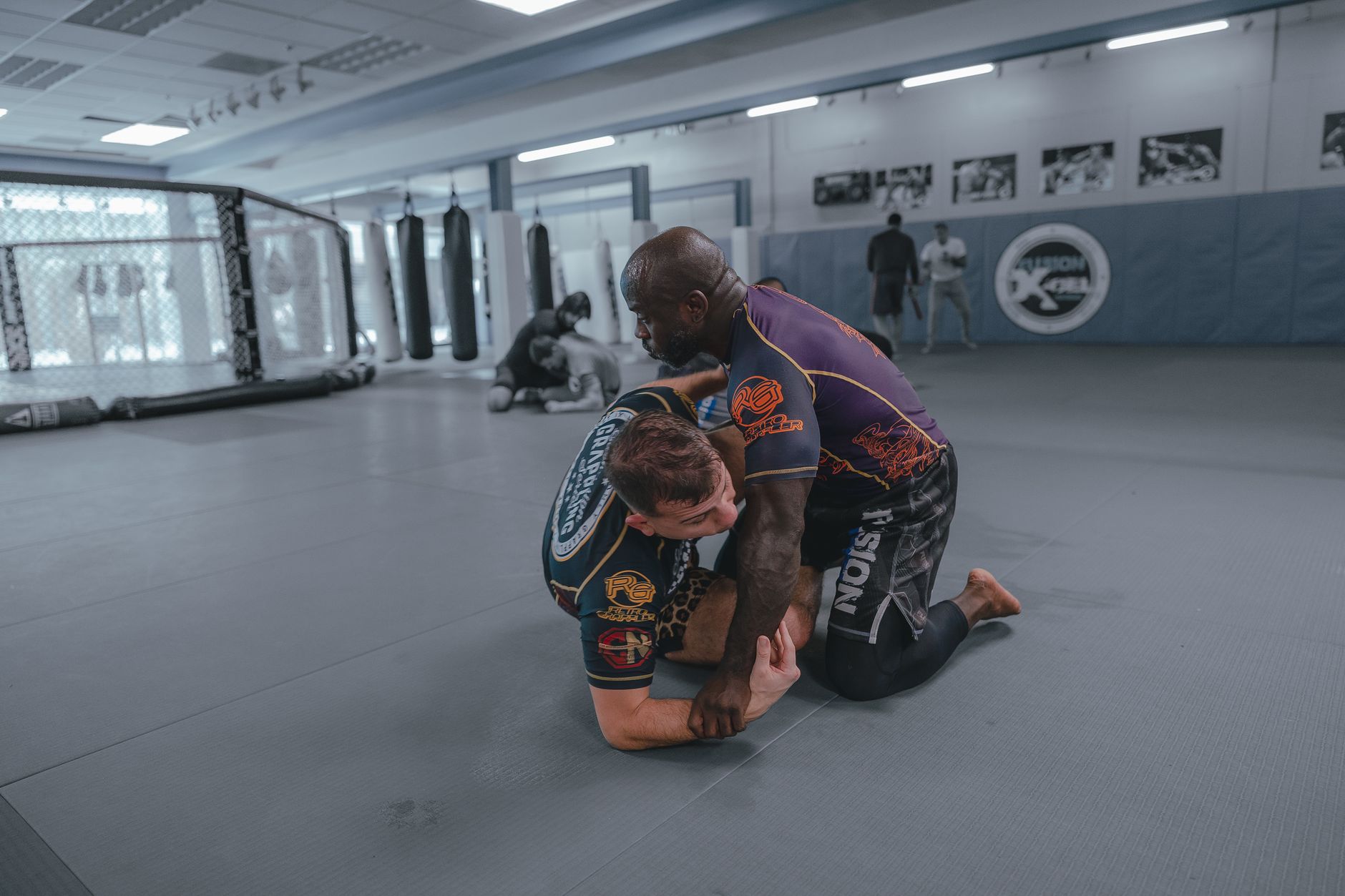
The last step before high effort is to put the movement into the actual positions of the lesson, at light resistance. This looks like a few minutes of guard retention, passing, or escape exchanges at conversational intensity — not full sparring. If the class is about the basic positions and escapes, the warm-up should touch guard work; our closed guard page is a good place to see where those positions live before you drill them under instruction.
Positional work is the bridge, not an afterthought: it warms the exact muscles and positions you will use and gets your attention on the class topic before the pace rises. Do it slow and clean.
Escalation into sparring, in small steps
If your session moves on to rolling, the warm-up should hand the body over in steps rather than a jump. A common pattern is short, light rounds that start at maybe 30–50% intensity and build. This is the “escalation” in the diagram above, and it serves two purposes: your first contact of the day is gentle enough to read and respond, and you burn less early energy fighting your own stiffness.
There is no one mandated schedule here — how many minutes each stage takes depends on your body, your age, your recent injuries, and your gym. That is deliberate. A fixed “10-10-10-10” formula would be an invention, and this guide is not going to hand you one. The structure is the logic; the timings are between you and your coach.
Dynamic warm-up vs stretching vs strength: which page covers what
| Focus | What it is for | Where it fits the session |
|---|---|---|
| Warm-up (this guide) | Raise the body and rehearse fall-and-roll and base movements before effort | First minutes of a session |
| Stretching / mobility | Longer-term range and recovery work, built up over weeks | Away from, or light parts of, the live warm-up |
| Strength training | Building force and capacity in a separate session | Its own session or a programmed slot, not the same minutes |
Our BJJ strength-training guide covers the strength side as a coach-designed framework. The warm-up here is not a strength workout — it typically adds no meaningful load for building muscle — so treat the two as separate pieces of a week. For how sparring and open training sessions actually run, the BJJ open mat guide explains what happens once you move from a taught warm-up into freer rolling.
Common warm-up mistakes
| Mistake | Why it causes trouble | Better cue |
|---|---|---|
| Warming up cold with a hard sprint | Uses the energy you will need, before the body is ready | Raise gradually; the first minutes should feel easy |
| Holding long static stretches instead of moving | Pre-activity static stretching can come with small transient performance dips | Lead with dynamic movement; save long holds for elsewhere |
| Skipping the fall-and-roll drills | Falls are a skill; landing on instinct is how wrists and elbows get taken | Learn breakfalls and rolls slow, with a coach, before they matter |
| Practising new drills at full speed with a resisting partner | Risking the body before technique is grooved | Slow, light, phrases first; escalate only under supervision |
| Jumping straight from the warm-up into full sparring | Body stiff, attention not on the lesson, first contact too hot | Add a positional or light-round step first |
BJJ warm-up FAQs
Should I stretch before or after a BJJ warm-up?
Prefer dynamic movement within and right before activity. Long, held static stretching is a better fit for the recovery or mobility side of a week, not the pulse-raiser minutes right before intense work — the 2016 review linked long held static stretches with small short-term performance dips.
How long should a BJJ warm-up take?
There is no standard answer, and this guide deliberately does not invent one. A warm-up that raises you, moves you, rehearses the day’s movements and bridges into positional work can be as short as a shared 10–15 minutes in a typical class or longer on your own. Match it to your body and your coach’s plan.
Do I need to do the fall-and-roll drills if I am strong?
Falling and rolling are technique, not strength. Being strong does not replace learning how to break a fall — the biomechanics research shows how much technique changes the impact of a fall. Build it slowly, like any other skill.
Does warming up prevent BJJ injuries?
Not something the research can promise. The performance benefit of warming up is well supported, but the injury-prevention side is less firmly established in the clinical evidence. Warm up for readiness and to move well, and rely on qualified coaching and sensible progression for safety.
Bottom line
Build a warm-up that raises, moves, rehearses and bridges: get the body warm, then moving, then into the fall-and-roll and base movements of the sport, then into light positional work before effort rises. Treat the structure as the logic and the timings as something you and your coach set together.
Sources
- Fradkin AJ, Zazryn TR, Smoliga JM. Effects of warming-up on physical performance: a systematic review with meta-analysis. J Strength Cond Res 2010 — performance benefit of warm-up; checked November 11, 2026.
- Fradkin AJ, Gabbe BJ, Cameron PA. Does warming up prevent injury in sport? J Sci Med Sport 2006 — limits of the injury-prevention evidence; checked November 11, 2026.
- Behm DG et al. Acute effects of muscle stretching. Appl Physiol Nutr Metab 2016 — dynamic vs static stretching before activity; checked November 11, 2026.
- Biomechanics of breakfall technique (ukemi) in judo. Int J Environ Res Public Health 2022 — breakfall impact and skill differences; checked November 11, 2026.
- Ukemi technique and head acceleration on osoto-gari. Neurol Med Chir (Tokyo) 2020 — breakfall and measured impact; checked November 11, 2026.
- Stegerhoek P et al. Injury prevalence among BJJ practitioners. BMJ Open Sport Exerc Med 2025 — sparring-injury context; checked November 11, 2026.