Quick answer: the fireman’s carry is a throw-style takedown that loads the opponent across your shoulders and dumps them to the mat. In the deep-head version shown by Dan Dennis, the thrower’s head comes all the way through to the far side, the opponent’s arm is locked tight to the chest, and the finish is either a step-through or a drop to the inside hip. Under the current IBJJF rulebook, a takedown scores 2 points when the thrower starts with both feet on the ground and stabilizes top position for 3 seconds — but the score depends on how the sequence lands, so check the event rules.
Last updated: November 10, 2026 (Pacific). Sources checked November 11, 2026 UTC.
This guide is educational. Practice under qualified coaching, apply pressure gradually, tap early, and release immediately when a partner taps or cannot communicate clearly.
Most BJJ takedown guides stop at the double-leg and single-leg. The fireman’s carry keeps catching people out because it uses the opponent’s own circling movement, needs no cloth, and ends with them on their back before they realize they left their feet.
Free every Tuesday
The Grappler Brief
The week’s biggest stories from BJJ, judo, wrestling, and submission grappling—curated for people who train.
Sent out weekly.Opt out anytime.
Fireman’s carry at a glance
| Detail | What to know |
|---|---|
| Technique family | Throw-style takedown (loads the opponent across the shoulders), not a pin or submission |
| Deep-head difference | The thrower’s head comes all the way through to the far side, unlike the shallow-head carry |
| First control priority | Lock the opponent’s arm tight to your chest/shoulder and keep your head against their ribs |
| Finish options | Step-through penetration, or drop to the inside hip |
| IBJJF scoring | Scores as a takedown (2 points) when it fits the rulebook’s definition and 3-second control |
| Training rule | Learn the carry and the fall with a cooperative partner first; club rules may be stricter than tournament rules |
What is the fireman’s carry?
The fireman’s carry is a standing takedown where the attacker drops their head to the side, loads the opponent across the shoulders, and throws them to the mat. Our wrestling moves reference calls it a throw-style takedown that loads the opponent across the shoulders — a staple of folkstyle and Greco-Roman wrestling. In BJJ it is a standing-game move: a way to take the fight to the floor without gripping the gi.
There are two broad versions. In the shallow-head carry the head stays on the near side. In the deep-head version — the one Dan Dennis demonstrates — the head comes all the way through to the far side, which changes the leverage and the finish.
How the deep-head fireman’s carry works
Dennis’s demonstration (FANATIC WRESTLING, publisher-linked) builds the move around three control points, not a sequence to memorize.
1. Head through, head on the ribs
Dennis’s head “comes all the way through” — that defines this version. His placement cue: balance the opponent “right on the center on the side of his ribs.” The head presses the torso, which is both a control surface and a safety boundary: the head belongs on the ribs, never the neck or jaw.
2. The arm lock is the whole move
He repeats that the opponent’s arm must be locked in — if the lock is loose, you are “losing all or most of” the throw. The grip is a two-on-one anchored to his chest and shoulder, elbows locked. Keep the grip up off the elbow: dropping it too low toward the elbow loses torque on the arm.
3. Two ways to finish
With the head all the way through, Dennis gives two finishes: drop to the inside hip or penetrate through with a stepping fireman’s. Which one you pick is “really just how you like finishing.” Both need the arm kept tight and a lean through the opponent.
Common entries: from wrestling and from BJJ
Wrestling entries
In Dennis’s demonstration the entry develops from the opponent circling. He lowers his level, brings his head into the fireman’s position, and lets the opponent’s movement create the opening; the arms stay relaxed until he gets underneath. The throw works from the same standing exchanges as the single-leg takedown and the double-leg takedown: a collar tie, a level change, and an opponent who circles instead of defending it.
BJJ entries
In BJJ the carry is most practical in no-gi and MMA because it needs no grips on the gi. From a standing clinch it can hit off a collar tie or underhook, and it pairs naturally with the folkstyle/Greco takedown background in our types of wrestling guide. In the gi, expect the opponent to grab and pull guard mid-throw, which changes what the throw scores — more below. These are general entry patterns, not a claim that the video shows any one of them.
Common mistakes and better cues
| Mistake | Why it causes trouble | Better cue |
|---|---|---|
| Head against the neck or jaw | Dangerous for the partner and weak leverage | Drive the head to the ribs; keep the ear on the torso |
| Arm lock loose | The opponent stands up or slips out of the throw | Anchored two-on-one, elbows locked, grip up off the elbow |
| Only one finish | Force the step-through when the position favors the hip drop | Read the position; step through or drop to the inside hip |
| Rushing the entry | The opponent feels the shot and sprawls | Let the opponent’s circling movement open the entry, then tighten |
| Treating the arm lock as a submission | Cranking a shoulder lock that was never a submission | The lock is control for the takedown; release it once the throw is done |
Defensive priorities
Defend before the load happens, not after the opponent is on your back.
- Deny the head position. The throw needs the head against your ribs — sprawl or circle away before the deep head gets through.
- Keep the arm free. The throw depends on the arm lock, so pull the arm back or hand-fight before the two-on-one is anchored.
- Stand up / sit out. If the thrower gets under you but has not loaded you yet, stand tall or sit out to remove the position.
- Do not invent a late escape. If the carry is loaded, tap early and ask a qualified coach for the escape to the exact variation rather than rolling blindly.
Safety boundaries: head and neck position
This is the section that matters most: the fireman’s carry is a head-and-shoulder throw with a fall attached.
- Your head goes on the ribs, never the neck. Dennis’s cue — balancing the opponent “on the side of his ribs” — is the boundary. Driving the head into the neck or chin is ineffective and dangerous.
- Protect your own neck. In the deep-head version your head finishes low, near the mat. Finish to the hip or shoulder with the head up; do not land on the crown of your head or roll over your own neck.
- The locked arm is control, not a submission. The two-on-one anchors the opponent’s arm for the throw. It is not an armbar and not a shoulder lock; do not crank it to force a tap.
- Control the descent. The IBJJF technical-fouls table lists a slam as illegal and prohibits a suplex that lands the opponent’s head or neck on the ground, while allowing the throw if the head and neck are not forced into the mat. Same principle: take the opponent down under control so their head never hits the floor.
- Train it in stages. Learn the carry and the fall with a cooperative partner, a coach watching, and a crash mat before adding resistance.
How the fireman’s carry scores in BJJ
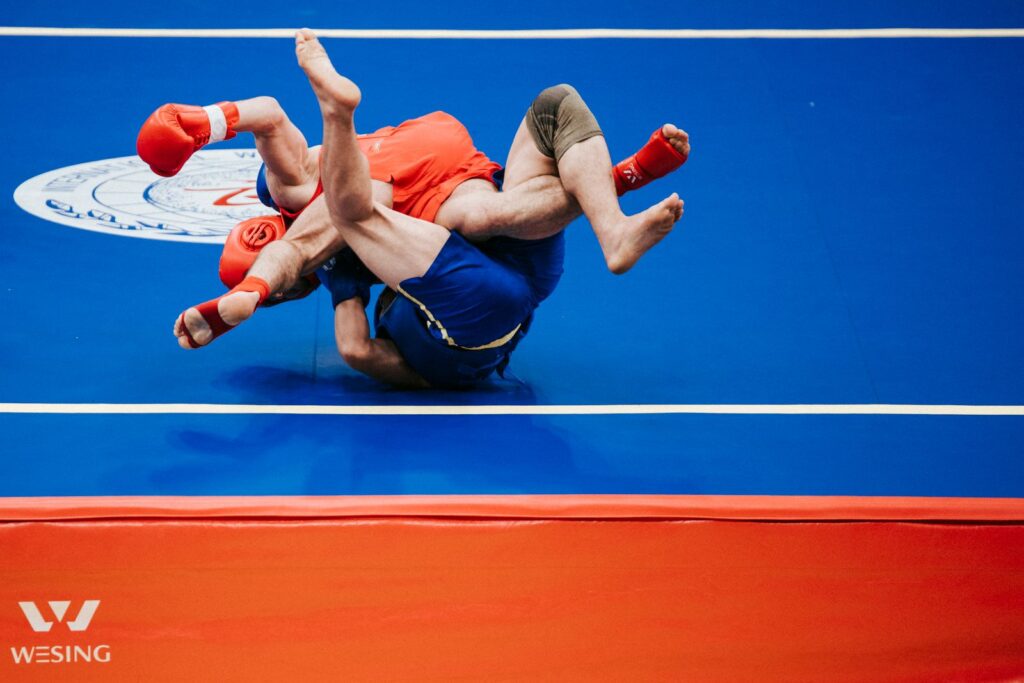
Under the current IBJJF rulebook (June 2024 edition), a takedown is worth 2 points. The definition (Article 4, item 4.1.1): the thrower starts with both feet on the ground, the opponent lands on their back, side, or seated, and top position is held for 3 seconds.
So a standing fireman’s carry — opponent lands on their back and top position is held for 3 seconds — fits the definition and scores 2 points. The catch is in how the sequence lands:
| Sequence | What IBJJF rules say |
|---|---|
| Standing throw, opponent lands back/side/seated, top position held 3 seconds | 2 points (Article 4, 4.1.1) |
| Throw against an opponent with one or two knees on the ground | Points only if the thrower is standing at the moment of the takedown; no points if the opponent is taken down from their knees (4.1.6) |
| Takedown initiated before the opponent starts a guard pull | 2 points if the thrower stabilizes top position (4.1.12) |
| Takedown initiated after the opponent starts a guard pull | No takedown points (4.1.12) |
| Land in guard or half-guard and get swept immediately | Advantage for the takedown, opponent gets 2 points for the sweep (4.1.10) |
| Near-takedown without 3-second stabilization | Advantage, not points (Article 5 example) |
A few honest caveats. The rulebook does not name the fireman’s carry; classification is the referee’s call, and event pages can override the baseline. Its version labels disagree — download page v6.0, PDF cover v6.1, final page v6.2 — so treat the detail as current for the June 2024 edition. Other organizations run their own scoring; check your event.
How to train the fireman’s carry with control
- Drill the lock without the throw. Practice the two-on-one anchored to your chest and shoulder, elbows locked, grip up off the elbow.
- Drill the head position. Get comfortable with the head against the ribs and “all the way through” before anyone leaves their feet.
- Drill the carry and fall slowly. Load a cooperative partner, step through or drop to the hip, and control the descent onto a crash mat.
- Add the circling entry. Have the partner circle while you lower your level and bring the head into position, then tighten the lock.
- Add resistance gradually. Let the partner defend the head position and the arm lock before you build speed.
- Follow club rules. A move being legal in one division does not make it right for every class or partner.
Fireman’s carry FAQs
Is the fireman’s carry legal in BJJ?
Yes, as a takedown, when finished under control. The IBJJF technical-fouls table prohibits slamming and throws that land the opponent’s head or neck on the ground, but the carry is a normal standing takedown. Classification is the referee’s call.
Does the fireman’s carry score points in IBJJF?
It scores 2 points when it meets the takedown definition: both feet on the ground, the opponent lands back/side/seated, and top position is held 3 seconds. Check 4.1.6 and 4.1.12 for the knee-on-ground and guard-pull exceptions.
What is the difference between a shallow-head and deep-head fireman’s carry?
In the shallow version the head stays on the near side. In the deep-head version it comes all the way through to the far side, which changes the leverage and allows the step-through or inside-hip finish.
Is the fireman’s carry a submission?
No. It is a takedown that loads the opponent across the shoulders. The arm lock used to control the opponent is control for the throw, not a submission, and should not be cranked as one.
Bottom line
Learn the deep-head carry as a control problem, not a move list: head against the ribs, arm locked to the chest, and a finish you choose — step through or drop to the hip. Protect both necks on the way down, and remember the standing carry scores IBJJF’s 2 takedown points only when it lands and stabilizes as the rulebook describes.
Sources
- Deep Head Fireman’s Carry by Dan Dennis, FANATIC WRESTLING — teaching mechanics and entry conditions; publisher-linked demonstration (description links fanaticwrestling.com), uploaded 2022-11-23; video inspected November 11, 2026.
- IBJJF Books and Videos — linked June 2024 rulebook (download page label v6.0; PDF cover and running headers v6.1; final page “VERSION 6.2”), Article 4 takedown scoring and Technical Fouls – Illegal Moves table; checked November 11, 2026.