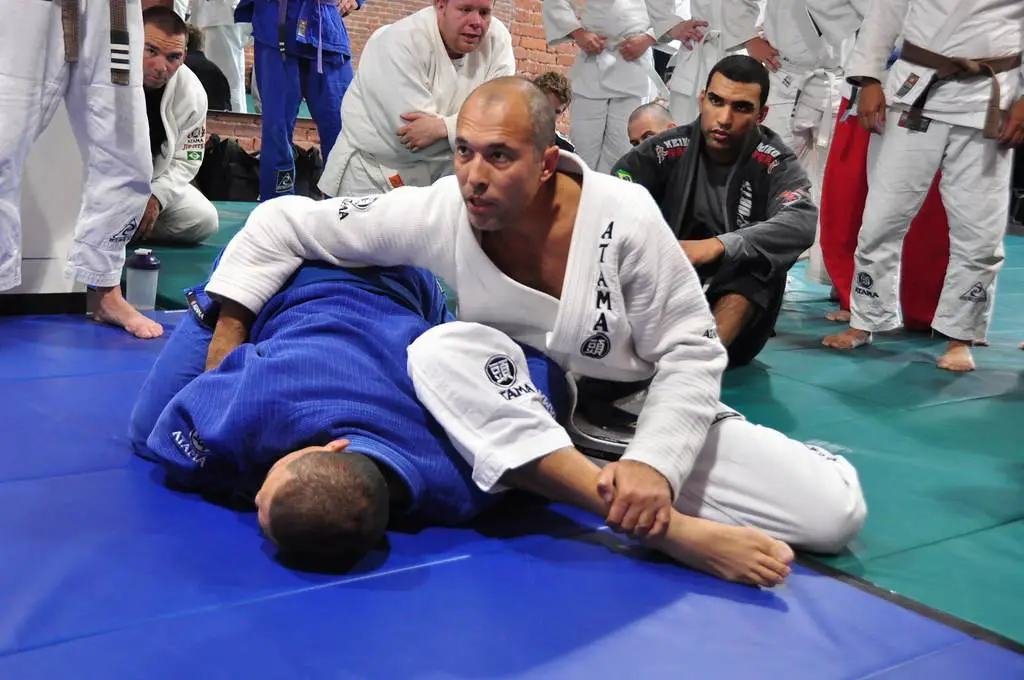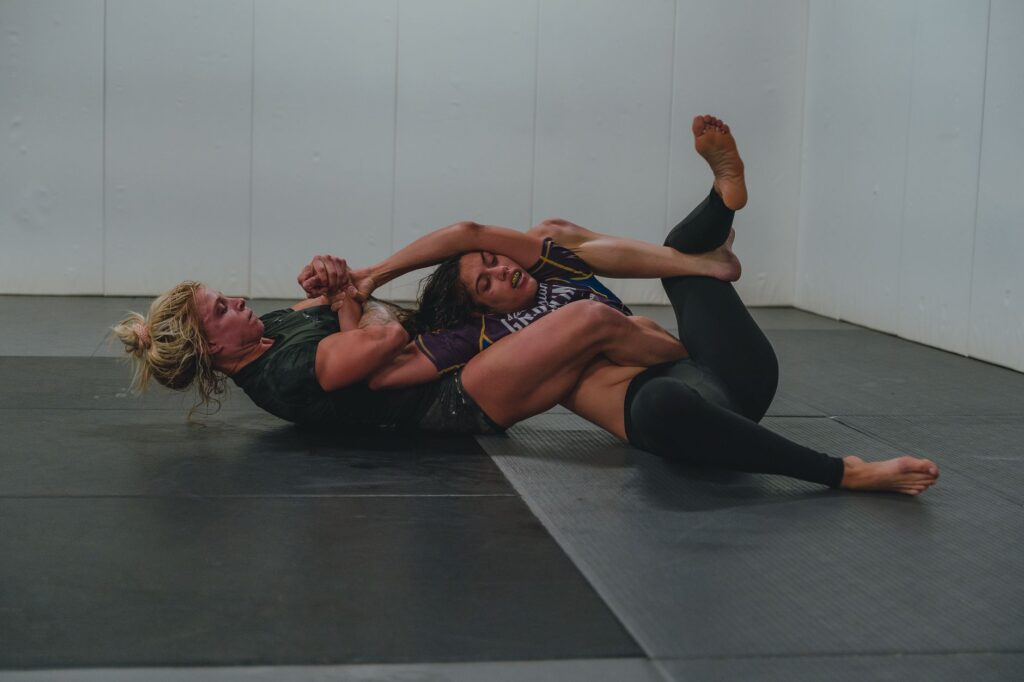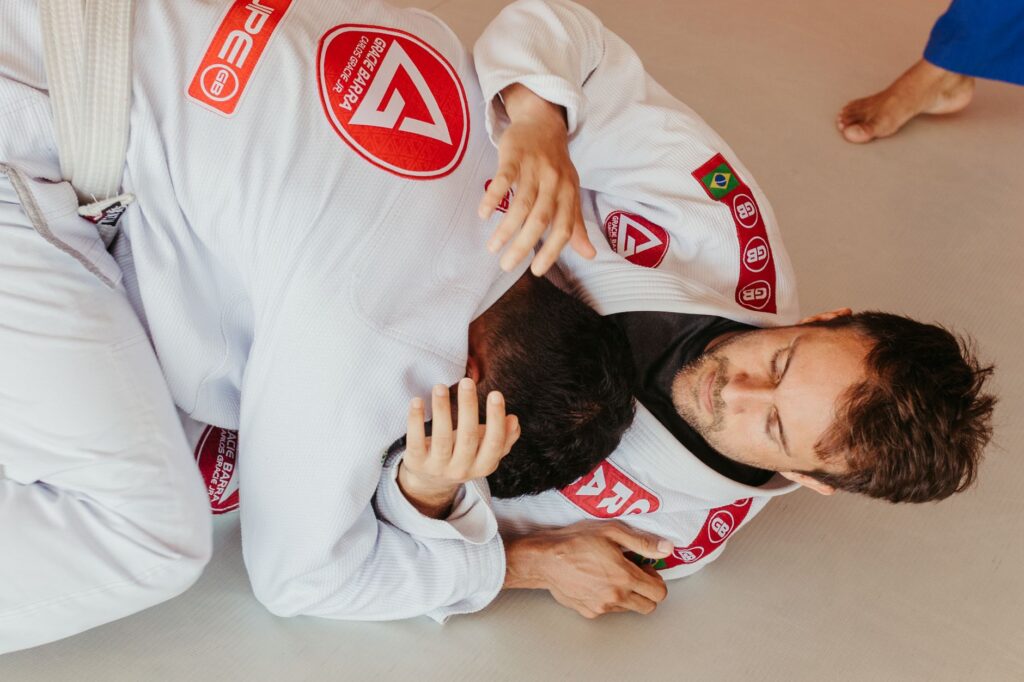
Quick answer: the arm triangle choke is a head-and-arm choke where you trap one of your opponent’s arms across their neck, connect your shoulder to one side of the neck, and use your body position to close the other side. In BJJ, MMA, and submission grappling, it is commonly finished from mount, side control, half guard top, or after passing. The finish depends less on squeezing with your arms and more on angle, shoulder pressure, head position, and keeping the trapped arm from escaping.
Train this technique only under qualified coaching, tap early, and release immediately when your partner taps. Chokes can be dangerous when applied carelessly. This guide is for understanding the position and common mechanics, not for unsafe practice outside a controlled grappling environment.
| Arm triangle concept | What it means |
|---|---|
| Common names | Arm triangle choke, head-and-arm choke, kata gatame |
| Main control | Opponent’s head and one arm are trapped together |
| Best-known entries | Mount, side control, half guard top, passing transitions |
| Key finishing idea | Shoulder pressure and angle close the space around the neck |
| Common beginner mistake | Squeezing arms harder instead of fixing position |
What is an arm triangle choke?
An arm triangle choke is a submission that uses your body and your opponent’s trapped arm to apply pressure around the neck. Unlike a rear naked choke, where both of your arms directly surround the neck from behind, the arm triangle uses one of the opponent’s arms as part of the trap. That is why it is often called a head-and-arm choke.
In judo, a related pin and choke family is commonly called kata gatame. In BJJ and MMA, the phrase arm triangle usually refers to the head-and-arm choke finish from top positions. The details vary by coach and ruleset, but the core idea is the same: isolate the head and arm, remove space, and finish with controlled pressure.
Free every Tuesday
The Grappler Brief
The week’s biggest stories from BJJ, judo, wrestling, and submission grappling—curated for people who train.
Sent out weekly.Opt out anytime.
How the arm triangle works
The arm triangle works when the defender’s own arm is pushed across their neck and kept there. Your shoulder applies pressure on one side, their trapped arm limits space on the other side, and your angle prevents them from turning back into a safe position. The finish usually gets weaker when there is space near the neck, when their elbow drops free, or when your hips are in the wrong place.
| Detail | Why it matters |
|---|---|
| Trapped arm across the neck | Creates the head-and-arm structure that makes the choke possible |
| Low head position | Makes it harder for the defender to posture, turn, or recover the arm |
| Shoulder connection | Closes space without relying only on arm strength |
| Correct angle | Lines up your pressure so the choke tightens efficiently |
| Stable base | Prevents reversals while you adjust the finish |
Arm triangle from mount
The mount is one of the most common places beginners first learn the arm triangle. From mount, the top player works to bring one of the defender’s arms across the centerline. Once the head and arm are controlled, the top player lowers their chest, connects shoulder pressure, and usually dismounts toward the side to create a better finishing angle.
- Control mount before attacking. A rushed submission is easier to reverse.
- Force or guide one arm across the defender’s neck line.
- Lower your head and shoulder so there is no easy space for the trapped arm to return.
- Walk or slide to the side while keeping the head-and-arm connection.
- Finish with controlled pressure, not a sudden crank.
The most common mount mistake is trying to finish while still square on top. Many arm triangles tighten only after the attacker changes the angle and removes the defender’s ability to turn back in.
Arm triangle from side control
Side control entries often happen after a pass, scramble, or failed frame from the bottom player. If the defender’s near-side arm gets pushed across the neck, the top player can settle chest pressure and begin connecting the head-and-arm position. From there, the finish depends on keeping the trapped arm high and preventing the defender from creating space with frames.
Side control arm triangles are especially useful when the bottom player overcommits a frame or turns the wrong way. The top player should still prioritize control first. If you lose chest pressure or let the defender’s elbow return to the mat, the choke usually disappears.
Common arm triangle mistakes
| Mistake | What goes wrong | Better cue |
|---|---|---|
| Squeezing with only the arms | You burn energy without closing the real space | Fix shoulder pressure and angle first |
| Leaving the trapped arm low | The defender can recover their elbow and frame | Keep the arm across the neck line |
| Finishing too square | The pressure points in the wrong direction | Move to the side and settle your weight |
| Rushing from mount | You give up top control | Stabilize mount before attacking |
| Ignoring the defender’s bridge | You can get rolled or forced to post | Keep a stable base while adjusting |
| Cranking the neck | Training partner safety suffers and the mechanics are poor | Use controlled pressure and release on the tap |
How to defend the arm triangle
Defense starts before the choke is locked. Do not let your arm get pushed across your neck. Keep your elbow connected, use frames to manage distance, and turn toward safer angles before the attacker settles shoulder pressure. Once the head-and-arm position is tight, late defense gets much harder.
- Protect the inside space: keep your elbow from being driven across your neck.
- Frame early: create space before the attacker’s shoulder settles.
- Recover guard or turn safely: do not expose your back recklessly.
- Tap when caught: do not wait to see how long you can last in a locked choke.
Arm triangle vs D’Arce choke vs anaconda choke
The arm triangle, D’Arce, and anaconda are all head-and-arm style chokes, but they use different arm threading and finishing positions. Beginners often mix them up because the defender’s head and arm are trapped in all three.
| Choke | Typical control | Common position |
|---|---|---|
| Arm triangle | Attacker’s shoulder and defender’s trapped arm close space around the neck | Mount, side control, top half guard |
| D’Arce choke | Attacker threads an arm under the near armpit and around the neck | Front headlock, half guard, turtle, scrambles |
| Anaconda choke | Attacker threads from the neck side under the far armpit | Front headlock and turtle transitions |
Where the arm triangle fits in a beginner BJJ game
The arm triangle is a good submission to understand early, but beginners should not chase it before learning positional control. It works best when you can hold mount or side control, prevent frames, and transition patiently. If you are still learning the positional map, start with GrapplerHQ’s BJJ for beginners guide.
It also connects naturally with other submission concepts. The triangle choke teaches angles and shoulder-line control from guard, while the kimura lock teaches two-on-one control. Together, those ideas help a beginner understand why submissions are usually built from position first.
Training safety notes
Chokes should be practiced with control, clear communication, and immediate respect for the tap. Do not apply sudden pressure, do not hold after a tap, and do not practice chokes outside supervised training. If a partner seems confused, trapped, or unable to tap clearly, release and reset.
Good arm triangle mechanics should feel controlled. If the finish feels like a neck crank, pause and ask a coach to check your angle, shoulder position, and pressure. The goal is technical development, not forcing a submission through pain.
For another core submission that teaches control before the finish, see GrapplerHQ’s armbar guide, which covers elbow-line mechanics, common mistakes, and safe training habits.
For a back-control choke comparison, see GrapplerHQ’s rear naked choke guide, which covers mechanics, defense, common mistakes, and safety notes.
FAQWhat is an arm triangle choke?
An arm triangle choke is a head-and-arm choke where one of the defender’s arms is trapped across their neck while the attacker uses shoulder pressure, angle, and body control to close space around the neck.
Is an arm triangle the same as kata gatame?
They are closely related. Kata gatame is a judo term often translated as shoulder hold or head-and-arm control. In BJJ and MMA, arm triangle usually refers to the head-and-arm choke finish from top positions.
Why is my arm triangle not working?
Common reasons include finishing too square, leaving space near the neck, letting the trapped arm escape, relying only on arm squeeze, or losing top control before the angle is set.
Can beginners learn the arm triangle choke?
Beginners can learn the basic idea, but they should focus on control and safety first. The arm triangle works best after a student understands mount, side control, frames, and escapes.
Is the arm triangle dangerous?
Any choke can be dangerous if applied carelessly. Practice under qualified supervision, apply pressure gradually, tap early, and release immediately when your partner taps.