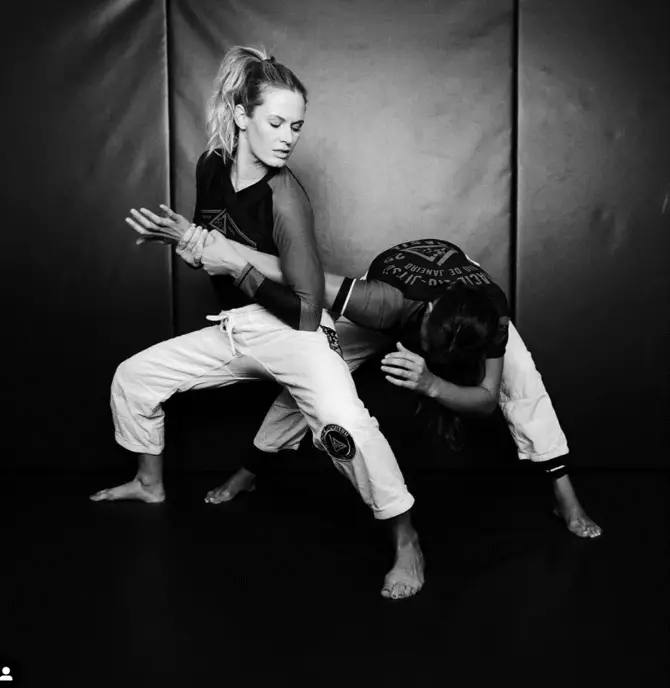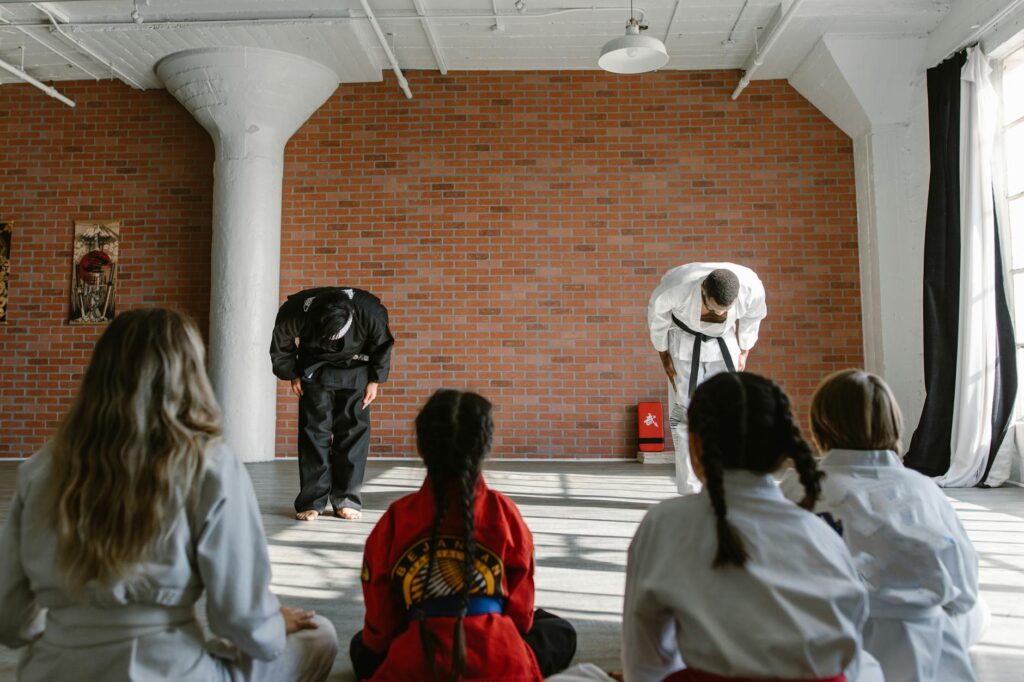
“OSS” (also written as “Oss”) is a term of acknowledgment, respect, and encouragement used widely in Brazilian jiu-jitsu and other martial arts. In a BJJ context it functions like “yes,” “understood,” “thank you,” and “I respect you” all at once — used to greet instructors, acknowledge instruction, and show appreciation on and off the mat. Its exact origin is debated, but it has become one of the most recognizable expressions in the global BJJ community.
What does OSS actually mean?
OSS does not have one fixed translation because it is not a standard word in Portuguese or Japanese — it is a term that evolved through martial arts culture. In BJJ it is used to mean several different things depending on context:
- Acknowledgment — “I heard you / I understand” when an instructor explains a technique
- Greeting — said when entering the gym, bowing on the mat, or greeting a training partner
- Encouragement — shouted to a teammate competing or sparring hard
- Respect — directed at a higher belt or instructor as a sign of deference
- Agreement — a general affirmative, similar to “yes” or “got it”
The meaning shifts with tone and context. A quiet “oss” after a technique explanation means “understood.” A loud “OSS!” during a tough roll means “keep going, you’ve got this.”
Where does OSS come from?
The origin of OSS is genuinely disputed, with several competing theories.
Free every Tuesday
The Grappler Brief
The week’s biggest stories from BJJ, judo, wrestling, and submission grappling—curated for people who train.
Sent out weekly.Opt out anytime.
Theory 1: Japanese naval origin
The most commonly cited origin traces OSS to the Japanese phrase “Onegai Shimasu,” meaning “please” or “I humbly request.” Over time it was shortened colloquially to “Oss” in Japanese martial arts culture and spread from judo into karate and eventually BJJ through the Japanese-Brazilian martial arts connection.
Theory 2: Osu no Seishin
Another theory links OSS to the Japanese concept of “Osu no Seishin” — the spirit of pushing through hardship and perseverance. In this interpretation, saying OSS is an affirmation of the martial arts mindset: to endure, push forward, and never give up. This meaning resonates strongly in grappling culture where training is physically demanding.
Theory 3: General Japanese dojo culture
A third explanation is that OSS was simply a common abbreviation used in Japanese dojos as a multipurpose affirmative. When Brazilian practitioners trained under Japanese judo and jiu-jitsu masters, they absorbed the term alongside the techniques. The history of jiu-jitsu traces directly from Japanese jujutsu through judo to the Gracie family in Brazil, and the cultural vocabulary — including OSS — came with it.
How OSS is used in BJJ training
- Entering the gym — many academies greet everyone with OSS when you walk in
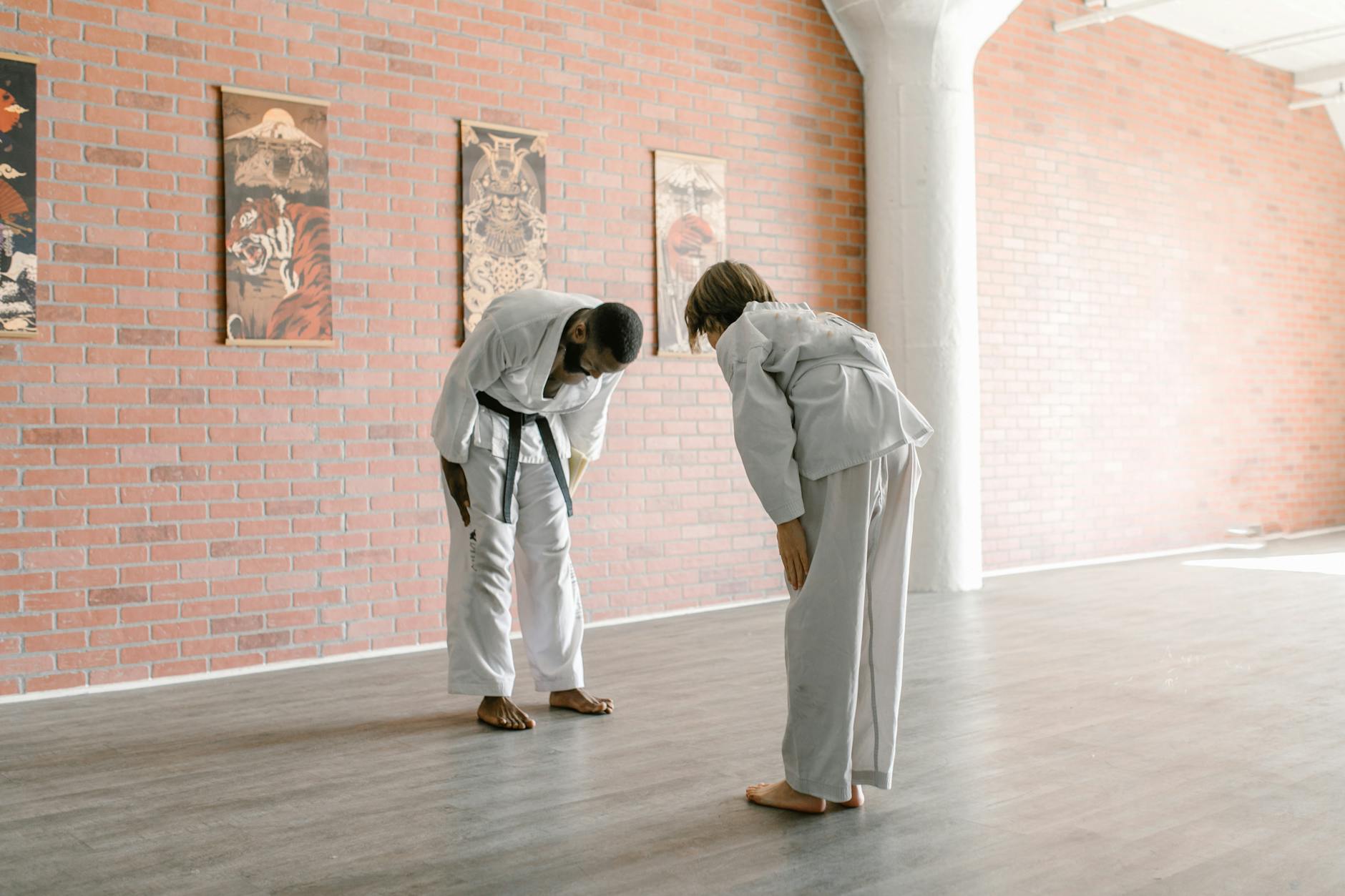
- Bowing at the start and end of class — OSS accompanies the bow to the instructor and training partners
- After technique instruction — the instructor demonstrates a move, students respond with OSS to confirm they understood
- Before and after sparring — partners say OSS before rolling and again at the end to show mutual respect
- Belt promotions — receiving a new belt is typically accompanied by OSS as an expression of gratitude and commitment
- During competition warm-ups — teammates shout OSS to pump up a competitor before a match
Understanding this is part of BJJ etiquette more broadly — knowing when and how to use OSS correctly signals that you respect the culture of the gym.
Is OSS used outside BJJ?
Yes — OSS is common across martial arts that share Japanese roots, including karate, judo, and Muay Thai gyms with traditional influences. In MMA, you will hear it used interchangeably regardless of the fighter’s primary discipline. Its use has become so widespread in combat sports culture that it now functions almost as a universal martial arts greeting.
That said, OSS is used more heavily in some academies than others. Some traditional and Gracie-affiliated schools use it constantly; some modern no-gi competition gyms barely use it at all. Neither approach is wrong — it reflects the culture of the individual school.
How to pronounce OSS
OSS is pronounced as a single syllable: “oss” rhymes with “boss.” It is often said with emphasis and a slight compression — a short, punchy sound rather than a drawn-out vowel. When used as encouragement it is typically louder and more energetic. When used as a quiet acknowledgment it can be almost muttered. Both are correct — the delivery matches the context.
Should beginners use OSS?
Yes — if your academy uses OSS, use it from day one. There is no rank requirement. Saying OSS when greeting your instructor, acknowledging instruction, and bowing before and after sparring is appropriate from your first class onward. It signals that you are engaged, respectful, and paying attention to the culture of the gym.
If you are not sure whether your gym uses OSS, follow the lead of your training partners and instructor in your first few sessions. Some academies are OSS-heavy; others barely use it. Mirror what you see.
Frequently Asked Questions
Is OSS disrespectful?
No — OSS is universally understood as a term of respect in martial arts. There is no context within a BJJ gym where saying OSS would be considered rude. The opposite is true: not acknowledging instruction or failing to greet training partners can be seen as poor etiquette.
What is the difference between OSS and “Osu”?
They are the same term — different spellings of the same sound. “Osu” is closer to the Japanese romanization; “OSS” is how it has been commonly written in BJJ and karate communities in English-speaking countries. You will see both spellings used interchangeably.
Do all BJJ academies use OSS?
No. Traditional and Gracie-affiliated academies tend to use it heavily. Modern sport-focused and no-gi gyms may use it sparingly or not at all. It depends entirely on the culture of the individual school and the instructor’s background.
Is OSS used in no-gi BJJ?
Less commonly than in gi training, but yes. Some no-gi gyms use it freely; others have moved away from it as no-gi culture has become more closely associated with wrestling and MMA than traditional martial arts. Teams like New Wave Jiu-Jitsu and B-Team vary on this — it comes down to individual gym culture.