Last updated: .
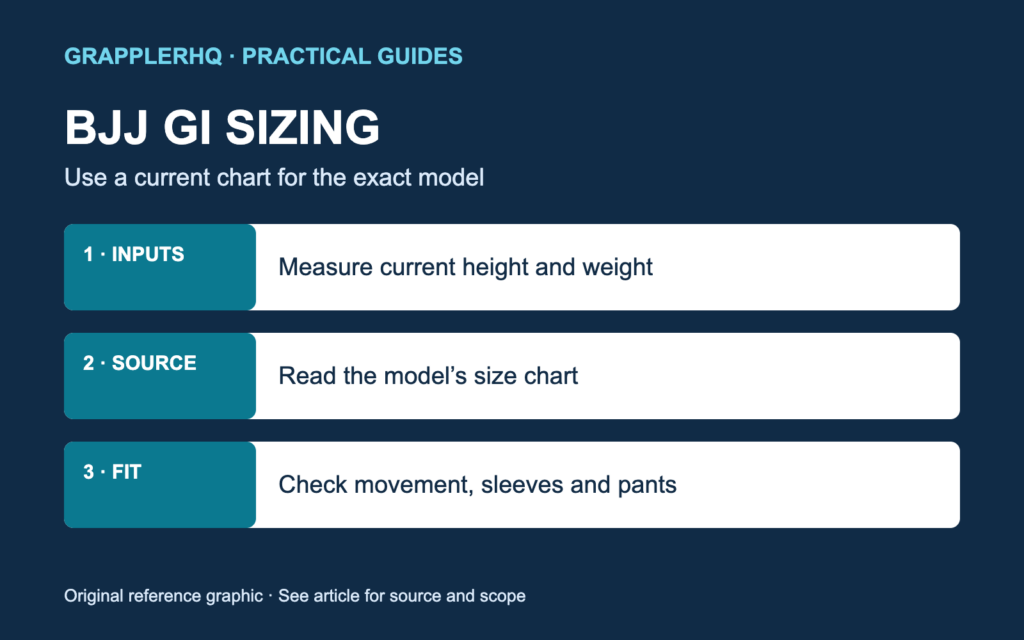
Quick answer: choose a BJJ gi size from the current chart for the exact brand and model, then check how the jacket and pants fit. A2 is not a universal measurement. Use your height and weight as inputs, check whether the maker lists body or garment dimensions, and compare the size’s actual cut. Do not automatically buy the smaller size because you plan to compete.
Free printable tools + the weekly Brief
Get the Gi Fit Checklist
Record your measurements, compare two exact models, and check care and return conditions. Confirm your email to receive both checklists, plus The Grappler Brief.
Sent out weekly.Opt out anytime.
Gi sizes can look standardized while describing different ranges. The most useful chart is the one attached to the gi you are buying. This guide shows how to read one verified manufacturer example, handle between-size choices and avoid turning a fit problem into an unplanned shrinking experiment.
A source-specific BJJ gi size chart
The table below transcribes the height and weight columns of the Fuji Sports Australia adult BJJ gi chart, checked October 2026. It is a Fuji chart example, not a universal conversion chart. Fuji publishes separate charts on that page, including a Nippon Edition chart. Check which one applies to the exact product you are ordering.
| Size | Height | Weight |
|---|---|---|
| A0 | 146–155 cm | 43–49 kg |
| A1 | 157–165 cm | 49–63 kg |
| A2 | 165–175 cm | 63–77 kg |
| A2L | 178–183 cm | 63–77 kg |
| A2H | 165–175 cm | 77–86 kg |
| A3 | 170–185 cm | 77–91 kg |
| A3L | 188–193 cm | 77–91 kg |
| A3H | 175–185 cm | 91–100 kg |
| A4 | 177–188 cm | 91–113 kg |
| A5 | 183–193 cm | 102–125 kg |
| A6 | 188–198 cm | 113–136 kg |
These ranges overlap in places and leave gaps in others. Do not fill an unlisted range with a made-up manufacturer recommendation. If your measurements do not fit one row clearly, use the product’s fit advice or ask the seller before washing or removing return tags.
What do A, L, H, F and kids’ labels mean?
A-size labels are common in adult gi ranges. Some makers add L or H variants to offer different proportions, while women’s and children’s ranges can use other label systems. The letter by itself does not tell you the dimensions, and not every product offers every variation.
In the Fuji example above, A2L has a taller height band than A2 while keeping the same weight band; A2H changes the weight band while retaining the A2 height band. Those are observable differences in that chart. Do not apply them as exact specifications for every brand’s similarly named size.
For women’s and children’s gis, open the appropriate current chart rather than converting from an adult A-size row by guesswork. A child’s everyday clothing size or an adult’s usual T-shirt label is not a direct gi-size conversion. Compare the measurements and the maker’s intended fit.
Measure the person and the garment correctly
- Write down current height and weight. Use the same units as the manufacturer’s chart, or convert carefully before comparing.
- Read each column heading. A body-height range is not a finished jacket length. A garment-width measurement laid flat is not automatically a body circumference.
- Follow the measurement diagram. If the chart labels dimensions A and B, find their arrows and start/end points. Do not rename a cuff-to-cuff span as one sleeve’s length.
- Compare useful existing gear if you have it. Measure a gi that fits using the same method as the chart. Note whether it has already been washed and how it was dried.
- Keep the jacket and pants separate. A good jacket fit does not prove the pants will have the length or room you need.
You do not need to create a spreadsheet of every measurement to buy a first gi. You do need to know which measurement a source is actually giving you. A photograph of a model with no measurements is a less precise fit reference than the manufacturer’s chart.
Two hypothetical sizing examples
Example 1: tall and relatively light
A hypothetical buyer is 180 cm tall and 70 kg. In the Fuji adult chart shown above, those two values fall in the A2L row. That makes A2L a source-backed starting point for a product using that chart, not a guarantee of personal comfort or a recommendation to buy A2L in every brand.
The next step is to confirm the product actually uses this chart and check any relevant garment measurements. Buying a wider size simply to obtain more length may solve one dimension while creating excess room elsewhere.
Example 2: the same height band with more weight
A second hypothetical buyer is 170 cm and 82 kg. In that same chart, A2H contains both measurements. The A2 row contains the height but not the weight. That is a reason to examine the listed H option, not an instruction to squeeze into A2 for competition.
Both examples are interpretations of one chart. A different model or brand needs a new comparison. If your measurements land in different rows, follow that maker’s between-size guidance instead of transplanting one of these examples.
What if you are between gi sizes?
Start with the seller’s own advice. The Fuji chart shown here recommends the larger of two sizes when height and weight land in different categories. That advice belongs to the source and product context; another maker may offer a different cut or a specific recommendation.
Before buying, check return conditions and whether washing, wearing or removing tags affects them. Tatami’s help center, for example, explains both fit variation and conditions around returns. Confirm the current policy for your actual purchase and location rather than assuming all shops handle a washed gi the same way.
| Situation | Check first | Avoid assuming |
|---|---|---|
| Height fits one row, weight another | Maker’s between-size guidance and alternative cuts | That “competition fit” always means the smaller row |
| Jacket fits but pants are long | Separate measurements, permitted alterations and sizing options | That shrinking the whole set will fix only the pants |
| A washed gi already fits | Its current measurements and care history | That an unwashed replacement starts with the same dimensions |
| No row clearly fits | Exact-model advice from the seller or manufacturer | That gaps can be safely interpolated into a buying recommendation |
How should a gi fit for training or competition?
For everyday training, check comfortable movement and secure fastening under the host’s requirements. Notice whether the collar, shoulders, waist or crotch stop normal movement before you conclude that the sleeve length alone makes the size right.
For IBJJF competition, check the official uniform requirements and the GrapplerHQ inspection guide. There are required lengths and openings; a size label does not guarantee an inspection pass. Check the finished dry garment after the care routine you will actually use.
Your gi also affects a gi weigh-in because the event’s uniform and weighing rules matter. Use the existing IBJJF weight-class guide for that separate decision. Do not choose an unusable fit simply to chase a division limit.
Should you buy a larger gi and shrink it?
Do not make an assumed amount of shrinkage the foundation of the purchase. Read the exact product’s care instructions and remaining fit guidance. “Pre-shrunk” does not provide a universal conversion from an oversized set into the next label down.
If the fit problem is already clear before washing, examine return or alteration options first. The gi-shrinking guide explains why a whole-garment heat process may change measurements you wanted to keep.
Gi-size questions
Is A2 the same across all BJJ gi brands?
No. Compare the current chart and fit notes for the exact brand and model rather than treating the label as a fixed set of measurements.
Can women use an adult A-size gi?
The useful question is whether the product’s cut and measurements work for the person wearing it. Compare the available charts, intended fit and return options; do not assume two differently labeled ranges convert exactly.
Can a judo gi use the same size chart?
Use the manufacturer’s chart for the judo product. The garment and the sport’s inspection requirements are separate from the label on a BJJ gi.
For regular cleaning rather than changing the fit, use the BJJ gi-washing guide. Keep the exact garment’s care instructions with your routine.
Source notes
The numeric example is from Fuji Sports Australia’s adult BJJ chart, visually checked October 2026. Fit and care context also uses the linked Tatami help information and IBJJF uniform rules. No personal wear test or universal brand-size equivalence is claimed.
Get the Gi Fit Checklist — free with The Grappler Brief. Confirm your email to receive your resources.