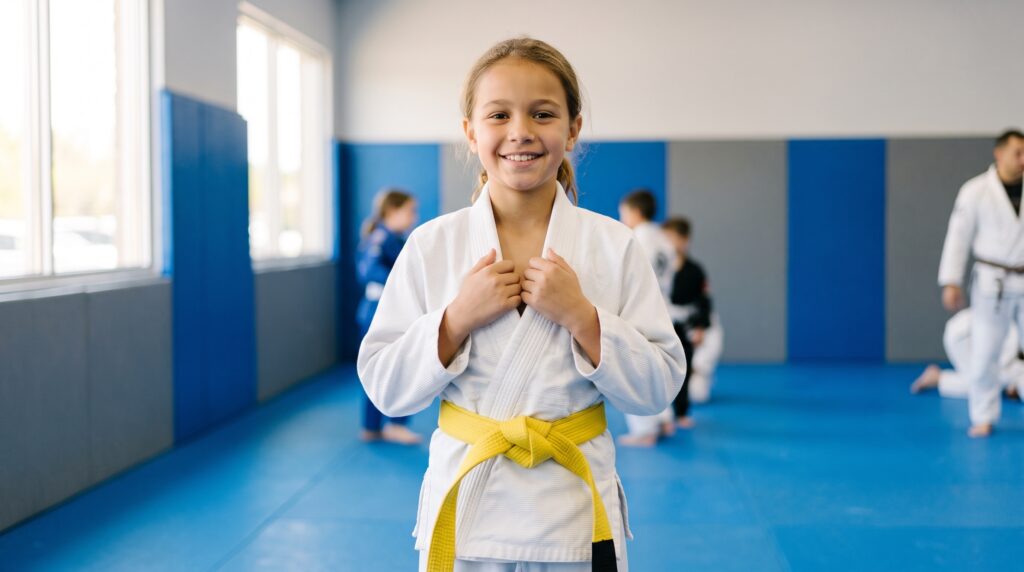
Quick answer: the yellow belt is the second colour group in BJJ’s separate youth belt system, one step up from grey. Under the IBJJF graduation system, the yellow group has three sub-belts — yellow-and-white, solid yellow, and yellow-and-black — and is officially open to athletes aged 7 to 15. It sits between the grey group (ages 4 to 15) and the orange group (ages 10 to 15), and in most kids’ programs it is where children land after the grey group, commonly from around age 7. IBJJF sets no minimum time in any youth belt: the professor decides, and a yellow belt who turns 16 moves to blue belt in the adult system.
Last updated: November 10, 2026 (Pacific). Sources checked November 11, 2026 UTC.
Belt rules vary by organisation and academy. This guide reflects the IBJJF graduation system as of June 2026; your child’s school may run a similar structure. Ask the head coach how their kids’ program moves children belt to belt.
The grey belt is the entry colour. Yellow is the next rung — and it raises the two questions parents actually ask: “Is my kid old enough for yellow?” and “When does yellow turn into an adult belt?” Both have clear answers in the federation document.
Free every Tuesday
The Grappler Brief
The week’s biggest stories from BJJ, judo, wrestling, and submission grappling—curated for people who train.
Sent out weekly.Opt out anytime.
Yellow belt at a glance
| Detail | What to know |
|---|---|
| Which system | The separate youth/kids belt system for athletes aged 4 to 15, not the adult white-to-black order |
| Yellow group steps | Three belts: yellow-and-white, solid yellow, yellow-and-black |
| Official age band | Ages 7 to 15 (Pee-Wee 1 to Teen 3); most kids reach it in the 7–9 range |
| Place in the order | Directly after the grey group, before the orange group (age 10+) |
| Minimum time in belt | None for ages 4 to 15; promotion is the professor’s discretion |
| Stripes / degrees | Set by the academy’s chosen system (monthly, triannual or quarterly); not the adult 4-stripe rule |
| When it ends | A yellow belt who turns 16 becomes a blue belt in the adult system |
What is a yellow belt in BJJ?
The yellow belt is the second colour group in Brazilian jiu-jitsu’s youth rankings. The youth ladder exists because small children need a different pace than adults: white, then the grey group, then yellow, then orange, then green — 13 belts in total for ages 4 to 15.
A “yellow belt” is really three belts in one colour group. When a family says their child “got their yellow belt,” they usually mean one step inside that group — the child has finished the grey group, the entry colours, and moved up one whole group.
Yellow is still a youth rank, not an adult one — none of the kids’ belts line up with the adult white-to-blue ladder. If you want the full order side by side, our BJJ belt order guide covers both progressions at a glance.
Yellow belt vs grey belt: what changed
Parents often blur grey and yellow because both live in the kids’ system. The practical difference is age and position:
| How they compare | Grey group | Yellow group |
|---|---|---|
| Where it sits | First coloured group in the youth system | Second coloured group, directly after grey |
| Official age band | Ages 4 to 15 (entry colours for the youngest) | Ages 7 to 15 |
| Sub-belts | Grey-and-white, solid grey, grey-and-black | Yellow-and-white, solid yellow, yellow-and-black |
| Typical child | Very young beginners, often 4–6 at a usual academy | School-age kids, often 7–9, who have left the grey group |
| What it usually means | Building comfort, survival and movement on the mat | Slightly more structured fundamentals and positional work |
| At age 16 | Grey → blue belt | Yellow → blue belt (same result) |
The yellow belt group and its age bands
The IBJJF graduation document gives each youth colour group a minimum starting age and a wider upper bound. Yellow officially spans the widest run after grey:
| Youth colour group | Official age range (IBJJF) | Typical place in a kids’ program |
|---|---|---|
| Grey (grey/white, grey, grey/black) | Ages 4 to 15 | Entry colours for the youngest children |
| Yellow (yellow/white, yellow, yellow/black) | Ages 7 to 15 | School-age group after grey, usually 7–9 in practice |
| Orange (orange/white, orange, orange/black) | Ages 10 to 15 | Older pre-teen group |
| Green (green/white, green, green/black) | Ages 13 to 15 | Teen group before the adult ladder |
Officially a yellow belt can be anywhere from 7 to 15, because the group spans the Pee-Wee through Teen divisions. Under IBJJF rules a child’s age is the current year minus birth year — so a child born in 2019 is age 7 in 2026. In most academies, yellow is what families see from about age 7 into the early tween years.
Yellow belts are also sized for kids: IBJJF says youth belts (ages 4 to 15) run about 2.5 to 3.5 cm wide versus 3.5 to 4.5 cm for adults. Uniform fit matters most at competition; our IBJJF gi rules guide covers the checks a belt-and-gi inspector actually looks for.
Where the yellow belt sits in the kids’ order
Here is the full IBJJF youth belt order (ages 4 to 15), with the yellow group highlighted:
| Position | Belt | Colour group |
|---|---|---|
| 1 | White | White |
| 2 | Grey-and-white | Grey group (4+) |
| 3 | Grey | |
| 4 | Grey-and-black | |
| 5 | Yellow-and-white | Yellow group (7+) |
| 6 | Solid yellow | |
| 7 | Yellow-and-black | |
| 8 | Orange-and-white | Orange group (10+) |
| 9 | Solid orange | |
| 10 | Orange-and-black | |
| 11 | Green-and-white | Green group (13+) |
| 12 | Solid green | |
| 13 | Green-and-black |
Think of yellow as the bridge between “kids who are starting out” and “kids with real fundamentals.” A child who leaves the grey group for yellow has already shown they can handle structured classes; yellow is where that structure starts to count.
What kids actually learn at the yellow belt
There is no single IBJJF-mandated yellow-belt curriculum, so it varies by academy. What holds across most kids’ programs: the grey years build comfort (dodging, rolling, breaking grips, simple escapes), and the yellow years turn those basics into recognisable positions and drills. Parent-focused advice like a popular BJJ Fanatics article on when kids should start training describes young beginners picking up grips, simple passes and escapes — the pattern most schools follow at this stage.
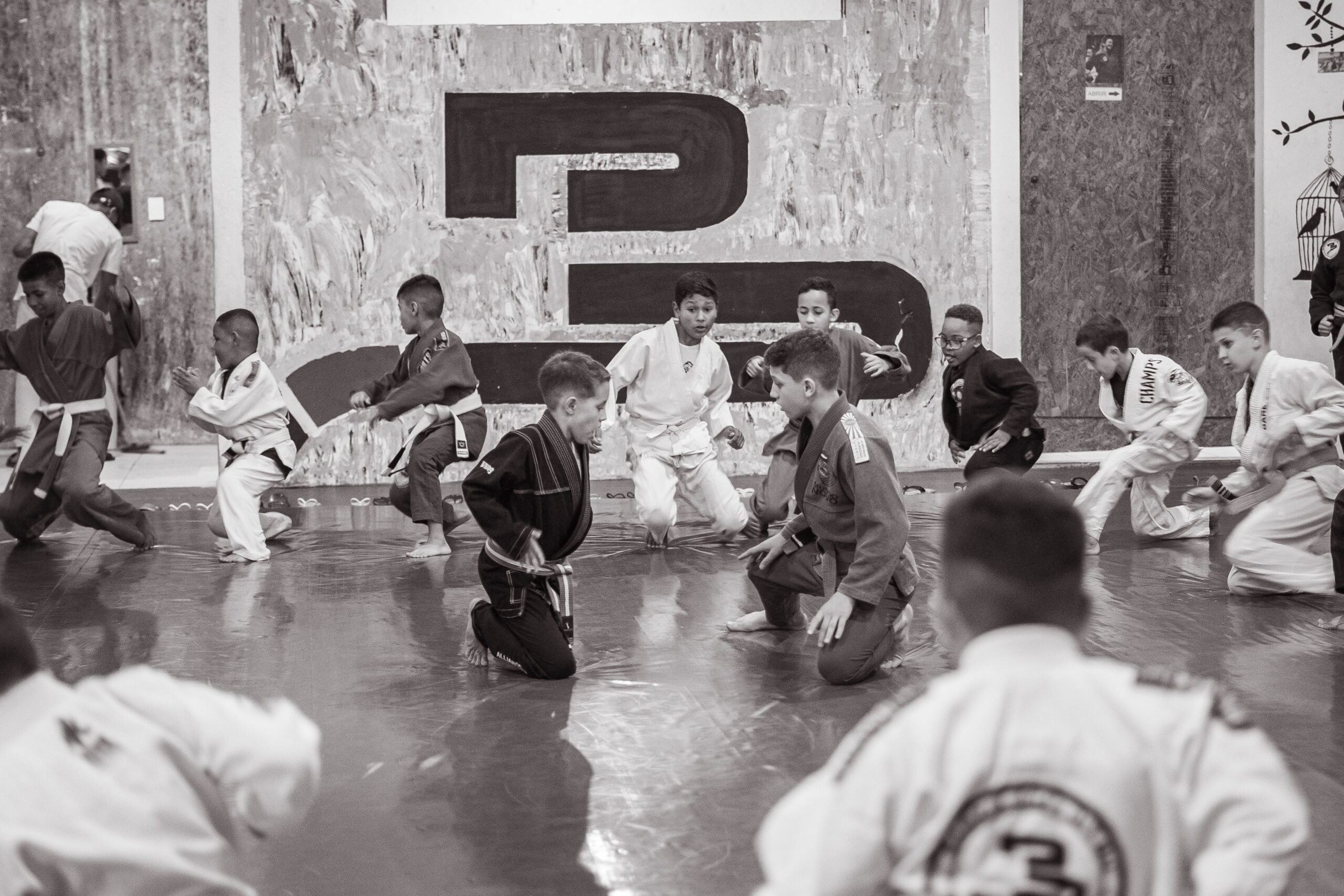
Belt colour does not tell you a child’s “skill level” the way an adult black belt would. At yellow, the honest reading is that the child has left the very first colours and is learning fundamentals with structure. Ask the head coach what the yellow-stage curriculum covers, how promotion is decided, and what safety rules the class enforces — same three questions as at grey. For the general training format, our guide to the BJJ open mat walks through what a rolling session looks like.
Stripes and degrees on a yellow belt
The part that surprises parents most: kids’ stripes and adult stripes are not the same system. Adults use four stripes up to brown belt; for youth belts, IBJJF only suggests how academies divide each colour into degrees, publishing three accepted methods at the professor’s discretion:
| System | Cadence | How many marks before the next colour |
|---|---|---|
| Monthly | One mark per month | 11 degrees; the 12th graduates the child |
| Triannual | Every four months | 2 degrees; the 3rd graduates the child |
| Quarterly | Every three months | 3 degrees; the 4th graduates the child |
So do not read a stripe count literally. A child on solid yellow with a few stripes can be in a very similar place to a child on yellow-and-black at a different club.
How promotion works: no minimum time
Under the IBJJF system, athletes aged 4 to 15 have no required minimum time in any youth belt, yellow included. This is the single most important fact for parents: there is no official clock that says “a child must spend X months at yellow.” The professor decides when the child is ready to move through the group.
Two rules govern how a kids’ belt move is recognised:
- The professor’s call. IBJJF leaves youth-belt timing entirely to the head coach; the “minimum period” rules start applying at age 16 and older.
- An affiliated black-belt professor signs off. A registered white-through-brown graduation must be approved by an IBJJF-affiliated black-belt professor to count with the federation — so do not assume a rank from a non-IBJJF club is recognised at IBJJF events.
In practical terms, a child typically rises yellow-and-white → solid yellow → yellow-and-black before the orange group, but nothing forces a fixed schedule. Ask the professor where your child sits rather than comparing them to a sibling or classmate.
What happens when a yellow belt turns 16
At 16 a youth athlete leaves the kids’ ladder for the adult one. The IBJJF rule is straightforward for yellow belts:
- Grey, yellow or orange belt → turns blue belt in the adult system.
- Green belt → blue or purple, at the professor’s decision.
- White belt → may stay white.
So a yellow belt does not keep climbing the kids’ colours and then reset at 16 — they graduate to the adult ranks as a blue belt. That is why nobody should compare a youth yellow belt to an adult blue belt along the way.
Yellow belt FAQs
How old are yellow belts in BJJ?
Officially, the IBJJF yellow group is for athletes aged 7 to 15. In most kids’ programs, children reach yellow after the grey group, commonly around age 7.
Is the yellow belt the same as a grey belt?
No. Grey is the first coloured group; yellow is the second, one step up. Yellow comes in three sub-belts (yellow-and-white, solid yellow, yellow-and-black) and usually signals the child has left the survival stage for structured fundamentals.
How long does a kid stay at the yellow belt?
There is no required minimum time for ages 4 to 15. How long a child stays yellow depends on the professor and the academy’s promotion style.
Does a yellow belt become a blue belt?
Yes, at 16. IBJJF says yellow belts (like grey and orange) turn blue when the athlete moves to the adult system; green belts may turn blue or purple at the professor’s decision.
Do yellow belts compete?
Yes, but check the specific event. Youth competition uses belt or colour group alongside age and weight, and divisions can vary between organisations. Look at the event page you registered for, not a general rule.
Bottom line
The yellow belt is the second colour group in BJJ’s youth system — three steps (yellow-and-white, yellow, yellow-and-black) for athletes aged 7 to 15, sitting between grey and orange. There is no minimum time in the belt: promotion is the professor’s call, and stripes reflect the academy’s chosen system. The useful sign for a parent is that the child left the entry colours, is learning structured fundamentals, and is having fun — not how fast the belt changes.
Sources
- IBJJF Graduation System — official page linking the June 2026 graduation document; primary source for the youth belt order, yellow age band, minimum periods, degree systems and the age-16 transition. The PDF pages carry “VERSION 3.1 2025©” while the final page prints “VERSION 3.3”; document date June 2026. Inspected November 11, 2026.
- When Should Children Start BJJ? (BJJ Fanatics) — parent-facing coaching article used for general advice on what young-to-school-age beginners learn; posted October 2018 under the platform’s “Fanatics Authors” byline. Used only for general advice, not for belt-age facts.