Quick answer: ashi garami is a leg-control position, not a submission. In Stephan Kesting’s standard-ashi breakdown, you control an ankle, bring your other knee between the partner’s legs, and place your other foot on their hip. Control the second ankle initially to limit stand-ups, and learn positional control before attacking. The exact entanglement, your division and the later attack determine what is legal.
Last updated: November 10, 2026 (Pacific). Sources checked November 11, 2026 UTC.
This guide is educational. Practice under qualified coaching, apply pressure gradually, tap early, and release immediately when a partner taps or cannot communicate clearly.
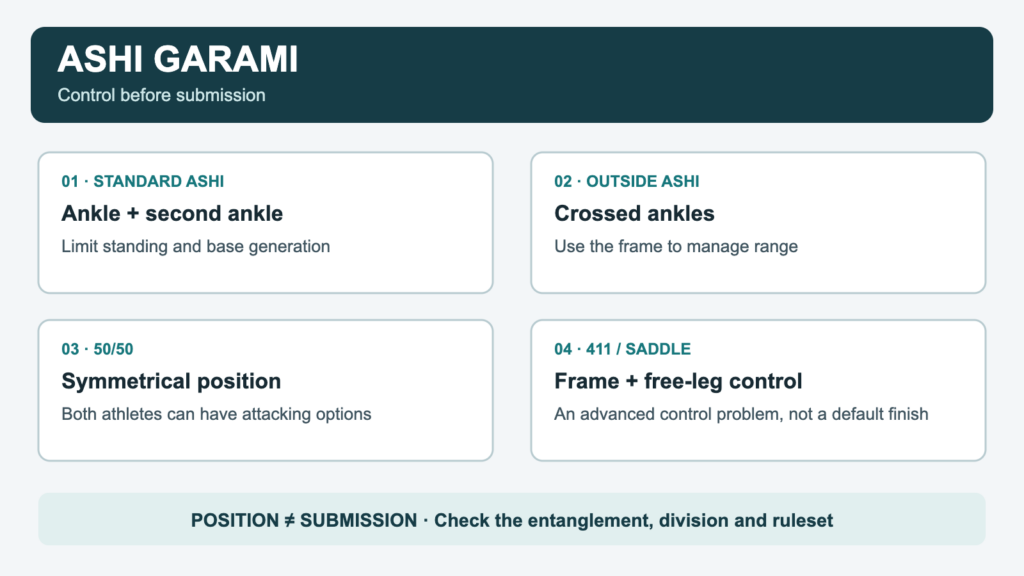
Ashi positions at a glance
| Position | Control priority | Main caution |
|---|---|---|
| Standard ashi | Control the ankle and second ankle; stop the stand-up | A recognizable shape without base control is not enough |
| Outside ashi | Move the middle leg outside, cross the ankles and manage range with the frame | Do not let the partner turn the transition into a back-take |
| 50/50 | Recognize the reciprocal leg configuration | Both athletes can have attacking options; it is not a one-way upgrade |
| 411 / saddle | Use a frame and control the free leg | Simply closing a triangle can let the partner push the knee and escape |
What is ashi garami?
In this context, ashi garami is a family of leg-entanglement positions used to control a partner’s leg and limit their base. Standard ashi is the starting configuration in Kesting’s breakdown and the Biernacki/Kesting reference.
Free every Tuesday
The Grappler Brief
The week’s biggest stories from BJJ, judo, wrestling, and submission grappling—curated for people who train.
Sent out weekly.Opt out anytime.
The naming is not perfectly consistent across gyms. The 2017 position reference describes standard ashi as superficially similar to single-leg X; it does not declare every use of those labels identical. If a coach says ashi, single-leg X, outside ashi or saddle, look at the actual leg configuration rather than relying on the word alone.
Our BJJ leg-lock reference separates position names from submissions. Use that glossary for orientation, then use the control checkpoints here to practice the position. Our single-leg-X guide covers guard entries, sweeps and passing in more detail.
Standard ashi: control the position first
Set the basic configuration
Kesting’s sequence is straightforward: control an ankle, bring your other knee between the partner’s legs, put your other foot on their hip, and clamp. The goal is to hold the position before reaching for an ankle lock, toe hold or heel hook.
Control the second ankle
Kesting emphasizes second-ankle control because otherwise the partner can stand. The 2017 reference says to control both legs initially to deny base, and notes that you can release that leg when digging for the actual submission.
Understand the strong side
You can hold standard ashi on either side. The position reference calls the side where the attacked leg is underneath the strong side, because it immobilizes the hip better. Treat that as a control preference, not a rule that every exchange will conveniently match.
Make balance the test
A position can look right and still do nothing. If the partner stands without resistance, peels your foot off their hip, or turns into you, the control has failed. Go back to the second ankle, the frame and your hip position before trying a finish.
A single-leg-X pressure drill that gives you feedback
The Ritchie Yip and Stephan Kesting drill gives a useful way to test whether the position affects balance. It is a control drill, not a submission drill.
- Start in single-leg X with your partner standing. The video deliberately skips entries, so begin from a stable, coach-checked position rather than forcing an entry.
- Check three connections. Yip’s cues are knee to your own heel, knee to the partner’s hip, and your hip to the partner’s knee.
- Lift your hips while maintaining those connections. Watch whether the standing partner’s hands come up for balance.
- Use the balance response as your endpoint. The feedback is the standing partner’s hands coming up for balance. Reset without adding a submission.
Keep the drill slow and give your partner a safe way to lower themselves.

How the main ashi positions connect
Outside ashi: change the frame, not just the name
From standard ashi, Kesting brings the middle leg outside and typically crosses his ankles. The position reference describes crossing the outside foot over the inside foot. Use the top knee as part of your frame to manage distance and make it harder for the partner to close in or take your back.
Control both legs as you move into outside ashi, and keep managing the partner’s base and escape routes.
50/50: recognize a mutual position
In 50/50, the athletes’ inside legs intertwine. Kesting demonstrates how both athletes can attack from this configuration, so do not assume the position favors you.
411 or saddle: use a frame and control the free leg
The 411 gets its name from your legs forming a 4 and the partner’s forming an 11. Kesting emphasizes opening or turning your knee toward the partner to create a frame and, ideally, controlling the other leg. His warning is specific: simply closing the triangle lets the partner push your knee and escape.
The position reference adds free-leg control and the range frame. For this introduction, focus on recognizing the saddle and practicing those controls under coaching before working on the reverse heel hook.
Common mistakes and better cues
| Mistake | Why it fails | Better cue |
|---|---|---|
| Chasing a submission immediately | The partner can stand, turn or peel the position apart | Hold the configuration first; add attacks only after control is reliable |
| Ignoring the second ankle | The free leg gives the partner a base | Account for both legs before allowing a stand-up attempt |
| Keeping a cosmetic single-leg-X shape | The position looks right but does not affect balance | Connect the circuit and look for the partner’s hands to come up for balance |
| Treating 50/50 as a one-way upgrade | The other athlete can have the same attacking options | Recognize the reciprocal position before entering it |
| Closing the 411 triangle without a frame | The partner can push your knee and escape | Turn the knee toward the partner and control the free leg |
| Assuming the position name settles legality | The actual entanglement can constitute reaping or lead to a restricted submission | Check the configuration, submission, division and event together |
Defensive priorities
Defend these control points before the position becomes settled.
- Keep your second ankle free. If the attacker controls it, do not force the stand-up; ask a coach to show the escape for that exact configuration.
- Address the frame early. Outside ashi gives the attacker range-management and back-take prevention. Respond before the crossed ankles and frame are established, not after your movement has been contained.
- Respect 50/50 as a two-way threat. Do not wait passively while assuming only the other person can attack.
- Identify a reap. If the configuration is prohibited in your division, stop and reset under the referee or coach’s direction. A label such as “ashi” does not make the configuration legal.
Is ashi garami legal in BJJ?
The position is not a submission, but that does not make every entanglement legal. The actual configuration can meet the definition of knee reaping, and the intended submission has its own belt, age and format restrictions.
The IBJJF illegal-moves poster v4.0 checked for this guide marks knee reaping in the 4–12, 13–15, 16–17/all-ranks/white, adult-to-Master-7 blue/purple, and adult-to-Master-7 brown/black except Adult No-Gi columns. It does not mark that row in the separate Adult brown and black belt no-gi column. That is a specific column distinction, not blanket permission for every masters division or every attack.
The poster also says the foot does not need to be held for it to be considered trapped. Do not assume you are outside the reaping rule just because your hands are not on the partner’s foot. Read the definition and compare the actual configuration, then check the submission separately in our IBJJF and ADCC leg-lock rules reference.
A straight ankle lock, heel hook and toe hold do not share one permission table. Your coach and the event documents need to match the exact attack to your division.
How to train ashi garami with control
- Name what you see. Have a coach identify standard ashi, outside ashi, 50/50 and the saddle from the actual legs, not just the label.
- Hold static positions without submissions. Practice the ankle control, second-ankle control and frames while your partner can communicate freely.
- Use the pressure drill. Connect the circuit and look for the standing partner’s balance response. Stop before adding an attack.
- Add one transition at a time. Move from standard to outside ashi, or recognize 50/50, then reset. Check that you have not given up the second leg or allowed a back-take.
- Check the rules before adding submissions. Club permission, tournament permission and the exact entanglement are separate checks. Increase resistance only when you can keep control without forcing a finish.
Ashi garami FAQs
Is ashi garami a submission?
No. It is a leg-control position or family of positions. The submission you attempt from that position is a separate technique with separate mechanics and rules.
Is ashi garami the same as single-leg X?
Not universally. The Biernacki/Kesting reference calls standard ashi superficially similar to single-leg X. Some coaches use related labels for related configurations, but you should check the actual legs and the instructional demonstration.
What is outside ashi?
Outside ashi is a related configuration where the middle leg moves outside and the ankles typically cross. It uses a frame to manage range and makes it harder for the partner to get close or take the back.
Is 50/50 a dominant position?
It can offer strong attacking options, but it is reciprocal. Both athletes may have options, so treating it as a one-way dominant position is a mistake.
Is ashi garami legal in IBJJF?
There is no single answer for every configuration and division. Standard position work is separate from submissions, while an actual reaping configuration can be prohibited. The checked poster has a specific adult brown/black no-gi exception for knee reaping, but that does not legalize every submission or masters category.
Bottom line
Ashi garami is useful when it controls base, not when it merely looks tangled. Control the second ankle and use the partner’s balance response to test the position. Before adding a submission, learn the frame and free-leg controls, then check the exact entanglement and attack against your division’s rules.
Sources
- Stephan Kesting, How to Get Started with Leglocks and the position demonstration — standard ashi, outside ashi, 50/50, reap and 411; video inspected November 11, 2026.
- Ritchie Yip and Stephan Kesting, Single-Leg X Pressure and the drill video — circuit connections, hip lift and off-balancing feedback; video inspected November 11, 2026.
- Rob Biernacki and Stephan Kesting, Modern Leglock Position Reference (2017) — position terminology and control concepts; pages 3, 5, 6 and 9 visually inspected November 11, 2026. Not used for current tournament legality.
- IBJJF Books and Videos — linked illegal-moves poster v4.0, including knee-reaping definition and category columns; visually inspected November 11, 2026.