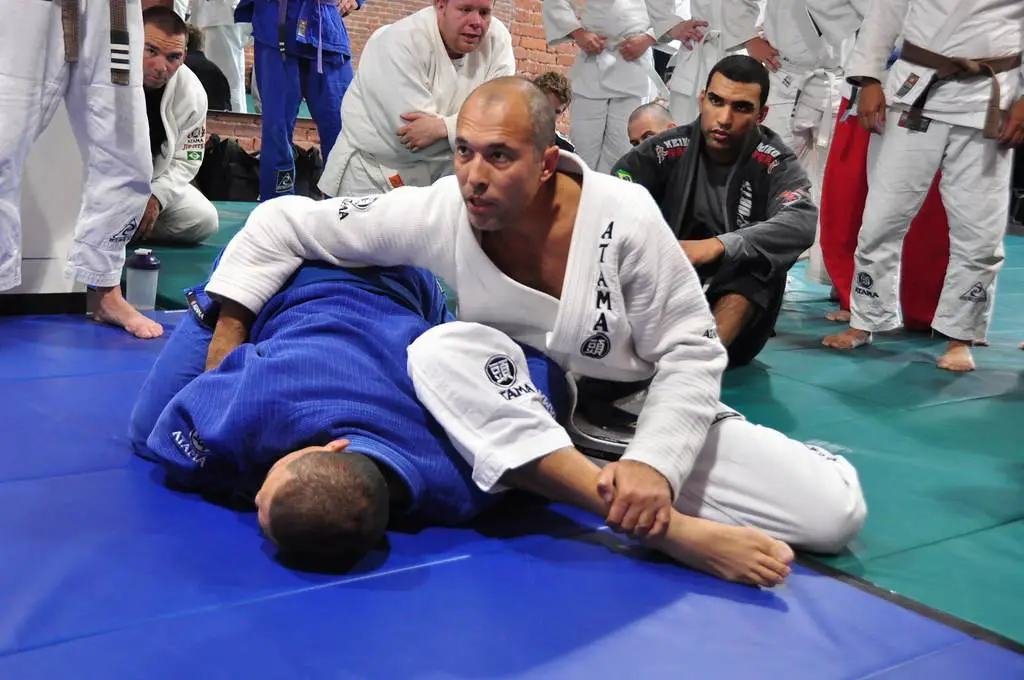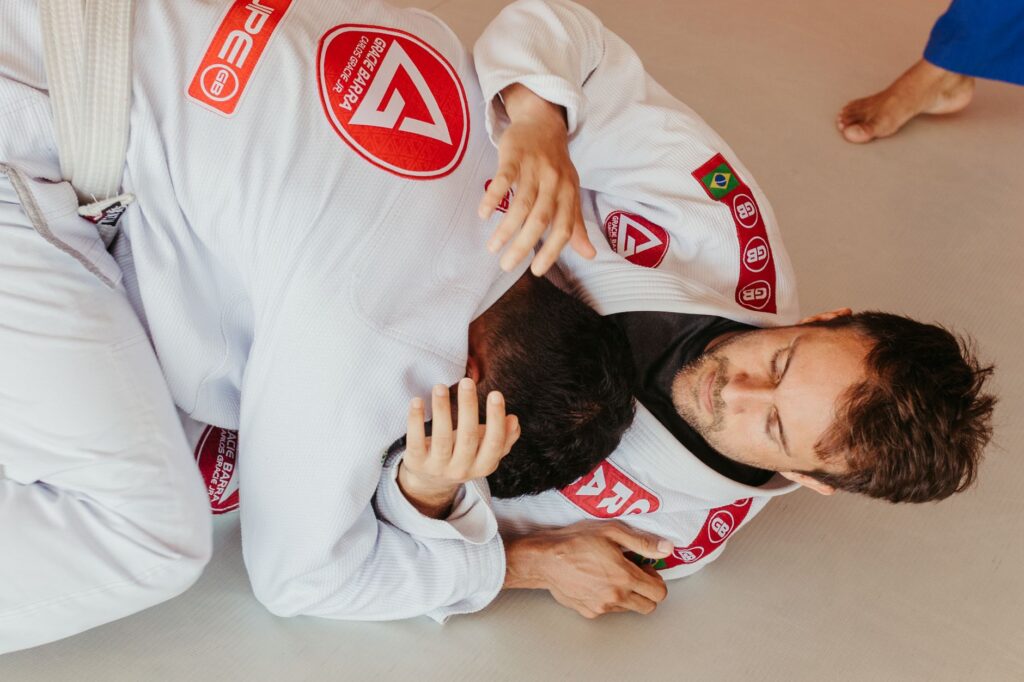
Quick answer: the D’Arce choke (also called the Brabo choke) is an arm-triangle-family strangle from the front headlock. Your arm threads under the opponent’s near armpit first, then across the back of their neck, and you lock a figure-four — their own trapped shoulder closes one carotid while your bicep closes the other. That “under the arm first” detail is the entire difference from the anaconda, which threads under the neck first. It is named after Joe D’Arce, who popularised it. In our dataset of 8,591 UFC bouts it accounts for 47 of 1,659 submission finishes (2.8%) — the sixth most common submission in UFC history.
Last updated: July 29, 2026. UFC figures come from our own analysis of 8,591 bouts (1994–2026) — methodology in the UFC statistics study. Legality is from the official IBJJF rule book and illegal-moves table.
Train chokes only under qualified supervision. Apply gradually, tap early, and release the moment your partner taps or stops responding.
D’Arce choke at a glance
| Question | Answer |
|---|---|
| Also called | Brabo choke, no-gi Brabo |
| Family | Arm-triangle — head and one arm trapped |
| Threading order | Under the arm first, then across the neck |
| What closes the artery | Their trapped shoulder on one side, your bicep on the other |
| UFC finishes | 47 — 2.8% of all UFC submissions, 6th most common |
| Where from | Front headlock, sprawl, failed takedowns, side control, half guard top |
| IBJJF legality | Legal at every belt, gi and no-gi |
Who is the D’Arce choke named after?
The technique takes its name from Joe D’Arce, the American black belt who used it prolifically enough that the grappling community attached his name to it. He is generally credited with popularising rather than inventing it — the Brazilian grappler Milton Vieira is widely credited with developing the mechanic, and in Brazil the same choke is usually called the Brabo choke.
Free every Tuesday
The Grappler Brief
The week’s biggest stories from BJJ, judo, wrestling, and submission grappling—curated for people who train.
Sent out weekly.Opt out anytime.
Attribution for grappling techniques is rarely clean, and this one is genuinely contested — treat “invented by” claims about the D’Arce with caution. What is not disputed is that the name honours D’Arce’s use of it, and that “Brabo” and “D’Arce” describe the same figure-four configuration.
How the D’Arce works
The D’Arce belongs to the arm-triangle family, which means the choking pressure is not really coming from your arm strength. It is coming from the opponent’s own shoulder being driven into the side of their neck.
Your choking arm threads deep under their near armpit and continues across the back of their neck, and your other arm completes a figure-four by gripping the bicep. Now their head and one arm are inside a closed triangle made of your limbs. Squeezing brings the two sides together: their shoulder on one carotid, your bicep on the other. This is the identical principle behind the triangle choke — the only difference is that the triangle builds the frame with legs and the D’Arce builds it with arms.

D’Arce vs anaconda vs arm-triangle
These three get confused constantly because all of them trap the head and one arm. The distinction is simply where your arm goes first and where you end up.
| D’Arce (Brabo) | Anaconda | Arm-triangle (head-and-arm) | |
|---|---|---|---|
| Arm threads under | The near armpit first | The neck first | Neither — you come from the side, chest to shoulder |
| Typical finish position | On your side or on top, perpendicular | Rolled through, opponent on their side | Mount or side control, flattened out |
| Common entry | Front headlock, sprawl, half guard top | Front headlock after a sprawl | Mount escape attempt, side control |
| UFC finishes | 47 | 38 | 126 |
The mnemonic worth remembering: D’Arce goes under the arm, anaconda goes under the neck. Everything else — the roll, the finishing angle, the grip — follows from that first decision.
How common is the D’Arce? UFC data
| Rank | Submission | UFC finishes | Share |
|---|---|---|---|
| 1 | Rear-naked choke | 648 | 39.1% |
| 2 | Guillotine choke | 293 | 17.7% |
| 3 | Armbar | 195 | 11.8% |
| 4 | Arm-triangle choke | 126 | 7.6% |
| 5 | Triangle choke | 114 | 6.9% |
| 6 | D’Arce choke | 47 | 2.8% |
Sixth of more than twenty classified techniques is a strong showing for a choke that only entered the mainstream in the 2000s. Worth noting the wider pattern in the data: the arm-triangle family — D’Arce, anaconda and the head-and-arm choke — accounts for 211 UFC finishes between them, 12.7% of all submissions. Learn the shared mechanic and you have three techniques, not one.
Finishing the D’Arce
- Thread deep. Shallow is the number-one reason the choke does nothing. Your hand should emerge well past the far side of their neck, not just reach it.
- Lock the figure-four — choking hand to your other bicep, that hand behind their head or on your own shoulder.
- Close their shoulder into their neck. Their trapped arm must be pushed across their own throat. If there is daylight between their shoulder and their neck, there is no choke.
- Drop your hips and change the angle. Sit toward their hips rather than staying square. Chest pressure does more than arm strength.
- Squeeze by bringing the elbows together and expanding your chest, exactly as in the arm-triangle.
Common mistakes
| Mistake | Why it fails | Fix |
|---|---|---|
| Arm not threaded deep enough | No frame; nothing compresses the far carotid | Swim the arm through until the hand clears the neck |
| Their shoulder not across the neck | The choke’s own engine is missing | Drive their trapped arm across their throat |
| Staying square to them | They defend and posture out | Drop hips, angle toward their legs |
| Squeezing with arms only | Tires fast, rarely finishes | Chest expansion + elbows together |
| Chasing it from a bad front headlock | They stand up and you lose the position | Break their posture down first |
Defending the D’Arce
- Prevent it: do not leave an arm trailing through when you turn in or shoot. The D’Arce is fed by the same low, head-down entries that hand over guillotines.
- Early: get your trapped-side hand to your own hip or thigh and keep your shoulder off your neck — that removes the compression before it exists.
- Posture and walk: circle your legs toward their head to kill the angle they need.
- If it is locked and angled, tap. Arm-triangle-family chokes go from comfortable to unconscious very quickly.
FAQ
Who is the D’Arce choke named after?
Joe D’Arce, the American black belt who popularised it. He is generally credited with popularising rather than inventing the technique — Milton Vieira is widely credited with developing the mechanic, and in Brazil it is usually called the Brabo choke. Attribution here is genuinely contested.
What is the difference between a D’Arce and an anaconda choke?
The threading order. In a D’Arce your arm goes under the opponent’s near armpit first and then across the neck; in an anaconda it goes under the neck first and then through the armpit. The D’Arce is usually finished from the side, the anaconda by rolling through.
Is the D’Arce choke effective?
Yes — 47 UFC finishes in our 8,591-bout dataset, 2.8% of all submissions and sixth most common overall. That is a strong record for a technique that only became widespread in the 2000s.
Is the D’Arce choke legal in BJJ?
Yes — under IBJJF rules it is legal at every adult belt in both gi and no-gi. It does not appear on the illegal-moves table. As with any arm-triangle, take care that pressure stays on the neck rather than becoming a crank on the spine.
Why can’t I finish my D’Arce?
Nearly always one of two things: the arm is not threaded deep enough, or the opponent’s trapped shoulder is not pressed across their own neck. Without the shoulder doing its half of the work you are just squeezing a head, which does nothing.
Is the D’Arce a gi or no-gi technique?
Both, but it is far more common in no-gi and MMA because it needs no cloth and thrives in the scrambles that follow failed takedowns. In the gi, grips slow the entries down. Our gi vs no-gi guide covers how format changes what works.
Bottom line
The D’Arce is an arm-triangle built with your arms instead of your legs, and it finishes for the same reason every choke in that family does: the opponent’s own shoulder closes one side of their neck. Thread deep, drive their shoulder across their throat, drop your hips and change the angle. Remember the one distinction that matters — under the arm is a D’Arce, under the neck is an anaconda — and you will stop confusing the two. Next, read the arm-triangle choke guide for the same mechanic from the top.
Sources
- GrapplerHQ UFC submissions dataset — 8,591 bouts (1994-03-11 to 2026-03-28), 1,659 submission finishes classified by technique. Methodology in our UFC statistics study.
- IBJJF Rule Book and Technical Fouls & Illegal Moves table — submission legality by belt