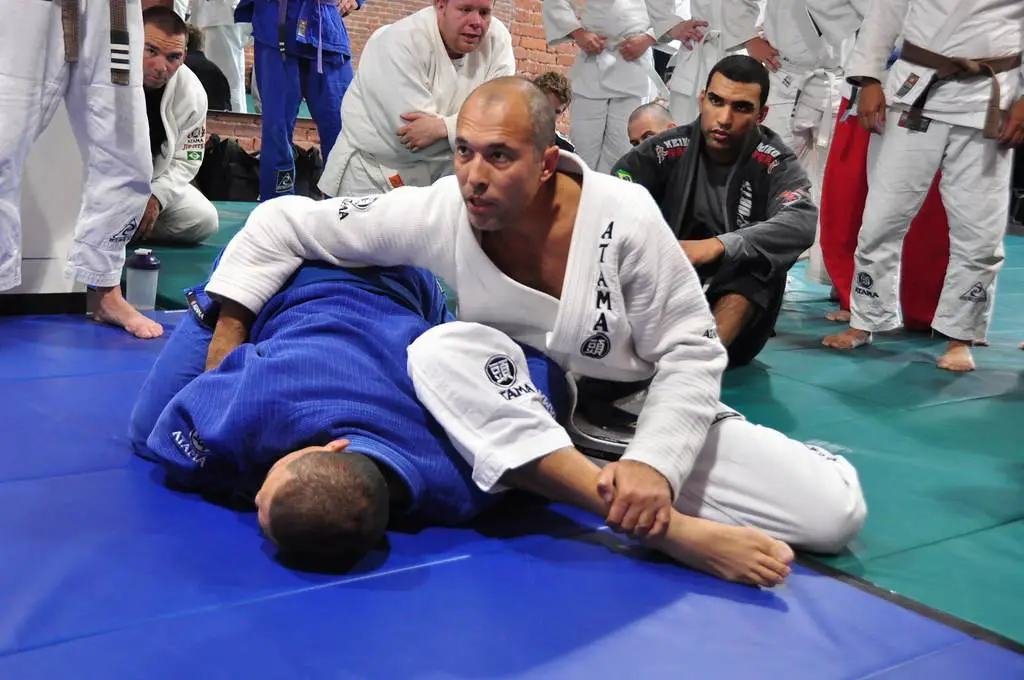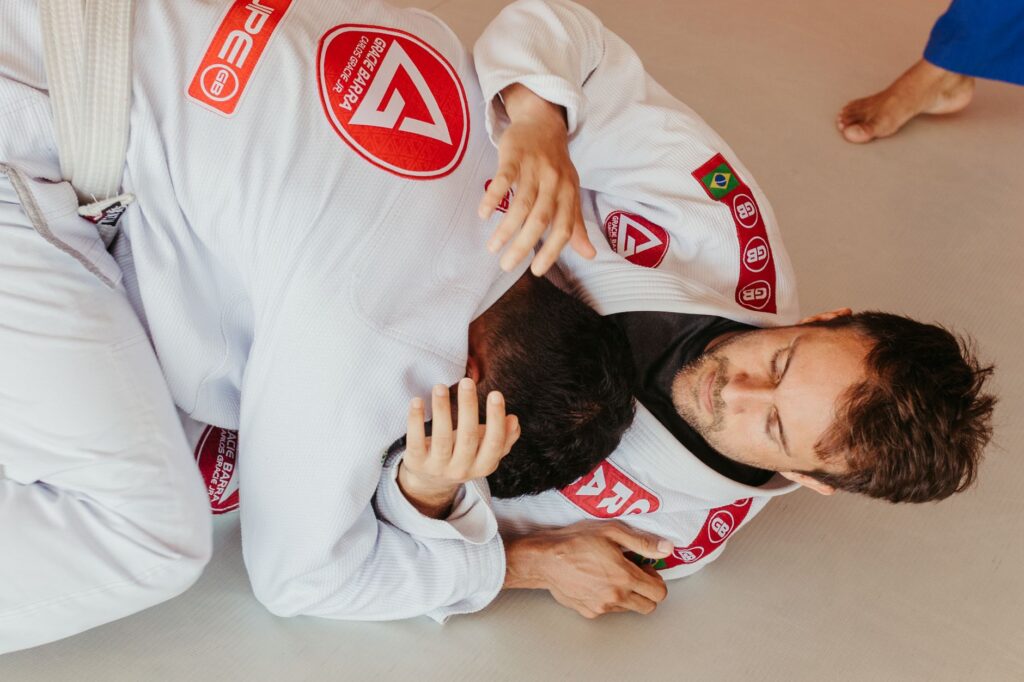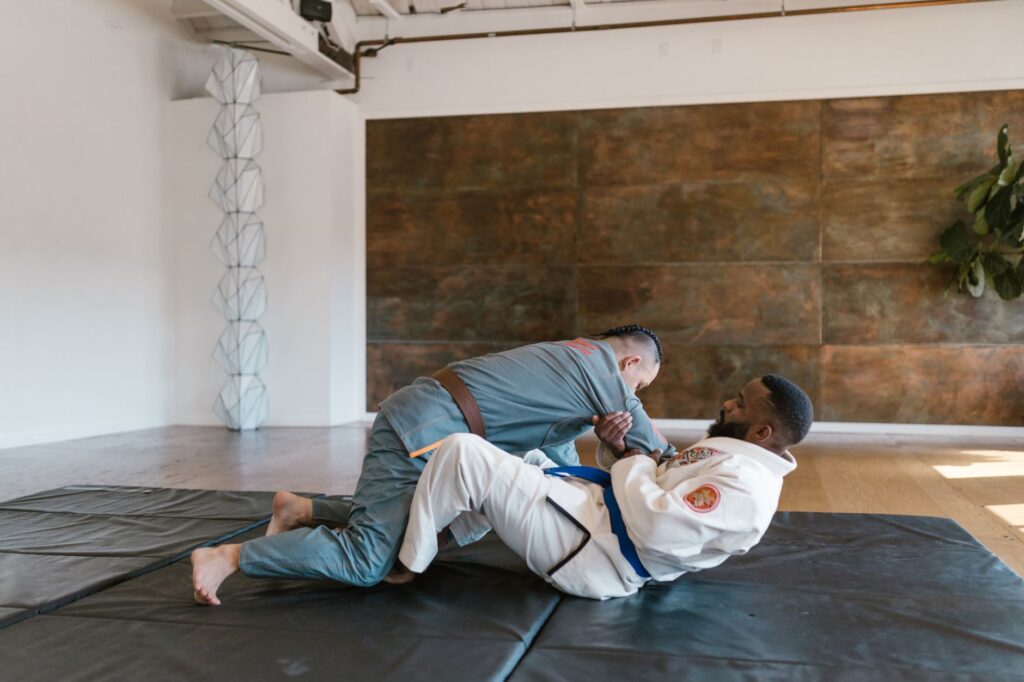
Quick answer: Half guard is the position where the bottom player traps one of the top player’s legs between both of theirs. Thirty years ago it was treated as a failed guard — the last stop before getting passed. Modern BJJ treats it as a complete attacking position with its own sweeps, back takes, and submissions. The whole position turns on one battle: who wins the underhook.
This guide is educational. Drill with qualified coaching, apply pressure gradually, tap early, and release immediately when a partner taps or cannot communicate clearly.
| Detail | Half guard summary |
|---|---|
| Technique family | Guard (bottom position) |
| Main variations | Knee shield (Z-guard), deep half, lockdown, dogfight |
| IBJJF scoring | Neutral; sweeps score 2, passing out of it scores 3 for the top player |
| Core battle | The underhook — and staying off your back on a shoulder |
What is half guard in BJJ?
Half guard means the bottom player controls one of the top player’s legs between their own — half of a closed guard, hence the name. That single trapped leg stops the top player from settling into side control, and everything else about the position grows from that delay.
The position’s reputation changed with the players who specialized in it. Lucas Leite built an entire world-class competition game around half guard sweeps and back takes. Bernardo Faria won IBJJF world titles pulling straight into deep half guard — voluntarily starting where older generations feared ending up. The knee-shield variation (often called Z-guard) became a staple for keeping distance, and in no-gi Craig Jones turned it into a launching pad for leg attacks.
Free every Tuesday
The Grappler Brief
The week’s biggest stories from BJJ, judo, wrestling, and submission grappling—curated for people who train.
Sent out weekly.Opt out anytime.
How half guard actually works
- Never lie flat. Flat half guard with the opponent’s crossface set is barely a guard at all. Stay on a shoulder, hips angled toward the trapped leg.
- Win the underhook. With the near-side underhook, you can come up to the dogfight, take the back, or sweep. Without it — crossfaced and flattened — you are mostly surviving.
- The knee shield buys space. A shin across the opponent’s torso (Z-guard) keeps their weight off you and creates the frames that longer-range attacks need.
- The trapped leg is a timer, not a treasure. Its only job is to slow the pass while you improve grips and angle. Holding it while flat just delays the inevitable.
Common entries into half guard
- Guard retention: when a pass is halfway through, catching the passer’s trailing leg converts a nearly-lost exchange into half guard. This is the most common entry in live rolling.
- Deliberate pull: gi competitors pull directly to knee-shield or deep half to start their preferred game, exactly as Faria did at the world-championship level.
- From mount and side escapes: the elbow escape from mount typically recovers half guard first, full guard second — half guard is the landing zone of most escapes.
What to attack from half guard
From the underhook and dogfight: the classic knee-tap and driving sweeps, plus back takes when the top player whizzers hard and leaves their hips behind. From deep half: sweeps that lift the opponent’s base leg and roll them over their own trapped foot. From knee shield: distance attacks like the omoplata, and in no-gi, entries into leg entanglements — though anyone attacking legs should study the heel hook‘s safety and legality profile first. The top player attacks too: half guard passing pressure feeds the D’Arce choke when the bottom player dives for underhooks carelessly.
Common mistakes
| Mistake | Why it fails | Better cue |
|---|---|---|
| Lying flat on the back | The crossface comes, the leg gets freed, the pass follows | On a shoulder, hips turned toward the trapped leg |
| Reaching for the underhook late | You dive under a settled whizzer and feed the D’Arce | Fight for the underhook as the position forms, not after |
| Using the knee shield passively | A static shield gets smashed flat or pummeled past | Shield creates space for an attack — use the space it buys |
| Ignoring the far leg (top player) | Bottom player’s knee lever keeps regenerating the guard | Control the knee line before extracting the trapped leg |
How opponents pass half guard
- Flatten and crossface: kill the bottom player’s angle first, then free the knee — the orthodox route. The crossface is what makes it work.
- Knee slice: cutting the trapped knee across the bottom player’s thigh while blocking the underhook.
- Backstep and leg extraction: stepping over to the other side against knee shields, or walking the trapped foot free once the upper body is controlled.
- The pattern across all of them: win the upper body before freeing the leg. Passers who tug the leg first usually stay stuck.
How half guard is scored in competition
Half guard is neutral under the IBJJF-style points system — nobody scores for being in it. Sweeps from half guard that reverse and stabilize score 2 points. For the top player, completing the pass out of half guard into side control scores 3. One nuance worth knowing: ending up in top half guard after a sweep still counts as the sweep’s 2 points in most rulesets, since you reversed the position — but stabilization requirements vary, so check the BJJ rules and scoring guide and the current event rulebook.
Safety and training notes
- The lockdown stresses knees and ankles. The figure-four leg configuration twists the trapped leg; apply it progressively and release when partners signal discomfort.
- Deep half puts your head near knees. In scrambles, protect your face and neck — accidental knees in drilling are a known hazard of the position.
- Leg entanglement entries from knee shield carry the usual leg-lock cautions: know what is legal for your belt and ruleset before training them live.
Stop if a partner reports unusual pain, numbness, or trouble breathing beyond normal positional discomfort. This article does not diagnose injuries; seek qualified medical care for concerning or persistent symptoms.
Examples to study
- Lucas Leite’s half guard. The reference game for the underhook-and-dogfight style: watch how he treats half guard as a wrestling position with his back merely near the mat.
- Bernardo Faria’s deep half. A world-title game built on entering deep half on purpose and sweeping with almost no athleticism required — the clearest proof that position beats explosiveness.
Related GrapplerHQ guides
Sources and further reading
- IBJJF Books and Videos — current rules materials
- ADCC Rules and Regulations
- Injury prevalence among BJJ practitioners — PubMed
FAQ
Is half guard a bad position?
Not anymore. Old-school BJJ treated it as a failing guard, but modern competitors have won world titles attacking from it. Flat half guard with no underhook is bad; angled half guard with the underhook is a genuine attacking platform.
What is the difference between half guard and Z-guard?
Z-guard (knee shield half guard) is a half guard variation where the bottom player’s top knee crosses the opponent’s torso as a frame, managing distance instead of playing chest-to-chest.
What is the dogfight in half guard?
The dogfight is the position where the bottom player comes up on the underhook to their knees, head to head with the top player who is whizzering back — the crossroads where half guard sweeps and back takes get decided.
Does sweeping from half guard score points?
Yes — 2 points under IBJJF-style rules once you reverse the position and stabilize, the same as sweeps from any guard. Verify details in the event’s current rulebook.
Bottom line
Half guard is only as good as your angle and your underhook. On a shoulder with the underhook won, it is a legitimate attacking position that has produced world champions. Flat on your back without it, it is exactly what the old-timers thought it was — a guard on a countdown. Get off your back, win the pummel, and the position does the rest.