Quick answer: catch wrestling — properly catch-as-catch-can — is an English wrestling style from 19th-century Lancashire in which you win by pinning both shoulders or by forcing a submission. It is defined by what it permits rather than what it bans, and one line separates the three major wrestling styles: Greco-Roman forbids attacking the legs, freestyle allows leg attacks but forbids joint locks, and catch allows both. Olympic freestyle wrestling is, in effect, catch-as-catch-can with the submissions legislated out — it entered the Games at St. Louis in 1904. Catch has no single governing body and no unified rule book, which is why “the rules of catch wrestling” vary by event.
Last updated: July 28, 2026. Unlike judo, sambo or BJJ, catch wrestling has no international federation publishing an official rule book, so this guide is sourced from wrestling’s governing body for the Olympic history (United World Wrestling) and from documented historical accounts for the rest. Where a claim is contested or unstandardised, it says so.
Catch wrestling occupies an odd place in grappling. It is simultaneously the ancestor of the wrestling you see at the Olympics, the root of professional wrestling before it became theatre, and the base of the Japanese shoot-style scene that produced modern MMA — and yet most people have never seen a match. The reason is structural, and it is the most useful thing to understand about the art.
Catch wrestling at a glance
| Question | Answer |
|---|---|
| Also called | Catch-as-catch-can (CACC), Lancashire wrestling, loose-hold, hooking |
| Origin | England — primarily the Lancashire style, with influence from Cumberland and Westmorland, Cornish and Devonshire wrestling, and Irish collar-and-elbow |
| How you win | Pin both shoulders (a fall) or force a submission |
| Leg attacks | Legal |
| Joint locks | Legal — the defining difference from freestyle |
| Governing body | None worldwide. Rules are set per event or per school |
| Practitioner names | Catch wrestler, catcher, hooker, shooter |
| Olympic status | Only in its de-fanged form — amateur freestyle, since 1904 |
What is catch wrestling?
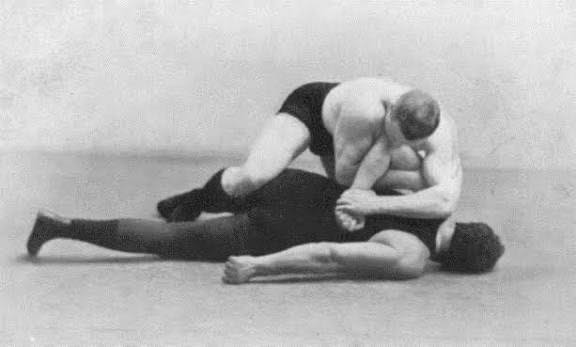
Catch wrestling is a jacket-free grappling style built on two ways to end a fight: put both of your opponent’s shoulders on the mat, or hurt them until they quit. Historically, matches began with both wrestlers standing. If neither scored a fall, the match continued on the ground, and — in the phrasing used of the old rules — almost all holds and techniques were allowable.
Free every Tuesday
The Grappler Brief
The week’s biggest stories from BJJ, judo, wrestling, and submission grappling—curated for people who train.
Sent out weekly.Opt out anytime.
The name is the definition. “Catch as catch can” means catch a hold wherever you can catch one: no restricted target areas, no forbidden grips, no positional etiquette. That permissiveness is the whole identity of the style, and it is why catch produced a vocabulary the Olympic styles never needed — a submission is a hook, a punishing hold used to wear an opponent down is a stretch, and a wrestler who could actually apply them for real was a hooker or a shooter.
The one rule that separates the wrestling styles
If you remember one thing from this page, make it this table. The three major wrestling styles are distinguished by exactly two permissions.
| Style | Attacking the legs | Joint locks / submissions | Won by |
|---|---|---|---|
| Greco-Roman | ❌ Forbidden | ❌ Forbidden | Pin or points |
| Freestyle | ✅ Allowed | ❌ Forbidden | Pin or points |
| Catch-as-catch-can | ✅ Allowed | ✅ Allowed | Pin or submission |
Catch is the only one of the three where you can make someone quit. That single permission changes everything downstream: it is why catch developed a deep leg-lock and neck-crank game while freestyle developed none, and why a catch wrestler on top is trying to hurt you rather than turn you. Our types of wrestling guide covers how folkstyle, freestyle and Greco-Roman diverge from each other, and wrestling rules and scoring explains the points systems catch never adopted.
Note the absence of a points column. Classical catch has no points — you win or you don’t. Some modern events layer scoring on top to avoid draws, but that is an event rule, not a feature of the style.
Signature holds: hooks and stretches
Catch’s submission set overlaps heavily with modern no-gi grappling, but the names and the emphasis differ. A few worth knowing:
- Double wristlock — catch’s name for the hold BJJ calls the kimura. Same shoulder lock, different lineage and a much heavier emphasis on hitting it from top position.
- Toe hold and ankle locks — leg attacks were never restricted in catch, so they arrived generations before the modern leg-lock boom in no-gi jiu-jitsu.
- Neck cranks — legal in classical catch and banned in most modern sport-grappling rule sets, including IBJJF competition.
- Body and limb “stretches” — holds designed to inflict pain and break posture rather than to finish immediately, used to force a mistake or a quit.
The strategic difference from jiu-jitsu is the pin. In BJJ, holding someone down is a means to an end; in catch, the pin is a win condition in itself, so a catch wrestler has two threats running at once and you cannot safely defend only one.
Where catch wrestling came from
Catch grew out of the English regional wrestling traditions, principally the Lancashire style, absorbing elements of Cumberland and Westmorland, Cornish and Devonshire wrestling along with Irish collar-and-elbow. It became genuinely popular through 19th-century fairs and festivals, where wrestlers took on all comers for money — an environment that rewarded holds that ended fights quickly and punished anything decorative.
Its most famous institution is Billy Riley’s gym in Wigan, Lancashire — the Snake Pit — which trained a generation of wrestlers whose influence spread far beyond England. British emigration and the American carnival and travelling-show circuit carried catch to the United States, where it became the foundation of early professional wrestling. Professional wrestling was, at that point, a legitimate competitive sport, and it was catch.
How catch became Olympic freestyle
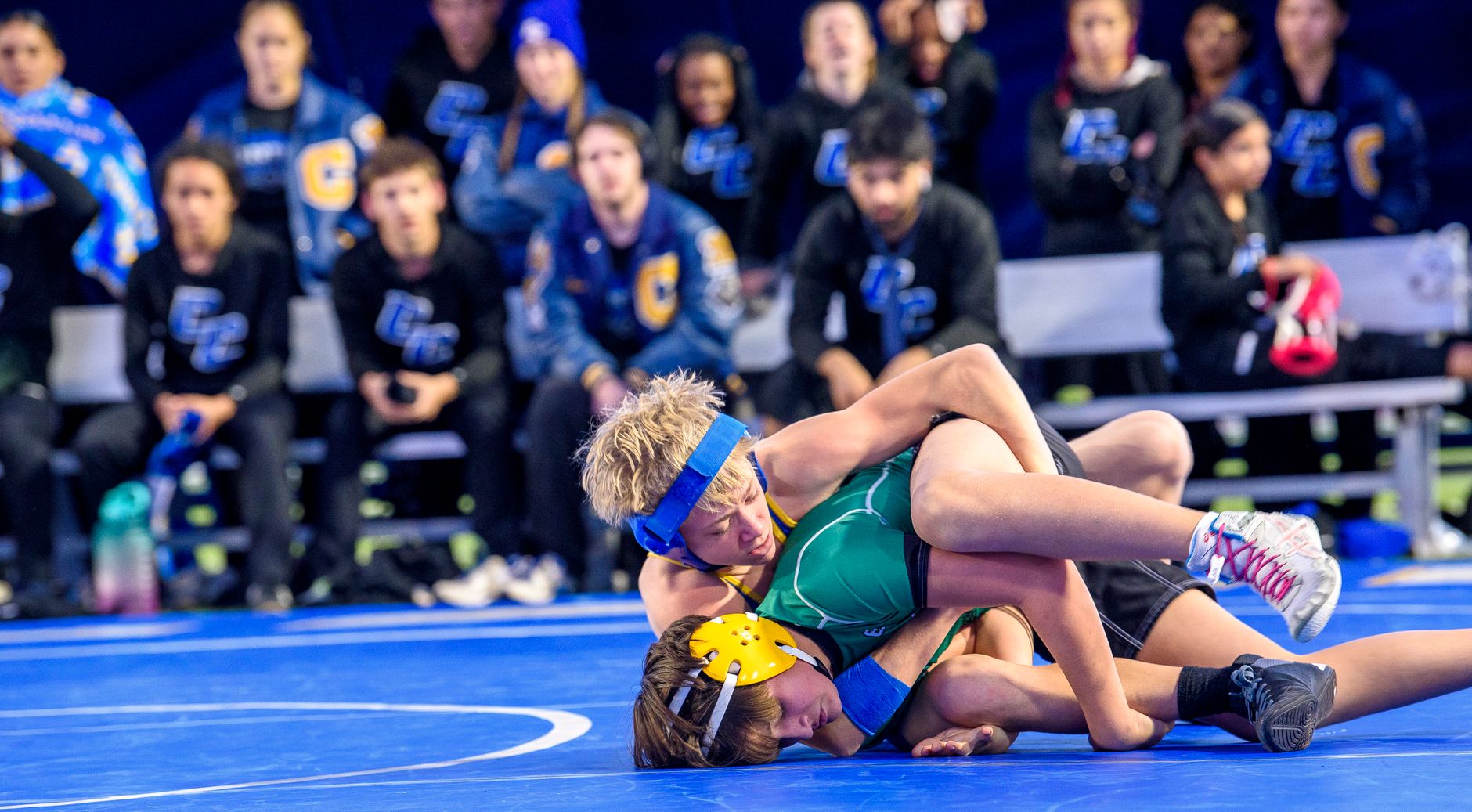
This is the part of the story that explains catch’s obscurity. When wrestling was organised for international amateur competition, the submissions had to go — an amateur governing body could not sanction joint locks and neck cranks. The result was freestyle: catch-as-catch-can with the dangerous holds removed and a points system added.
Freestyle wrestling entered the Olympics at the 1904 St. Louis Games, where, as United World Wrestling records, it “was only disputed by American wrestlers.” The international federation that would become UWW followed later — the International Amateur Wrestling Federation was created at the IOC Congress in Lausanne in 1921, becoming FILA in 1954 and United World Wrestling in the modern era.
So catch did not die; it split. The pinning half went to the Olympics and became the most institutionally successful grappling sport on earth, feeding American school and college wrestling. The submission half went to professional wrestling and, eventually, to Japan.
The MMA lineage
Catch’s route into modern MMA runs through one gym and one man. Karl Gotch trained at Billy Riley’s Snake Pit in Wigan, then began teaching catch wrestling to Japanese professional wrestlers in the 1960s — among them Antonio Inoki, Tatsumi Fujinami, Hiro Matsuda, Satoru Sayama and Yoshiaki Fujiwara.
Those students drove the “shoot-style” movement and the UWF, which staged professional wrestling contested with real submissions — and that scene led directly into Japan’s MMA boom. The threads are traceable at the individual level: Wigan’s Billy Robinson trained Kazushi Sakuraba, and Lou Thesz trained Kiyoshi Tamura. Catch wrestling is the acknowledged base of Japanese shoot wrestling, and its fingerprints are also on Luta Livre and on sambo.
This is why catch keeps resurfacing in MMA commentary despite having almost no competitive infrastructure. The techniques never left — they were absorbed. Our UFC statistics study shows how much of the sport is still decided by exactly the skills catch prioritised: top control, pressure and finishing.
Does catch wrestling still exist?
Yes, though at a scale nowhere near judo, wrestling or BJJ. A deliberate revival began in the 1980s, and there is now a competitive circuit — the Snake Pit’s Catch Wrestling World Championships, the Snake Pit British Championships, and events such as the ACWA US Open. The Wigan gym still operates and still teaches.
What catch does not have is a single international federation. There is no catch equivalent of the IJF, FIAS or IBJJF setting one rule book, ranking athletes and sanctioning championships. Several organisations promote the style in parallel. That is a genuine structural weakness — it means “catch wrestling rules” is always an event-specific question — and it is the honest answer to why the art stayed small while its techniques went everywhere.
Catch wrestling vs BJJ
One rule separates them: in catch a pin loses you the match, in BJJ it costs points and you fight on. That is why catch is relentlessly top-oriented with almost no guard game, while BJJ built a complete offensive system for fighting off the back. Catch also permits neck cranks, which the IBJJF bans, and never restricted leg locks by rank.
Our full catch wrestling vs BJJ comparison works through the submissions, the guard question, training culture and which transfers better to MMA.
FAQ
What is catch wrestling?
Catch wrestling, or catch-as-catch-can, is an English wrestling style in which you win by pinning both of your opponent’s shoulders or by forcing a submission. It permits both leg attacks and joint locks, which distinguishes it from Greco-Roman (no leg attacks) and freestyle (no joint locks).
Is catch wrestling the same as BJJ?
No. Both use submissions, but catch also lets you win by pin, has essentially no guard game, permits neck cranks, and has no belt ranking system. BJJ developed a deep system for fighting from the bottom precisely because being held down does not lose you the match.
Is catch wrestling a legitimate sport?
Yes — it is a real competitive style with active championships, including the Snake Pit’s Catch Wrestling World Championships and the ACWA US Open. The confusion comes from its link to professional wrestling, which began as genuine catch competition before becoming scripted entertainment.
Does catch wrestling still exist?
It does, following a revival that began in the 1980s, but on a small scale and without a single global governing body. Billy Riley’s Snake Pit gym in Wigan still operates, and several organisations run events under their own rule sets.
Is freestyle wrestling the same as catch wrestling?
Freestyle descends from catch-as-catch-can but is not the same thing. Amateur governing bodies removed the joint locks and other dangerous holds and added a points system, producing the Olympic style that debuted at the 1904 St. Louis Games.
What is a “hooker” in catch wrestling?
A hooker is a wrestler skilled at applying real submissions — “hooks” — as opposed to performing them. The related term “shooter” describes someone capable of wrestling for real, which is where the phrase “shoot fight” comes from.
Bottom line
Catch wrestling is the missing link in grappling history: the style that allowed both leg attacks and submissions, lost its submissions to become Olympic freestyle, and passed its finishing game to professional wrestling and then to Japanese shoot-style and MMA. It survives as a living art with real championships but no unified federation — which explains both its obscurity and the fact that its techniques are everywhere. If you want the styles it became, start with our types of wrestling guide and the wrestling hub.
Sources
- United World Wrestling — History of Wrestling & UWW — the 1904 St. Louis freestyle debut and the IAWF/FILA/UWW federation timeline
- Catch wrestling and Freestyle wrestling — regional origins, the catch-as-catch-can to freestyle lineage, the Wigan/Gotch transmission into Japanese shoot-style, and the modern revival
Note on sourcing: catch wrestling has no international federation publishing an official rule book, so no primary rules document exists to cite in the way the IBJJF rule book can be for jiu-jitsu. Historical claims here follow the documented consensus account and are flagged where they are contested.