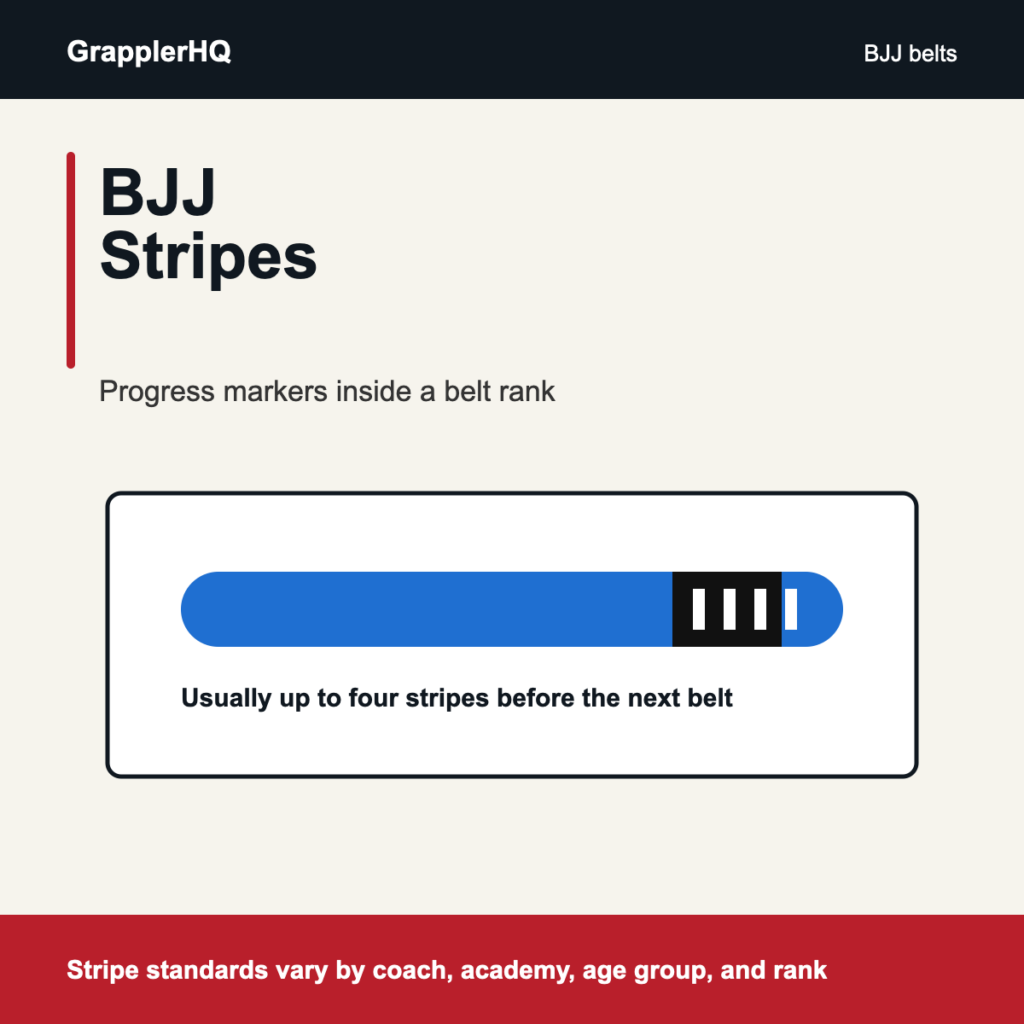
Quick answer: BJJ stripes are progress markers inside a belt rank. For white, blue, purple, and brown belts, many academies use up to four stripes before the next belt, but stripe standards vary by instructor and gym. At black belt, stripes are usually discussed as degrees and follow a more formal senior-rank structure.
Last updated: June 15, 2026. This guide explains what BJJ stripes mean, how they are usually awarded, how many stripes are common, and why stripes are not the same thing as a guaranteed promotion. For the full rank sequence, see our BJJ belt order guide.
What do stripes mean in BJJ?
In Brazilian Jiu-Jitsu, stripes usually show progress within your current belt. They are often small pieces of tape added to the rank bar on the belt. A stripe can reflect attendance, technical improvement, sparring progress, attitude, competition performance, or a mix of those factors.
The key point is that stripes are not universal. One academy may award stripes on a schedule. Another may use them only when a student shows specific skills. Another may barely use stripes at all. Your coach’s standard is the one that matters in your gym.
Free every Tuesday
The Grappler Brief
The week’s biggest stories from BJJ, judo, wrestling, and submission grappling—curated for people who train.
Sent out weekly.Opt out anytime.
How many stripes are on a BJJ belt?
Many academies use up to four stripes on white, blue, purple, and brown belts before promotion to the next belt color. The official IBJJF Graduation System says white, blue, purple, and brown belts for athletes 16 and older can be divided by four degrees, while adoption of the degree system up to brown belt is at the professor’s discretion.
| Rank | Common stripe use | Important caveat |
|---|---|---|
| White belt | Often 0 to 4 stripes before blue belt | Standards vary widely by academy. |
| Blue belt | Often 0 to 4 stripes before purple belt | Some gyms use stripes formally; others do not. |
| Purple belt | Often 0 to 4 stripes before brown belt | Progress is usually more skill-based than attendance-based. |
| Brown belt | Often 0 to 4 stripes before black belt | Promotion standards are usually strict and academy-specific. |
| Black belt | Degrees over time | Senior degrees are handled differently from colored-belt stripes. |
How do you earn stripes in BJJ?
There is no single universal formula. A white belt might earn a stripe for consistent attendance and basic progress. A blue or purple belt may need to show more technical depth, better sparring decisions, and stronger control of specific positions.
- Consistency: showing up often enough to build and retain skill.
- Technical growth: improving escapes, guard work, passing, control, and submissions.
- Live application: using techniques against resisting partners, not only in drilling.
- Safety and attitude: training in a way that helps partners improve too.
- Coach discretion: instructors can weigh different factors based on the student, rank, and academy.
Do stripes guarantee the next belt?
No. Four stripes often means a student is approaching the next belt, but it does not guarantee promotion. Some students spend a long time at four stripes. Some academies promote students without using all four stripes. Some do not use stripes consistently at all.
The better way to read stripes is as feedback. A stripe can tell you that your coach sees progress, but it should not become the main goal of training.
White belt stripes vs black belt degrees
White belt stripes and black belt degrees are not the same thing. White belt stripes are usually gym-level progress markers. Black belt degrees are senior-rank recognition and are much more tied to time at rank, teaching, contribution, and federation rules.
If you want the full senior-rank picture, start with our BJJ coral belt guide. For the broader student-rank map, use the BJJ belt order guide.
How to think about stripes as a student
Stripes can be motivating, especially early in training. The problem starts when the stripe becomes the point. If you train only for the next piece of tape, you may miss the real work: learning how to move, stay safe, solve problems, and become a better training partner.
- Ask your coach what they want you to improve before the next stripe.
- Track skills, not just attendance.
- Use positional rounds to test the weak areas your coach points out.
- Do not compare your stripe timeline to another student’s timeline.
- Remember that some gyms use stripes differently, so context matters.
Bottom line
BJJ stripes are useful progress markers, but they are not universal guarantees. Many academies use up to four stripes on colored belts, while black belt degrees follow a different senior-rank structure. The safest rule is simple: treat stripes as feedback, keep training, and let your coach’s standards guide the next promotion.
FAQ
What do stripes mean in BJJ?
Stripes usually mark progress within your current belt. They can reflect attendance, skill development, sparring improvement, attitude, or coach discretion.
How many stripes do you need before the next BJJ belt?
Many academies use up to four stripes before the next belt, but this is not universal. Some gyms promote without using all four stripes, and some use stripes loosely.
How long does it take to get a stripe in BJJ?
It varies. Some academies award early white belt stripes after a few months of consistent training, while higher-rank stripes can take much longer and depend more on skill development.
Are BJJ stripes official?
Stripes are widely used, but colored-belt stripe standards vary by academy. IBJJF recognizes degree divisions in its graduation system, while adoption up to brown belt is at the professor’s discretion.