Quick answer: strength training for BJJ is worth doing, but it works best as a coach-designed framework built around your existing mat load — not a copied program. A 2023 systematic review of Olympic combat sports found strength training improved maximal and isometric strength, power, flexibility and balance, and a 2026 randomised trial reported strength-endurance gains in competitive BJJ athletes from an 8-week structured program. The practical question is scheduling: how much lifting your body can recover from on top of sparring. This guide gives a framework coaches can adapt — capacity, compound movement selection, recovery, and in-season management — and it is not a substitute for individualised programming.
Last updated: November 11, 2026. Sources checked November 11, 2026 (UTC).
This article is educational and is not medical advice. It does not prescribe a fixed training program. If you have symptoms, a diagnosed condition, a recent injury, or you are returning to training, speak with a qualified healthcare professional and work with a coach before starting or changing strength work.
Most grapplers do not need a “BJJ strength program.” They need to know how much extra training load they can carry, which movements give the most return, and when to cut strength work back during competition weeks.
Free every Tuesday
The Grappler Brief
The week’s biggest stories from BJJ, judo, wrestling, and submission grappling—curated for people who train.
Sent out weekly.Opt out anytime.
Strength training for BJJ at a glance
| Framework area | What to know |
|---|---|
| Why lift | Combat-sport athletes show strength, power, balance and flexibility gains from structured resistance training |
| Capacity first | Start from your current BJJ schedule, age, injury history and training status; add load you can actually recover from |
| Movement selection | Multiple-joint (compound) movements form the core, coached with controlled technique before load |
| Frequency guideline | General strength-guidance for novices and intermediates is about 2–3 sessions per week; a coach adjusts this for your BJJ load |
| Recovery | Progress only when you recover; poor sleep, constant soreness and declining sparring quality are signals to reduce load |
| In-season management | Competition weeks usually mean cutting strength volume and intensity, not stacking it on top |
| Who should design it | A qualified S&C coach or experienced coach who knows your sport and your training history |
What the evidence says about strength training and combat sports
The best summary evidence comes from combat sports closely related to BJJ. A 2023 systematic review of 20 studies covering 504 athletes across judo, boxing, karate, wrestling and fencing found that strength-training interventions improved maximal dynamic and isometric strength, muscle power, flexibility and balance, with gains also seen in sport-specific actions. The review is explicit that findings apply to Olympic combat sports, so treat it as supporting context rather than a BJJ-specific verdict.
The direct BJJ evidence is thinner but growing. A 2026 randomised trial put 44 competitive male BJJ athletes through eight weeks of structured circuit training — resistance, plyometric, gymnastic and BJJ-related work — while a control group did standard BJJ training. The strength-training group showed large improvements in bench press and squat strength-endurance, pull-ups with a gi and trunk flexibility. Treat one trial as a signal, not a law: it used a circuit format, competitive males, and a single program.
A 2017 systematic review of BJJ athlete profiles adds a practical note: BJJ is intermittent, athletes can face several matches in a day, and maximal, isometric and endurance strength have each been linked with competitive success. In other words, strength is relevant to BJJ because matches demand sustained force application — squeezing, framing, controlling posture — not because you need to look like a powerlifter.
A coach-friendly framework: four areas, not one program
No fixed sets-and-reps plan belongs in this article. What coaches can use is a framework that adapts to the athlete. The ACSM position stand on resistance-training progression — the widely used reference for exercise selection, loading and frequency — recommends starting novices with multiple-joint exercises before single-joint ones, using loads around 8–12 repetitions to start, and progressing gradually. Those are starting references for a qualified coach to adapt, not a prescription for a grappler.
The people who publish on this topic underline the same point. Combat-sports S&C coach Joel Jamieson (author of Ultimate MMA Conditioning, training combat athletes since 2004) describes his own approach as individualised and science-based rather than template-driven. Sport scientist Dr. Mike Israetel — a PhD in sports physiology who coaches through Renaissance Periodization and trains BJJ — works from the same idea: program around the athlete, not around a copy-paste plan. Treat that as a shared coaching philosophy, and let the peer-reviewed evidence carry the factual claims in this guide.
1. Capacity: the load you can actually recover from
Before choosing lifts, count the training load that already exists. BJJ athletes commonly train several times a week, and injury surveys show most BJJ injuries happen during sparring — the kind of open-mat and hard-roll volume most gyms expect — with the knee and shoulder the most affected areas. Add strength sessions on top of that, and recovery is the binding constraint — not motivation. A coach starts from current mat volume, age, injury history and how the athlete responds to a week of combined load, and only then decides how many strength sessions the athlete can carry.
2. Compound movement selection
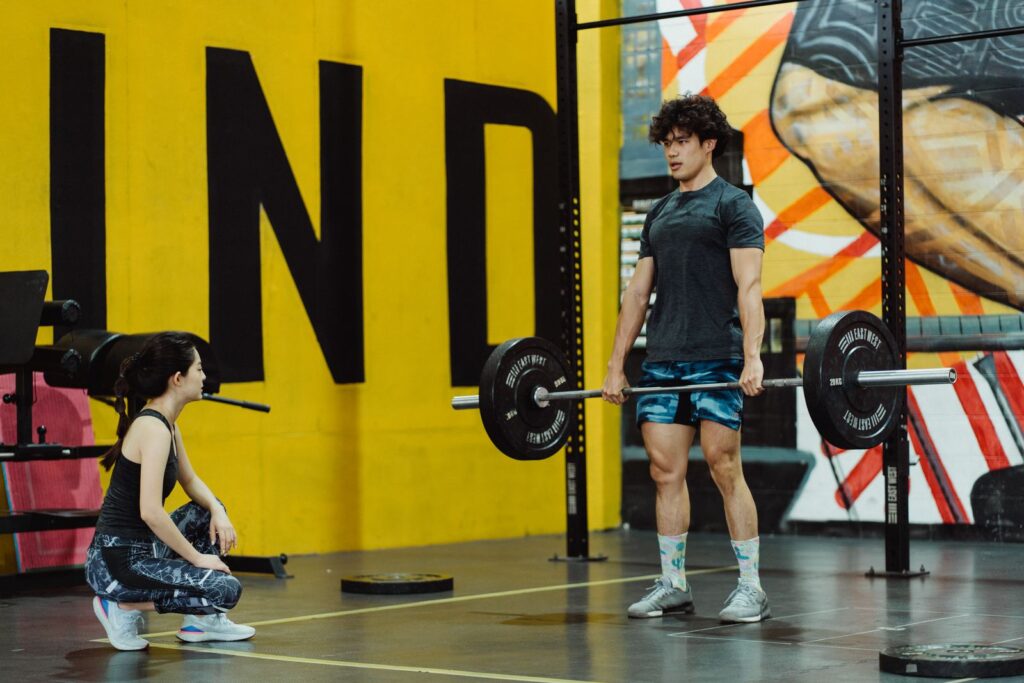
Multiple-joint movements give the most transfer for the recovery cost: squat patterns, hip-hinge patterns, pushes, pulls and loaded carries cover most of what grappling asks of the body. The evidence for prioritising compound work is the ACSM progression guidance itself, which recommends multiple-joint exercises be performed before single-joint ones because they recruit more muscle and more closely resemble the demands of the sport. Technique is coached before load is added; a bar with bad mechanics is not strength, it is an injury risk.
3. Recovery is part of the program
Strength adaptations happen between sessions, and BJJ already taxes the body. The survey of judo strength-and-conditioning practice found S&C coaches were the primary designers of S&C work for athletes — the takeaway for a BJJ gym is that someone with training in program design should be doing the same. Practical recovery signals a coach tracks: sleep quality, persistent soreness, declining sparring performance, rising resting heart rate or simply feeling flat. When those appear, the first lever is usually cutting strength volume, not adding to it. (If conditioning is the actual gap, our stamina for hard sparring guide separates that from strength work.)
4. In-season management
Around a competition, the pattern changes. The ACSM progression guidance describes periodising training — varying volume and intensity across blocks rather than holding everything constant. For a grappler, that usually means strength work is kept simple and lower-volume in the weeks before competition so hard sparring and competition itself carry the load, then rebuilt after the event. The exact plan depends on the athlete and the event calendar; the principle is that strength training supports competition rather than competing with it.
Injury context: why knee and shoulder care matters
BJJ injury data makes the strength case concrete but also keeps it humble. A 2025 global survey of 881 BJJ practitioners found roughly 5.5 injuries per 1,000 training hours and 55.9 injuries per 1,000 competition matches, with knees (25%) and shoulders (13%) the most affected areas, and most training injuries occurring during sparring. A separate 2021 survey of 1,140 athletes reported knees as the most common injury site, with ACL tears linked to the longest return-to-sport times, and identified regular competition, older age and higher belt rank as risk factors.
Strength training is not a guarantee against any of this — the surveys describe what happens on the mat, and most injuries involve techniques and sparring. But leg and shoulder strength, coached mechanics and adequate recovery are the levers coaches have. A 2026 study of knee injuries in competitive BJJ found higher knee-injury rates in competitions where a leg submission was permitted versus not, and the authors recommended skill training to mitigate knee injury risk — a reminder that protective value comes from training the position and the leg as much as from lifting.
Main risks of getting strength training wrong
- Stacking load without recovery. Adding lifting to a full BJJ week without reducing anything can produce fatigue that turns into poor sparring decisions and injury.
- Ignoring your mat schedule. BJJ is the training that already exists, and most of it is sparring. Adding strength on top without adjusting the plan for hard-roll days rarely ends well.
- Chasing numbers. BJJ reward is force application and durability, not a bigger squat. Maxing out on the bar carries risk with little mat transfer.
- Uncoached mechanics. Bad form on a barbell under load is an avoidable injury source; coaching technique is not optional.
- Copying a program. A plan written for a 22-year-old competitor or a professional athlete is not a plan for you. S&C for combat athletes is typically designed by a qualified S&C coach, and BJJ deserves the same treatment.
What beginners should do
- Talk to your BJJ coach first. Tell them how many sessions you want to add and ask how it fits the class schedule. Most gyms have a sensible default: lift on a light or non-sparring day.
- Start below what you think you can do. Two strength sessions a week is a common starting point in general strength guidance for novices; your coach adjusts for your BJJ load. Three sessions is not automatically better.
- Learn technique before load. Squat and hinge patterns taught by someone qualified, using light weights, beat heavy lifting with borrowed form.
- Keep one hard day at a time. If Monday is hard sparring, do not also make Monday your heaviest lifting day.
- Treat fatigue as data. If sleep suffers or sparring gets sloppy, reduce the strength work before reducing the BJJ you actually enjoy.
When to stop and get help
Stop or modify strength work and talk to a qualified healthcare professional if you have sharp joint or muscle pain, pain that does not settle, swelling, numbness or weakness, or any pain during a lift that does not feel like normal effort. The same applies before starting if you have a known condition, are returning from injury, or have been told by a professional to avoid certain movements. A good rule for any guide like this one: the article explains the framework, but your body and your history are the actual program input.
Sources
- Kraemer WJ et al., ACSM position stand: progression models in resistance training for healthy adults, Med Sci Sports Exerc, 2002 — exercise selection, loading and frequency references; abstract checked November 11, 2026.
- Cid-Calfucura I et al., Effects of strength training on physical fitness of Olympic combat sports athletes: a systematic review, Int J Environ Res Public Health, 2023 — 20 studies, 504 athletes; combat-sport context.
- Wąsacz W et al., Effect of the experimental training program “Grappler Quest” on motor fitness of Brazilian Jiu-Jitsu athletes, J Clin Med, 2026 — the 8-week BJJ RCT; single trial, circuit format, competitive males.
- Andreato LV et al., Physical and physiological profiles of Brazilian Jiu-Jitsu athletes: a systematic review, Sports Med Open, 2017 — strength links to BJJ success; match intermittency context.
- Weldon A et al., Strength and conditioning (S&C) practices of judo athletes and S&C coaches, J Strength Cond Res, 2024 — who designs S&C for combat athletes.
- Stegerhoek PM et al., Injury prevalence among Brazilian Jiu-Jitsu practitioners globally (881 participants), BMJ Open Sport Exerc Med, 2025 — incidence and knee/shoulder injury distribution.
- Hinz M et al., Injury patterns, risk factors and return to sport in Brazilian Jiu-Jitsu (1,140 athletes), Orthop J Sports Med, 2021 — knee injuries, ACL return-to-sport, risk factors.
- Piekarski M et al., Knee injury in competitive BJJ athletes: implications for training, Sports Health, 2026 — competition leg-submission knee-injury context.
- Joel Jamieson, 8 Weeks Out (founder, author of Ultimate MMA Conditioning) — named combat-sports S&C coach; credentials checked November 11, 2026.
- Dr. Mike Israetel (PhD sports physiology, Renaissance Periodization; BJJ black belt) — named sport scientist who trains BJJ; credentials checked November 11, 2026.
Strength training for BJJ FAQs
How many days a week should a BJJ athlete lift?
There is no fixed answer that applies to everyone. General strength-guidance for novices and intermediates is around 2–3 sessions a week, and that is the right starting discussion with your coach — but your mat schedule, age, recovery and injury history determine the final number. Two well-managed sessions usually beat three that wreck your sparring.
Do I need to lift heavy to get stronger for BJJ?
No. The research that links strength to BJJ describes maximal, isometric and endurance strength, and combat-sport reviews show gains from structured programs rather than from maximal lifting alone. Heavy lifting is one tool, not the whole answer; coached technique and progressive load matter more than the number on the bar.
Will strength training make me stiff or slow?
Not automatically. The systematic review found combat-sport athletes gained strength, power and flexibility from resistance training. Poor programming — too much volume, no recovery, no mobility work — can leave you sore, but that is a programming problem, not evidence against lifting.
Can lifting prevent BJJ injuries?
Strength training is one tool coaches use for durability, but it is not a guarantee. The injury surveys cited here describe injuries that occur mostly during sparring, and knee and shoulder work should include technique and position training, not just lifting. Treat strength as part of a wider injury-management picture, designed with your coach.
Should I lift on the same day as BJJ?
It can work if planned, but avoid making the same day your hardest sparring and your heaviest lifting. Common coach practice is to pair strength work with a lighter mat day or a non-sparring day, and to schedule recovery in between. Your coach should set the actual calendar.
Bottom line
Strength training for BJJ is supported by combat-sport research and shows promise in BJJ-specific trials, but it only works when it fits the load you can actually recover from. Start with capacity, build around compound movements, let recovery guide progression, and cut strength volume back around competition. Get a qualified coach to design it for you.