Last updated: 30 July 2026
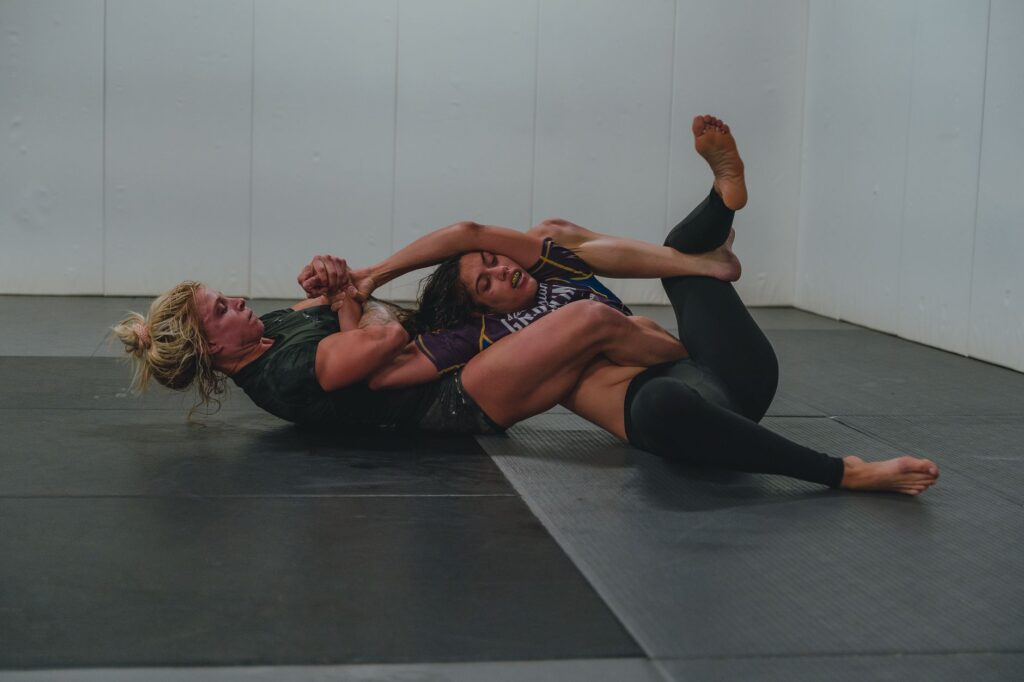
Quick answer: an armbar is a joint lock that isolates one arm, traps the elbow against your hips as a fulcrum, and hyperextends the joint until the opponent taps. Its Japanese name is juji-gatame (十字固, “cross lock”). Across 8,591 UFC bouts from 1994 to March 2026 it produced 195 finishes — 11.8% of all 1,659 submissions, third overall and first among joint locks by a wide margin: every other joint lock in UFC history combined accounts for just 96 finishes.
That last number is the point. The two submissions ahead of the armbar — the rear naked choke and the guillotine — are strangles, and strangles finish fights whether or not the opponent chooses to submit. Among techniques that work purely by threatening a joint, nothing else is close.
Train armbars only under qualified supervision. Joint locks injure training partners when applied suddenly or held after the tap.
Free every Tuesday
The Grappler Brief
The week’s biggest stories from BJJ, judo, wrestling, and submission grappling—curated for people who train.
Sent out weekly.Opt out anytime.
The armbar at a glance
| Question | Answer |
|---|---|
| Also called | Juji-gatame (十字固), cross armlock, straight armbar |
| Joint attacked | Elbow — hyperextension |
| Family | Straight-arm lock (the kimura and americana are bent-arm locks) |
| UFC finishes 1994–2026 | 195 (11.8% of all submissions) |
| Rank among joint locks | 1st — more than all others combined (96) |
| The fulcrum | Your hips, not your hands |
| Common entries | Closed guard, mount, back control, side control |
| Competition status | Legal at every adult belt, gi and no-gi, and in judo, sambo and MMA |
The submission figures come from our own classification of every submission finish in the UFC record — the same 8,591-bout snapshot behind the UFC statistics study and the UFC BJJ statistics study.
How the armbar works
Every armbar, from every position, does the same four things in the same order. If one is missing, the submission fails — and which one is missing tells you exactly how it will fail.
| Phase | What it does | What happens if you skip it |
|---|---|---|
| Isolate | Separates one arm from their body and their other arm | They grip their own hands and defend indefinitely |
| Position | Hips tight to their shoulder, one leg over the head, one across the chest | Space appears; they sit up, stack, and pass |
| Control | Knees pinched, thumb pointing up, wrist pinned to your chest | They rotate the elbow off the fulcrum and slide free |
| Extend | Hips lift into the elbow, slowly | Nothing happens — or you injure a partner by rushing |
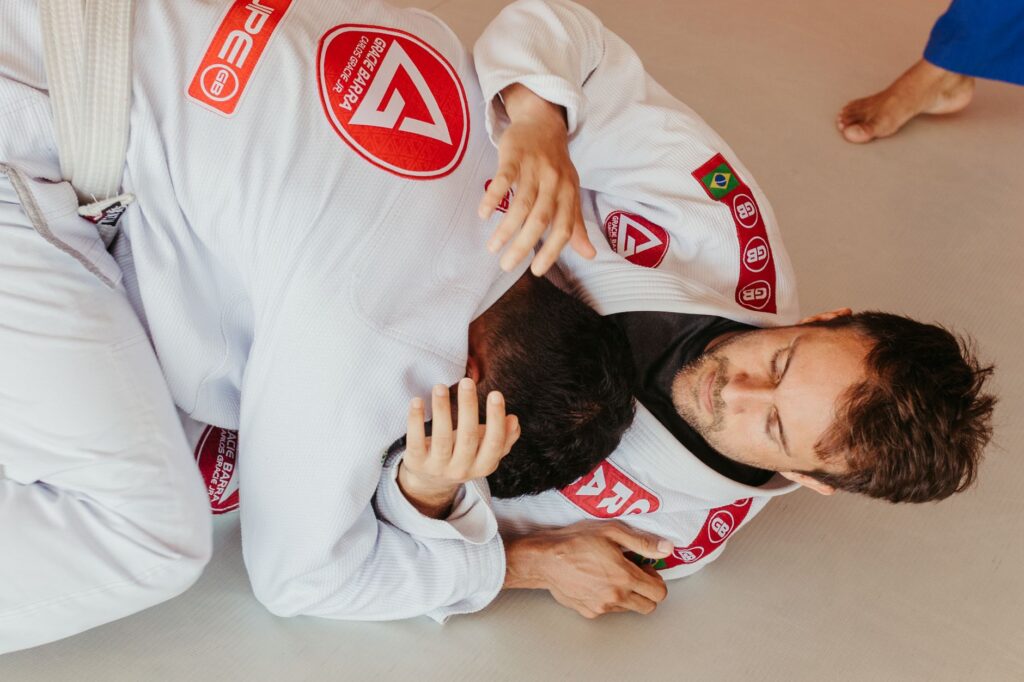
The detail most beginners miss is the thumb. The elbow only hyperextends cleanly when the arm is rotated so the thumb points toward the ceiling, which puts the joint’s weak axis directly against your hips. Turn the thumb toward the floor and the identical movement becomes a shoulder crank most opponents can simply ride out.
The second is that the hips are the fulcrum, not the hands. Pulling on the wrist is how most white belts try to finish, and it is why their armbars stop working against stronger training partners. A hip bridge generates far more force than arms can resist, and it does so without the grip strength contest.
Where the armbar comes from
| Position | Why it works from here | Main risk |
|---|---|---|
| Closed guard | Their posture is already broken and the arm sits inside your frame | They stack and pass as you swing the leg over |
| Mount | Their escape attempt hands you the arm | Losing the position if the transition is slow |
| Back control | The hand fighting off a choke leaves the elbow exposed | Trading the back for the arm |
| Side control | Their far-side frame is already isolated | They recover guard during the switch |
From closed guard the armbar shares its setup with two sweeps that use the same arm and the same hip mechanics — the pendulum sweep and the flower sweep. That overlap is what makes the position genuinely hard to defend rather than merely dangerous: defend the sweep and the arm is available, defend the arm and the sweep is available.
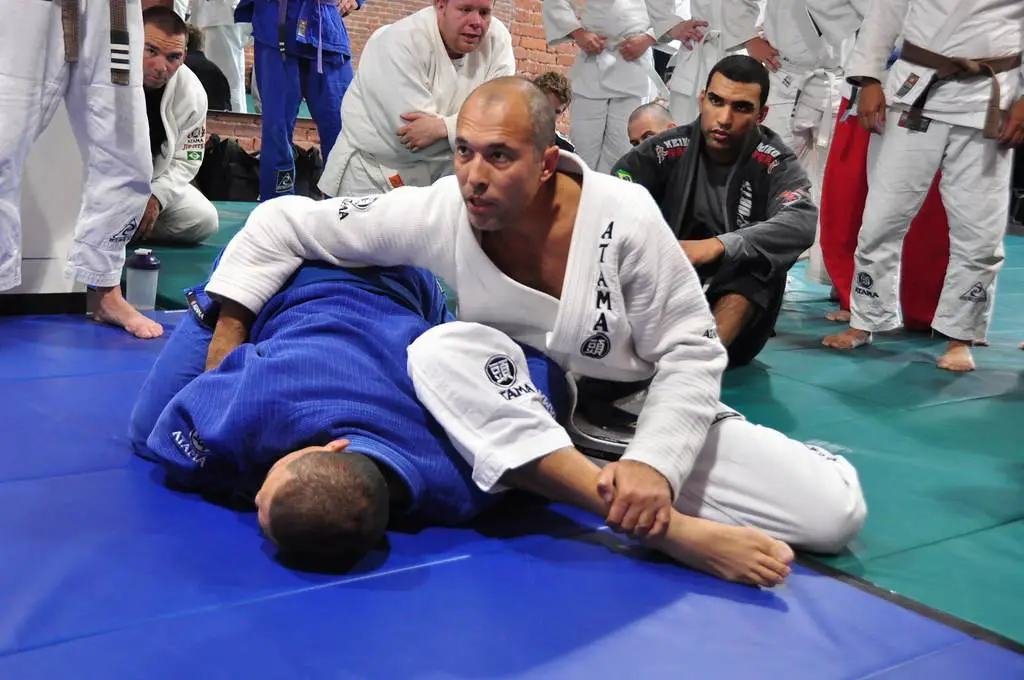
From mount, the armbar is the standard punishment for a poor escape. A defender who pushes on the chest to make space is offering the arm, which is why drilling a correct mount escape matters — the wrong escape walks directly into the submission.
Common armbar mistakes
| Mistake | What happens | Fix |
|---|---|---|
| Knees apart | The arm slides straight out of the gap | Pinch the knees before anything else |
| Pulling with the arms | Stronger opponents simply resist | Bridge the hips; hands only maintain position |
| Thumb rotated down | Becomes a shoulder lock they can survive | Turn the wrist so the thumb points up |
| Head uncontrolled | They sit up, stack, and pass | Keep the leg heavy across head and neck |
| Hips low or gapped | No fulcrum, so no leverage | Hips tight to the shoulder, then extend |
How to defend an armbar
Defence is a sequence, and each step is harder than the one before it. The earlier you act, the cheaper the escape.
- Prevent the isolation. Keep your elbows tight to your ribs. An arm that never leaves the body cannot be attacked.
- Grip early. If the arm is caught but not yet straight, join your hands — a figure-four or palm-to-palm grip buys real time.
- Turn the thumb down. Rotating so the elbow points away from their hips converts the lock into something survivable.
- Stack. Drive your weight over their hips to remove the fulcrum entirely, then pass.
- Spin toward the trapped arm. The “hitchhiker” escape rotates your elbow out of the line of pressure.
Once the arm is straight and the hips are elevated, the honest answer is to tap. The elbow has very little safe range past full extension, and no training round is worth the injury.
Armbar compared with other submissions
| Submission | Target | UFC finishes | Relationship to the armbar |
|---|---|---|---|
| Armbar | Elbow | 195 | — |
| Kimura | Shoulder | 43 | Attacks a bent arm where the armbar needs a straight one |
| Triangle choke | Neck | 114 | Same closed-guard entry; the answer when they pull the arm out |
| Rear naked choke | Neck | 648 | The back-control finish when the arm is unavailable |
The armbar and the triangle are the classic pair. Both begin from closed guard, both punish a broken posture, and each is the answer to the other’s defence — pull the arm free of the armbar and the head and one arm are still trapped. The kimura completes the set: it needs the arm bent where the armbar needs it straight, so whichever way a defender bends the elbow, one of the two is available.
Frequently asked questions
What does an armbar do?
It hyperextends the elbow. The arm is isolated and straightened, the hips are driven into the joint as a fulcrum, and pressure is applied against the elbow’s natural range of motion until the opponent submits. Because it attacks a joint rather than contesting muscle, it works across large strength differences.
What is another name for the armbar?
Juji-gatame (十字固), meaning “cross lock” — the judo and sambo name, still widely used in Brazilian jiu-jitsu. It is also called the cross armlock or straight armbar, which distinguishes it from bent-arm locks such as the kimura and the americana.
What injury does an armbar cause?
Hyperextension of the elbow. Applied slowly and released on the tap it causes no lasting damage. Applied explosively, or resisted past the tap, it can strain or tear the ulnar collateral ligament, damage the joint capsule, or in severe cases dislocate the elbow or fracture bone around the joint. This is exactly why the technique is taught as a slow hip extension rather than a snap.
Is it possible to escape an armbar?
Yes, but it depends almost entirely on timing. Before the arm is straightened there are several reliable escapes — gripping your own hands, turning the thumb toward the floor, stacking to remove the fulcrum, or spinning toward the trapped arm. Once the arm is extended and the hips are raised, escapes stop being realistic and the correct response is to tap.
Is the armbar legal in competition?
Yes. The armbar is permitted in adult Brazilian jiu-jitsu competition at every belt, in both gi and no-gi, and it is legal in judo, sambo and mixed martial arts. It is one of the first submissions taught precisely because it is legal everywhere — unlike leg locks such as heel hooks, which are restricted by belt level and by ruleset.
Is the armbar good for beginners?
It is one of the best first submissions to learn. The mechanics are easy to understand, it appears from the positions beginners spend most of their time in, and it does not rely on strength or unusual flexibility. The UFC record backs this up: it is the most successful joint lock at the highest level of the sport, not a technique people grow out of.
Where the armbar fits
If you are building a submission game from the ground up, the armbar belongs near the start. It teaches the principles every other joint attack depends on — isolate the limb, make your hips the fulcrum, control rotation, extend slowly — and those transfer directly to the kimura, the omoplata and the whole leg lock game.
It also holds up against resistance better than almost anything else in the syllabus. Nearly two hundred fighters have finished a professional UFC bout with it against opponents who trained specifically to avoid it. Very few techniques survive the trip from the academy to the highest level of the sport unchanged.