Quick answer: Gui Mendes, full name Guilherme Mendes Godoy, is a Brazilian BJJ black belt under Ramon Lemos, four-time black-belt world champion, AOJ co-founder, and one of the key figures in modern featherweight and academy-development BJJ.
Last updated: 2026-06-18
Gui Mendes quick facts
| Detail | Summary |
|---|---|
| Full name | Guilherme Mendes Godoy |
| Nickname | Gui |
| Nationality | Brazilian |
| Team/academy | Art of Jiu-Jitsu |
| Rank | BJJ black belt under Ramon Lemos |
| Known for | Four black-belt world titles, AOJ, Atos history, and coaching elite AOJ athletes |
Career snapshot
| Year | Milestone | Why it matters |
|---|---|---|
| 2008 | Received his black belt from Ramon Lemos after winning world titles through the colored belts. | The promotion moved both Mendes brothers into elite adult competition. |
| 2009 | Won his first IBJJF black-belt world title and became Atos’s first world champion. | The result established Gui as a leading light-featherweight immediately after promotion. |
| 2011 | Won a second IBJJF World Championship. | The title began another sustained run at the top of the division. |
| 2012 | Co-founded Art of Jiu-Jitsu in Costa Mesa and won a third world title. | The year joined his competitive prime with the start of his long-term coaching project. |
| 2014 | Won his fourth IBJJF black-belt world title before shifting his focus toward coaching. | He stepped away with one of the strongest records in light-featherweight history. |
Why Gui Mendes matters in grappling
Guilherme ‘Gui’ Mendes paired a four-title world championship career with an even larger coaching legacy at Art of Jiu-Jitsu. His compact guard passing, berimbolo-era positional knowledge, and early retirement make his profile as much about building athletes and a technical culture as collecting medals.
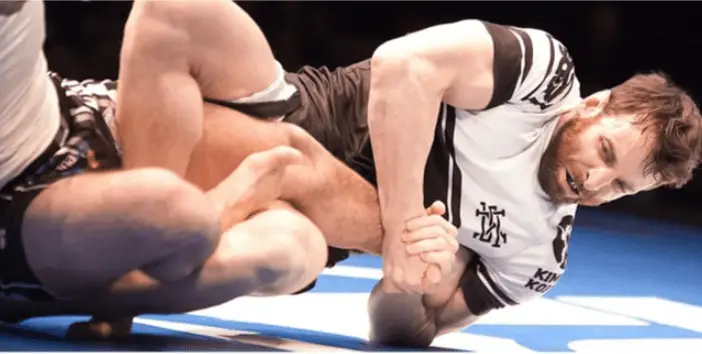
Gui Mendes was especially effective at passing without giving lighter opponents the space needed to invert freely. He used close-range headquarters and leg-drag positions, pinned the hips before moving the shoulders, and changed sides when the defender’s frames became strong. From guard, his familiarity with berimbolo and crab-ride exchanges meant he understood the back side of the position from both directions. That two-sided knowledge later became visible in AOJ’s systematic approach to developing young competitors. His passing posture stayed compact enough to deny underneath entries, while his grips at the knees and hips allowed him to redirect rather than collide with strong frames. For lighter athletes, that economy is more instructive than simply trying to copy the final burst around the legs.
Free every Tuesday
The Grappler Brief
The week’s biggest stories from BJJ, judo, wrestling, and submission grappling—curated for people who train.
Sent out weekly.Opt out anytime.
AOJ’s later success helps separate athlete talent from teachable method. Students with different body types reproduced the academy’s emphasis on distance, leg-drag control, and back exposure, suggesting that Gui’s competitive ideas were organized into a coaching system rather than preserved as personal instinct.
Gui Mendes’s grappling style
Gui Mendes’s style is best understood through the positions and habits that repeatedly show up in high-level matches. For a grappling fan, this is the part of the profile that turns a name and record into something useful to watch, compare, and learn from.
- Featherweight guard and back-take systems.
- AOJ-style positional discipline and detailed sequencing.
- Strong technical development through coaching and academy structure.
- A legacy that matters as much through students as through personal medals.
What to study in Gui Mendes’s game
| Match | What to watch | Why it matters |
|---|---|---|
| Gui Mendes vs. Samuel Braga, 2009 IBJJF Worlds final | Watch how Mendes manages a narrow advantages match and protects the back side of guard exchanges. | The win made him Atos’s first black-belt world champion. |
| Gui Mendes vs. Ary Farias, 2011 IBJJF Worlds final | Study grip discipline and the transition from guard exchange to stable scoring position. | The final shows his response to another fast, technically sophisticated lighter-weight athlete. |
| Gui Mendes close-range passing sequences | Look for hip pins, leg-drag alignment, and side-to-side changes before the chest settles. | These mechanics became a recognizable part of AOJ’s competition style. |
Training takeaways
Against flexible guards, control the hips before trying to flatten the shoulders. The leg drag is a staging position, not merely a place to hold the pants.
Study positions from both sides of the exchange. Gui’s passing benefits from deep knowledge of the inversion and back-take routes he is trying to deny.
How Gui Mendes compares with related grapplers
Gui Mendes pairs naturally with Rafael Mendes, Tainan Dalpra, Jessa Khan, Kade Ruotolo, and Tye Ruotolo because those names create useful context around teams, divisions, rule sets, and technical choices. Comparing them helps readers see whether an athlete is winning with pressure, guard retention, passing, wrestling, leg attacks, back control, or a blend of several areas.
Related grapplers and pages
Gui Mendes connects naturally to Rafael Mendes, Tainan Dalpra, Jessa Khan, Kade Ruotolo, and Tye Ruotolo. These profiles and guides are useful if you want to compare eras, teams, rule sets, or stylistic matchups across BJJ and submission grappling.
- /profiles/rafael-mendes-grappler-profile/
- /profiles/tainan-dalpra-grappler-profile/
- /profiles/jessa-khan-grappler-profile/
- /brazilian-jiu-jitsu/bjj-belt-order/
- Browse all BJJ fighter profiles
Sources and further reading
- Guilherme Mendes biography and record.
- Art of Jiu-Jitsu official site.
- Guilherme Mendes entity reference.
FAQ
Who is Gui Mendes?
Gui Mendes is Guilherme Mendes Godoy, a Brazilian BJJ black belt, four-time black-belt world champion, and co-founder of Art of Jiu-Jitsu.
Is Gui Mendes related to Rafael Mendes?
Yes. Gui Mendes is Rafael Mendes’ brother and AOJ co-founder.
What is Gui Mendes known for?
Gui Mendes is known for featherweight BJJ success, AOJ coaching, and helping build one of the strongest modern competition academies.