Quick answer: Adam Wardzinski is a Polish BJJ black belt, two-time IBJJF World Champion, 2019 No-Gi World Champion, and one of Europe’s most important gi competitors.
Last updated: 2026-06-18
Adam Wardzinski quick facts
| Detail | Summary |
|---|---|
| Nationality | Polish |
| Nickname | Megatron |
| Rank | BJJ black belt under Alan Finfou |
| Known for | IBJJF world titles, butterfly guard, heavyweight gi success, and European BJJ history |
| Recent context | Public references describe Wardzinski retiring after winning a second IBJJF world title in 2025 |
Career snapshot
| Year | Milestone | Why it matters |
|---|---|---|
| 2016 | Received his black belt from Alan Finfou after building his career in Poland and across the European circuit. | The promotion placed a home-grown Polish competitor into the deepest adult division of international BJJ. |
| 2018 | Won the ADCC European Trials. | The result showed that his clinch, base, and guard could function outside gi competition. |
| 2021 | Won the Abu Dhabi World Pro and continued establishing himself among the leading heavyweights of his era. | It was a major international title before his eventual IBJJF Worlds breakthrough. |
| 2024 | Won his first IBJJF black-belt world title and The Crown heavyweight grand prix. | He became the first Polish man to win an adult black-belt world title. |
| 2025 | Repeated as world champion and completed the IBJJF Grand Slam with European, Pan, Brazilian National, and World gold. | The season confirmed that the 2024 breakthrough was part of sustained dominance rather than a single tournament run. |
Why Adam Wardzinski matters in grappling
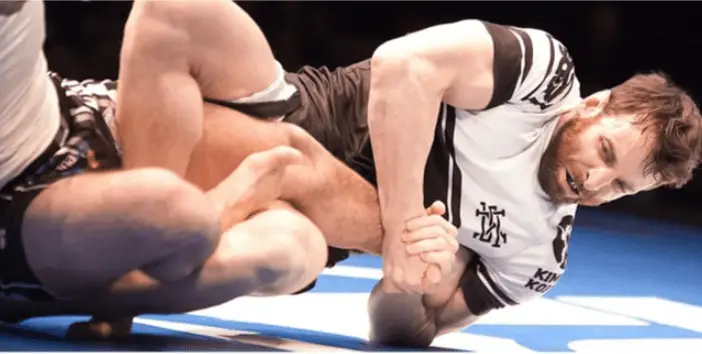
Adam Wardzinski gave heavyweight gi jiu-jitsu a technical identity that did not depend on forcing a conventional top game. His butterfly guard, underhook battles, and patient elevation attacks made him a reference point for larger athletes, while his 2024 and 2025 world titles marked a breakthrough for Polish and European men’s BJJ.
Wardzinski builds his guard around seated alignment and the ability to get underneath an opponent without surrendering upper-body connection. His butterfly hook matters because it is paired with an underhook, belt grip, or overhook that turns elevation into a controlled angle. When an opponent widens the base, he can switch toward single-leg or wrestle-up routes; when the opponent drives inward, the hook and shoulder line create space for a sweep. On top, he settles into pressure rather than trying to win a speed race with lighter guards.
Free every Tuesday
The Grappler Brief
The week’s biggest stories from BJJ, judo, wrestling, and submission grappling—curated for people who train.
Sent out weekly.Opt out anytime.
The 2025 Grand Slam adds useful context to the technique: Wardzinski had to reproduce the same core game across four major tournaments, different brackets, and repeated matchups with athletes who already understood his butterfly guard. Reliability, not surprise, became the competitive advantage.
Adam Wardzinski’s grappling style
Adam Wardzinski’s style is best understood through the positions and habits that repeatedly show up in high-level matches. For a grappling fan, this is the part of the profile that turns a name and record into something useful to watch, compare, and learn from.
- Butterfly guard as a primary attacking and sweeping platform.
- Heavyweight gi strategy built around timing rather than only physical force.
- Strong top control after sweep sequences.
- A patient competition style with clear technical identity.
What to study in Adam Wardzinski’s game
| Match | What to watch | Why it matters |
|---|---|---|
| Adam Wardzinski vs. Fellipe Andrew, 2024 IBJJF Worlds final | Watch how Wardzinski keeps a seated guard connected, creates elevation, and converts a narrow opening into the scoring exchange. | The final captures the butterfly-guard structure behind his first world title. |
| Adam Wardzinski vs. Erich Munis, 2025 IBJJF Worlds | Study the hand fighting and base management required when both athletes are comfortable in heavyweight guard exchanges. | The match shows how Wardzinski adjusted during his repeat title run. |
| Adam Wardzinski vs. Mahamed Aly, 2017 Rome Open absolute | Look for how Wardzinski manages distance and scoring against a larger, explosive opponent. | It is a useful earlier example of his heavyweight strategy before the world-title seasons. |
Training takeaways
A butterfly hook is strongest when the upper body is attached. Practice winning an underhook or controlling the far shoulder before trying to lift.
Wardzinski’s game rewards patient angle changes. If the opponent widens the base, switch to a leg or wrestle-up route instead of repeatedly forcing the same sweep.
How Adam Wardzinski compares with related grapplers
Adam Wardzinski pairs naturally with Bernardo Faria, Lucas Lepri, Xande Ribeiro, Mahamed Aly, and Victor Hugo because those names create useful context around teams, divisions, rule sets, and technical choices. Comparing them helps readers see whether an athlete is winning with pressure, guard retention, passing, wrestling, leg attacks, back control, or a blend of several areas.
Related grapplers and pages
Adam Wardzinski connects naturally to Bernardo Faria, Lucas Lepri, Xande Ribeiro, Mahamed Aly, and Victor Hugo. These profiles and guides are useful if you want to compare eras, teams, rule sets, or stylistic matchups across BJJ and submission grappling.
- /profiles/bernardo-faria-grappler-profile/
- /profiles/xande-ribeiro-grappler-profile/
- /brazilian-jiu-jitsu/ibjjf-rules/
- /brazilian-jiu-jitsu/bjj-weight-classes/
- Browse all BJJ fighter profiles
Sources and further reading
- Adam Wardzinski competition record and biography.
- Adam Wardzinski entity reference.
- IBJJF World Championship title records.
FAQ
What is Adam Wardzinski known for?
Adam Wardzinski is known for IBJJF world titles, heavyweight gi success, butterfly guard, and his role in European BJJ history.
Did Adam Wardzinski win IBJJF Worlds?
Yes. Public references list Wardzinski as a two-time IBJJF World Champion.
What is Adam Wardzinski’s style?
Wardzinski is strongly associated with butterfly guard, patient sweeping, and heavyweight gi strategy.