Last reviewed: October 26, 2026.
Quick answer: BJJ spats are close-fitting stretch pants worn for grappling. They are a clothing option, not a universal requirement for no-gi training. Whether you can wear them alone, under shorts or in a competition depends on the host and the exact ruleset. For IBJJF events, read the separate men’s and women’s uniform sections instead of assuming one spats rule covers every division.
The useful buying question is not simply “Do grapplers wear leggings?” It is whether the garment fits, has suitable coverage and construction, and is permitted where you plan to train. This guide explains those decisions without ranking products or claiming a pair has been personally wear-tested.
What are spats in BJJ?
“Spats” usually refers to fitted pants used as part of grappling clothing. They can look similar to leggings sold for other activities. The name alone does not establish fabric quality, seam comfort, opacity or whether a garment meets a tournament’s uniform requirements.
Free every Tuesday
The Grappler Brief
The week’s biggest stories from BJJ, judo, wrestling, and submission grappling—curated for people who train.
Sent out weekly.Opt out anytime.
The IBJJF uniform page uses the term “compression pants” and identifies skin-tight spats in its women’s no-gi section. That terminology describes a clothing category; do not read it as a promise of a medical or athletic benefit.
Spats, shorts and ordinary leggings
| Option | What to check | What the name does not establish |
|---|---|---|
| Grappling spats | Fit, seams, coverage, care instructions and host policy | Automatic permission in every event |
| No-gi shorts | Length, fasteners, pockets, waistband and current rules | That every gym or tournament uses the same shorts requirements |
| Leggings made for another activity | Whether their construction and coverage suit the proposed use | That a similar appearance makes them equivalent to a permitted competition garment |
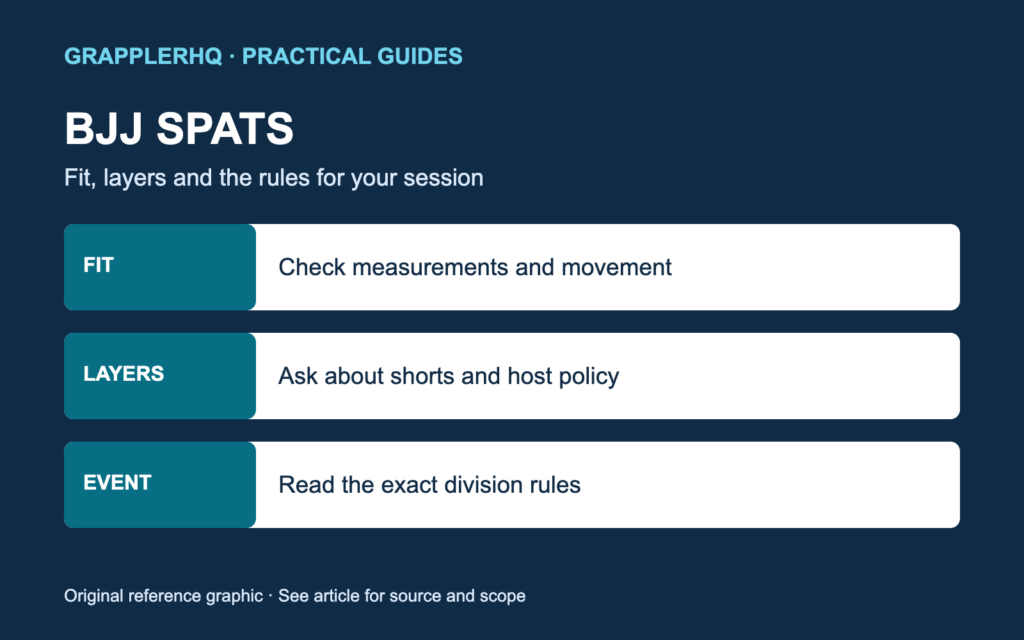
Ask the gym what it expects before buying. If you already own a garment that might work, describe it or show the host the product information. A specific answer about that session is more useful than a universal claim that all leggings are either suitable or unsuitable for BJJ.
For the wider clothing and rules differences between formats, see the gi versus no-gi guide.
Do you need shorts over spats?
Your host can set a training policy, and a tournament can set a different competition policy. Check both. Do not assume that what you see in a highlight clip establishes what you should wear in a beginner class or an event inspection.
For IBJJF no-gi, the published men’s section lists board shorts and permitted compression shorts underneath; the women’s section explicitly lists compression pants among its options. The men’s text does not present full-length spats as an interchangeable listed option. If your intended full-length layer is not clearly covered, confirm the current requirement with the organizer rather than applying the women’s wording to a men’s entry.
This is a reading of that named organization’s published options, not a rule for every grappling event. For more IBJJF context, use the no-gi rules guide and the official source linked above.
How should BJJ spats fit?
Start with the exact model’s chart. Compare the measurements it actually requests—such as waist, hips or length—rather than relying solely on a familiar S, M or L. Find out whether the chart describes body measurements or the garment laid flat.
Then check the fit while moving in the ways you need for training. Sit, bend and step comfortably. Notice whether the waistband moves out of place, seams feel uncomfortable or the fabric changes coverage in a way that makes the garment unsuitable. A close fit should still work for the person wearing it.
- Waist: use the listed measurement method and check secure, comfortable fastening.
- Length: compare the stated garment length with your needs rather than sizing up only to gain room elsewhere.
- Movement: make sure ordinary movement does not reveal an obvious fit mismatch.
- Coverage: check the actual fabric and construction, not just a studio product photograph.
- Return options: decide before training or washing beyond the seller’s return conditions.
If your measurements fall between published bands, ask for the model’s between-size guidance. Do not assume that a rash-guard chart or a gi chart is also a spats chart.
A practical layering example
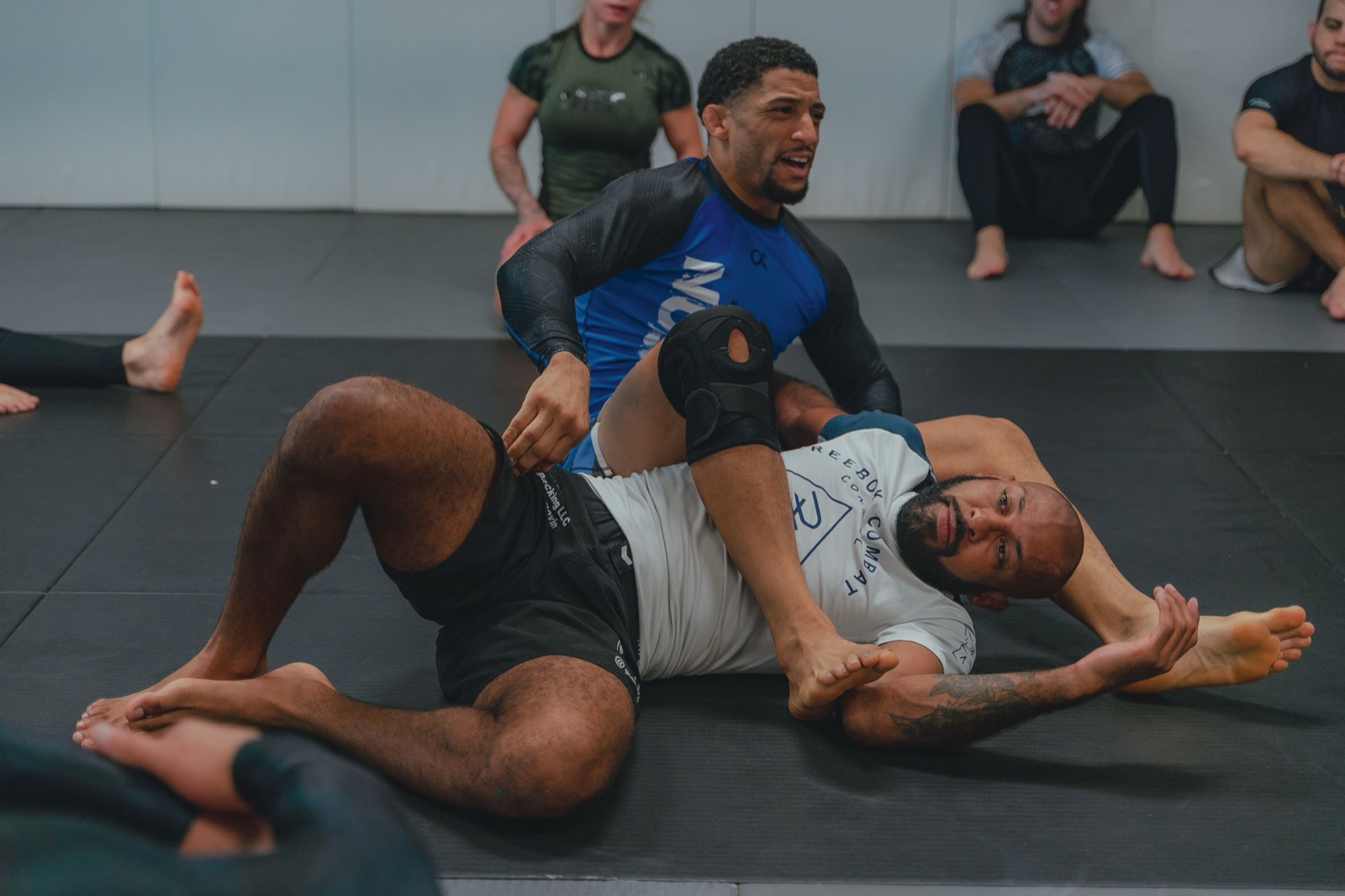
Suppose you are visiting a no-gi session and already own fitted leggings and a pair of shorts. The first step is to ask what the host permits. If that combination is accepted, try the pieces together: waistband position, length and movement can differ from how either piece feels alone.
Now suppose the next session is a tournament under a named federation. Start the clothing check again using that event’s division and rules. Permission at the first gym did not pre-approve the competition outfit. This is a planning example, not a statement about one brand’s garments.
What about spats under a gi?
Ask the host for training. For competition, read the gi-division requirements separately; do not use a no-gi clothing allowance as permission for an underlayer in a gi match. The gi inspection guide explains the relevant context.
Also check whether the combination fits comfortably under your gi pants. Changing an underlayer can change how an otherwise familiar uniform feels. The answer should come from the actual combination and the applicable requirements, not a rule that everybody must layer the same way.
Care and useful product details
Read the garment’s own washing and drying instructions. Keep it separate from rough or exposed fasteners where the maker advises that. Do not assume a fitted synthetic garment should follow the same care process as a woven gi.
Before purchasing, identify the fabric, intended fit, measurement chart, care guidance and return conditions. Those are inspectable details. Claims about being the “best,” making you faster or fitting every body type are not substitutes for them.
If you are buying other no-gi clothing, the rash-guard fit guide uses the same measurement-first approach for a different garment. Check each item’s chart individually.
Spats questions
Are spats mandatory for BJJ?
There is no single clothing requirement covering every gym and event. Check the host, format and division you actually plan to attend.
Are spats the same as compression shorts?
They are different garment categories and lengths. When a rule names shorts, do not silently replace that word with full-length pants.
Can I use regular leggings?
Check their fit, coverage, construction and the host’s permission. A product name or similar appearance alone does not settle the question.
Do spats replace a rash guard?
No. They are lower-body clothing. A shirt requirement is a separate part of an outfit’s rules and fit checks.
Sources and scope
The official IBJJF uniform requirements are the primary source for the specifically named competition distinction. Other hosts and rulesets can differ. This guide gives clothing decisions and an illustrative planning example; it does not claim product testing or universal tournament approval.