Quick answer: Cobrinha, full name Rubens Charles Maciel, is a Brazilian BJJ black belt under Fernando Terere, Alliance athlete, multiple-time world champion, ADCC Hall of Fame inductee, and one of the greatest featherweights in jiu-jitsu history.
Last updated: 2026-06-18
Cobrinha quick facts
| Detail | Summary |
|---|---|
| Full name | Rubens Charles Maciel |
| Nickname | Cobrinha |
| Nationality | Brazilian |
| Team lineage | Alliance Jiu Jitsu |
| Rank | BJJ black belt under Fernando Terere |
| Known for | Featherweight world titles, guard work, ADCC Hall of Fame status, and Cobrinha BJJ |
Career snapshot
| Year | Milestone | Why it matters |
|---|---|---|
| 2005 | Received his black belt from Fernando Terere after beginning BJJ at age 21. | The promotion completed a rapid rise built on an earlier capoeira background and intensive competition training. |
| 2006 | Won his first IBJJF black-belt world title, submitting every opponent in the bracket. | The run began four consecutive world-title seasons at featherweight. |
| 2009 | Won a fourth straight IBJJF World Championship and reached the ADCC final. | The season confirmed his dominance in the gi while beginning the defining no-gi rivalry with Rafael Mendes. |
| 2013 | Defeated Rafael Mendes in the ADCC final to win his first ADCC title. | The result broke through after two previous ADCC final losses in the rivalry. |
| 2017 | Won the IBJJF and ADCC titles again at age 37. | The late-career sweep demonstrated exceptional longevity at the fastest men’s weight classes. |
Why Cobrinha matters in grappling
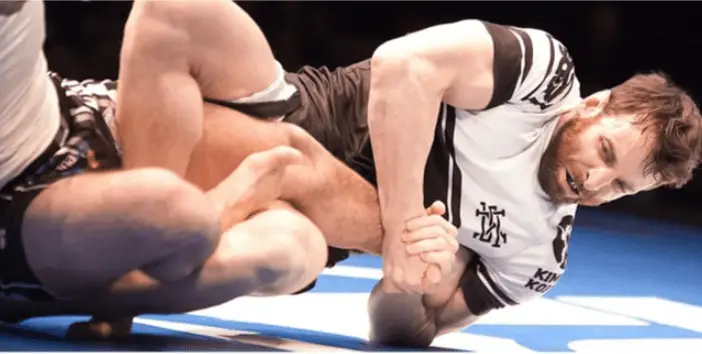
Rubens Charles ‘Cobrinha’ set the standard for sustained featherweight excellence across gi and no-gi competition. His movement background, aggressive guard, passing pressure, and long rivalry with Rafael Mendes produced a technical record that spans five IBJJF world titles and three ADCC championships.
Cobrinha’s athleticism is obvious, but the useful detail is how he converts movement into attachment. From De La Riva and seated guard he controls a leg before changing angle, preventing the opponent from simply stepping away. On top, he combines quick direction changes with enough shoulder pressure to keep the guard player from rebuilding. Against Rafael Mendes, the tactical layer becomes especially clear: each athlete knows the other’s preferred grips, so small wins in stance, guard-pull timing, and edge position decide whether either can begin a full attack. His capoeira background may help explain his comfort in unusual movement ranges, but the competition footage shows disciplined grip recovery underneath the movement, not improvisation for its own sake.
Free every Tuesday
The Grappler Brief
The week’s biggest stories from BJJ, judo, wrestling, and submission grappling—curated for people who train.
Sent out weekly.Opt out anytime.
The 2017 season is particularly instructive because Cobrinha was no longer winning through novelty. A younger field had years of footage on his guard and passing, yet he still captured major gi titles and ADCC by refining first contact, positional patience, and match management.
Cobrinha’s grappling style
Cobrinha’s style is best understood through the positions and habits that repeatedly show up in high-level matches. For a grappling fan, this is the part of the profile that turns a name and record into something useful to watch, compare, and learn from.
- Dynamic guard work and back-take threats.
- Lighter-weight pace with elite positional discipline.
- A creative attacking style that influenced featherweight competition.
- Strong transitions between guard, sweeps, and submissions.
What to study in Cobrinha’s game
| Match | What to watch | Why it matters |
|---|---|---|
| Cobrinha vs. Rafael Mendes, 2013 ADCC final | Watch the standing exchanges, guard-pull timing, and how both athletes protect the first scoring action through overtime. | The match is the tactical center of one of grappling’s best rivalries. |
| Cobrinha vs. Rafael Mendes, 2008 Capital Challenge | Study the earlier version of their rivalry, especially Cobrinha’s passing direction and response to inversion. | Comparing early and late meetings reveals how both games evolved around the other. |
| Cobrinha’s 2017 IBJJF Worlds run | Look for how he combines movement with stable grips instead of relying on speed alone. | The title run shows a veteran version of his game against a younger featherweight field. |
Training takeaways
Movement has to end in control. Use an angle change to secure a leg, hip, or shoulder before launching the next attack.
Long rivalries reward tactical review. Compare several Cobrinha-Mendes matches to see how stance and first grips change when both athletes already know the major techniques.
How Cobrinha compares with related grapplers
Cobrinha pairs naturally with Rafael Mendes, Gui Mendes, Bernardo Faria, Romulo Barral, and Marcelo Garcia because those names create useful context around teams, divisions, rule sets, and technical choices. Comparing them helps readers see whether an athlete is winning with pressure, guard retention, passing, wrestling, leg attacks, back control, or a blend of several areas.
Related grapplers and pages
Cobrinha connects naturally to Rafael Mendes, Gui Mendes, Bernardo Faria, Romulo Barral, and Marcelo Garcia. These profiles and guides are useful if you want to compare eras, teams, rule sets, or stylistic matchups across BJJ and submission grappling.
- /profiles/rafael-mendes-grappler-profile/
- /profiles/marcelo-garcia-grappler-profile/
- /brazilian-jiu-jitsu/bjj-points-system/
- /brazilian-jiu-jitsu/bjj-belt-order/
- Browse all BJJ fighter profiles
Sources and further reading
- Cobrinha biography and competition record.
- Official 2013 ADCC results.
- Cobrinha BJJ official academy site.
- Rubens Charles entity reference.
FAQ
Who is Cobrinha in BJJ?
Cobrinha is the nickname of Rubens Charles Maciel, a Brazilian BJJ black belt, Alliance athlete, world champion, and ADCC Hall of Fame inductee.
What is Cobrinha known for?
Cobrinha is known for featherweight dominance, guard work, world titles, and one of the most important lighter-weight legacies in BJJ.
Who gave Cobrinha his black belt?
Public references list Cobrinha as a black belt under Fernando Terere.