Quick answer: JJWL (Jiu Jitsu World League) uses one scoring system for gi and no-gi: takedowns, sweeps, and knee-on-belly score 2, passing the guard scores 3, and mount, back mount, and back control score 4 — every position held for 3 seconds. There are no advantages at all, and the tiebreaker is unique: in a points draw, the last competitor to score wins. Back control only counts with both hooks in — a body triangle or crossed feet scores nothing. Penalties run signal, signal, 2 points to your opponent, disqualification. Matches are 5 minutes for most adults (6 for adult black belts in gi, 5 for every adult and master no-gi division), and brackets of four or more are double elimination, so a loss still leaves you competing for third. Heel hooks exist only in one division: Advanced no-gi for brown and black belts.
Last updated: July 23, 2026. This guide covers the official JJWL rules for 2026 — scoring, penalties, match lengths, age divisions, legal techniques, uniforms, and bracket formats — from the official JJWL rulebook (revised February 2024, current as of this writing). It is a planning guide, not a substitute for the rulebook or your event page.
JJWL points system: one system for gi and no-gi
Unlike NAGA or ADCC, JJWL scores gi and no-gi identically, and the values sit close to IBJJF’s. Control must be held for 3 seconds — and notably, the points stand even if your opponent escapes immediately after the third second.
| Action | Points | Key condition |
|---|---|---|
| Takedown | 2 | Opponent down, 3 seconds of top control |
| Sweep | 2 | Bottom of guard to top control, 3 seconds |
| Knee on belly | 2 | Knee or shin on belly/chest/ribs, other foot on the ground |
| Guard pass | 3 | Clear the legs into side control, KOB, north-south, or mount |
| Full mount | 4 | Seated on torso, max one arm trapped under a leg |
| Full back mount | 4 | Opponent flat and face-down, knees or knee-and-foot down |
| Back control | 4 | Both hooks in — body triangle or crossed feet score zero |
No advantages — and a tiebreaker nobody else uses
JJWL has no advantages. Instead, if the match ends in a points draw, the win goes to the last competitor who scored — a rule that completely changes endgame strategy, because protecting a lead means nothing if your opponent ties it late. If the match ends 0-0, or the scores are tied because of penalty points, the referee decides based on who came closer to scoring or finishing. Compare that with the advantage-based system in our BJJ points system guide.
Free every Tuesday
The Grappler Brief
The week’s biggest stories from BJJ, judo, wrestling, and submission grappling—curated for people who train.
Sent out weekly.Opt out anytime.
Penalties
The ladder is short: first and second penalties are signals only, the third gives 2 points to your opponent, and the fourth is disqualification. Stalling is called after 20 seconds of avoiding the fight, guard pulling requires at least one grip (or contact in no-gi), grips inside sleeves or pants are illegal, and talking to the referee is a penalty — for competitors and coaches alike. Severe fouls skip the ladder entirely: inappropriate language, illegal techniques, coach misconduct, unfair play, or deliberately dragging a submission out of bounds are instant disqualifications.
Match lengths
| Division | Match length |
|---|---|
| Toddler | 2 min |
| Kindergarten, Youth, Pre-Teen | 3 min |
| Jr. Teen and Teen | 4 min |
| Juvenile, adult white–brown belts, all masters | 5 min |
| Adult black belt (gi) | 6 min |
| All adult & master no-gi divisions | 5 min |
Age divisions and weigh-ins
Youth divisions run by birth year — Toddler through Teen, then Juvenile (17 and under) — similar in spirit to the IBJJF’s birth-year system. Adults are 18–29, and masters split by sex: women have Master 1 (30–35), Master 2 (36–40), and Master 3 (41+), while men run Master 1 through Master 5 (51+). Weigh-ins happen on tournament day, at least an hour before your first match — with the gi on for gi divisions and the no-gi uniform on for no-gi, and photo ID is required at check-in.
Legal techniques by division
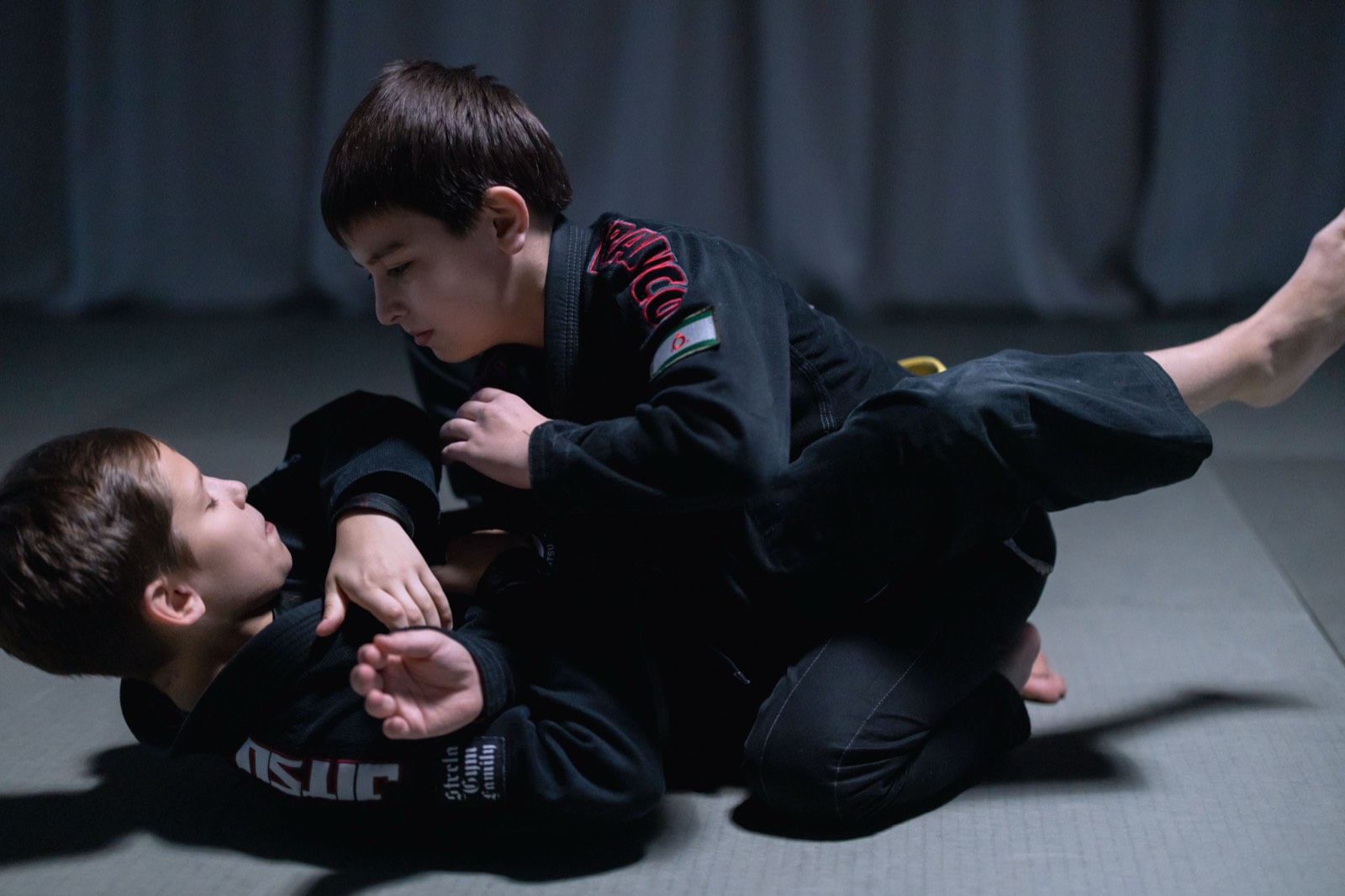
JJWL’s illegal-technique chart is one of the most restrictive in youth grappling: kids’ divisions ban all leg attacks, all guillotines (even arm-in), arm triangles, d’arce and anaconda chokes, omoplatas, Ezekiel chokes, and pulling the head on triangles. Referees in kids divisions also stop matches before the tap in any situation where a child could be hurt — and a child crying with a submission in progress counts as a tap.
Techniques unlock progressively for adults: white belts add both-arms-out guillotines; blue and purple belts add wrist locks, kidney locks, and jumping guard; brown and black belts add knee bars, slicers, and toe holds. Heel hooks and knee reaping are legal in exactly one place — the Advanced no-gi division for brown and black belts. And some things are illegal for everyone, always: neck cranks, slams, scissor takedowns, and any suplex that lands the opponent on their head or neck.
Uniform rules
JJWL allows seven solid gi colors — white, gray, blue, black, pink, purple, and green — with the jacket and pants matching, which is more generous than the IBJJF’s three (see our IBJJF gi requirements guide for that contrast). Rashguards are permitted under the gi for all competitors. Inspection measurements: 5 cm collar width, 7 cm sleeve opening, sleeves within 5 cm of the wrists, pants within 5 cm of the ankles. No-gi means grappling or board shorts (solid color, no pockets or hardware, ending between mid-thigh and 5 cm above the kneecap) with a short- or long-sleeve rashguard. Cups are not allowed, and neither is jewelry, piercings, or hard braces. If your uniform is damaged mid-match, the referee gives you 10 minutes to find a replacement.
Brackets: double elimination and the two-match guarantee
JJWL’s bracket formats favor mat time: two-competitor brackets run best-of-three, three-competitor brackets run round robin (ties broken by submissions, then points, then head-to-head), and brackets of four or more are double elimination — lose before the final and you still compete for third place. JJWL also runs a video-review policy: scorekeeping errors caught before the bracket progresses are fixed on the spot, and errors caught after earn the competitor a credit toward a future event.
Bottom line
JJWL is a points-forward, family-oriented league: one scoring system across gi and no-gi, no advantages, a last-to-score tiebreaker that rewards late aggression, strict youth safety rules, and double-elimination brackets that guarantee real mat time. Learn the both-hooks back-control rule and the 3-second counts, and check the official rulebook before every event.
FAQ
Does JJWL use advantages?
No. In a points draw, the last competitor to score wins. A 0-0 or penalty-tied match goes to referee decision based on who came closer to scoring or submitting.
Are heel hooks legal at JJWL?
Only in the Advanced no-gi division for brown and black belts. They are illegal everywhere else, in gi and no-gi alike.
How many points is back control at JJWL?
4 points — but only with both hooks between the opponent’s thighs. A body triangle or crossed feet scores nothing.
How long are JJWL matches?
Most adult and master divisions are 5 minutes; adult black belt gi matches run 6. Youth matches run 2 to 4 minutes by age group.
What gi colors are legal at JJWL?
Seven solid colors: white, gray, blue, black, pink, purple, and green — jacket and pants must match.