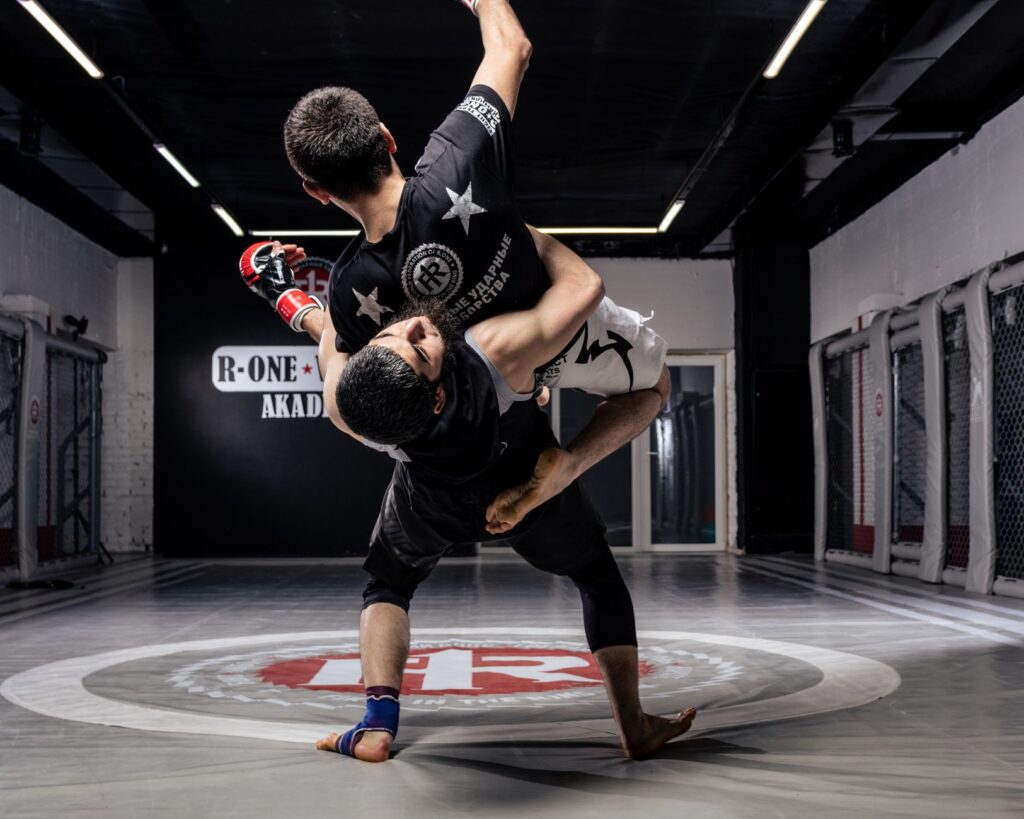
Quick answer: The single-leg takedown captures one of the opponent’s legs — usually after a level change and a penetration step — then finishes by running the pipe, bumping the knee, or tripping the far leg to put them on the mat. It’s the most common takedown in BJJ because it commits less than a double-leg and leaves you better positioned to defend the guillotine on the way in.
This guide is educational. Drill on suitable mats with qualified coaching, learn breakfalls, control the descent, and avoid uncontrolled twisting or head impact.
| Detail | Single-Leg Takedown summary |
|---|---|
| Technique family | Wrestling-style takedown |
| Main finishes | Running the pipe, inside trip, knee tap, far-leg trip |
| IBJJF scoring | 2 points once the takedown lands and control is established |
| First control priority | Head inside or tight to the hip — not out where the guillotine lives |
What is the single-leg takedown?
A single-leg isolates one of the opponent’s legs and controls it above and below the knee (or with clasped hands around the thigh) while you use angle, lifting, or a trip to break their base and bring them down. Compared with a double-leg, it asks for less penetration and less commitment — you’re taking one leg, not diving between both — which is exactly why it fits BJJ so well, where a badly-timed deep shot can hand the opponent a guillotine or a front headlock.
The takedown starts long before contact. Stance, hand fighting, and a reaction you create (a snap, a level change, an arm drag) are what open the leg. The actual grab is usually the easy part; keeping your head in the right place and turning the corner instead of pushing into their base is what separates a finish from a scramble.
Free every Tuesday
The Grappler Brief
The week’s biggest stories from BJJ, judo, wrestling, and submission grappling—curated for people who train.
Sent out weekly.Opt out anytime.
How the single-leg finishes
- Keep your head inside or tight to the hip. A head that drifts to the outside is an open invitation for a guillotine or a front headlock — the single biggest reason BJJ shots get punished.
- Control above and below the knee. Clasping the leg without pinning the knee line lets the opponent hop, kick free, or re-post the foot.
- Turn the corner, don’t drive straight in. Pushing into a strong base just gets you sprawled on; circling to change the angle breaks the base far more efficiently.
- Pick a finish and commit. Running the pipe, a knee tap, or a far-leg trip each work — but hesitating between them mid-finish is how the leg gets recovered.
Common entries into the single-leg
Entries work best off a reaction you provoke, not a cold shot into a braced opponent.
- Level change after hand fighting. Winning an inside tie or clearing a grip creates the split-second the leg is reachable.
- Arm drag that exposes the near leg. Dragging the arm across turns the opponent slightly and puts their lead leg right in front of you.
- Snapdown reaction. Snapping the head down and forward often makes the opponent post a leg back to recover posture — that leg is the target.
- Wrestle-up from seated or half guard. Single-legs are one of the most reliable ways to come up from the bottom and reverse the position, tying directly into guard recovery when the wrestle-up stalls.
Common mistakes
| Mistake | Why it fails | Better cue |
|---|---|---|
| Shooting with the head on the outside | Exposes the neck to a guillotine or front headlock | Keep the head inside or pressed tight to the hip |
| Grabbing the leg without controlling the knee line | The opponent hops, kicks, or re-posts the foot free | Control above and below the knee before finishing |
| Driving straight into a braced base | You get sprawled on and lose the leg | Turn the corner to change the angle instead |
| Shooting cold with no setup | The opponent sees it coming and frames early | Provoke a reaction — snap, tie, or drag — first |
How to defend the single-leg
Defense starts before contact with stance and hand fighting, then shifts to frames and hip position once the leg is captured.
- Get the whizzer or crossface in early. An overhook on the attacking-side arm slows the finish and gives you time to fight the leg back.
- Move the captured knee outside their centerline. Turning the knee out kills the pipe finish and lets you re-post the foot.
- Use hips and footwork, not just a sprawl. Hopping to re-square and reling the leg matters as much as the initial sprawl.
- Protect the neck through the scramble. A single-leg defense that exposes the neck to a guillotine trades one problem for a worse one.
Is the single-leg legal in BJJ?
Yes — single-leg takedowns are broadly legal and score 2 points under IBJJF-style rules once you land and establish control.
The cautions are around the finish, not the takedown: slamming, certain reaping follow-ups, and going out of bounds are treated differently across rulesets, age divisions, and belt levels.
Details differ by organization and division — confirm the current rulebook for the event you’re actually entering via the BJJ rules and scoring guide or the event page itself.
Safety and training notes
- Don’t rotate a planted knee during the finish. Trips that twist a foot the opponent can’t clear are a common, avoidable knee injury; give the leg somewhere to go.
- Return partners to the mat with control. Lifting single-legs especially can drop a partner hard — guide the landing rather than dumping it.
- Keep the head out of collision and guillotine lines. The head-inside rule is a safety rule as much as a technical one.
Stop if a partner reports unusual pain, numbness, or joint discomfort beyond normal positional pressure. This article does not diagnose injuries; seek qualified medical care for concerning or persistent symptoms.
Examples to study
- Wrestle-up single-legs from seated guard in competition footage. Watch how the bottom player uses the opponent’s own forward pressure to come up onto the leg rather than muscling up cold.
- Gi single-leg finishes against a grip-fighting opponent. Note how much of the work happens in the hand fight before the leg is ever touched.
Pause footage at the moment the head position is set, before the finish even starts — head placement usually decides whether the single-leg becomes a takedown or a scramble.
Related GrapplerHQ guides
- Double-leg takedown
- Ankle pick
- Guard recovery
- BJJ rules and scoring
- Wrestling: styles, rules, and what it teaches grapplers
Sources and further reading
- Mastering the Single Leg Takedown in BJJ.
- IBJJF Books and Videos — current rules materials.
- ADCC Rules and Regulations.
- Injury prevalence among BJJ practitioners — PubMed.
FAQ
What’s the difference between a single-leg and a double-leg?
A single-leg captures and finishes on one leg; a double-leg attacks both at once with a deeper penetration step. The single commits less and is generally safer against the guillotine, which is why it’s more common in BJJ.
Why do BJJ single-legs get guillotined so often?
Almost always because the head drifts to the outside of the leg. Keeping the head inside or pinned tight to the hip removes the neck from the guillotine line.
Does a single-leg takedown score in BJJ?
Yes — 2 points under IBJJF-style rules once you complete the takedown and establish control. Scoring always depends on control, not just touching the opponent down.
Can you single-leg from the bottom?
Yes — the wrestle-up single-leg from seated or half guard is one of the most reliable ways to reverse position and come up on top.
Bottom line
The single-leg is the BJJ-friendliest takedown because it commits less and, done right, keeps your neck safe. Head position is the whole game: inside or tight to the hip and you’re taking someone down; outside and you’re getting guillotined. If your single-legs keep stalling, it’s rarely the grip — it’s that you’re driving straight in instead of turning the corner.