Quick answer: Knee-on-belly escapes are won in the first second, before the top player’s weight settles and the 2 points register. The reliable route is the turn-in: frame the knee and ankle, shrimp your hips out, and bring your inside knee through to recover guard. The famous mistake is pushing the knee with both hands — that reaction is precisely what knee-on-belly exists to provoke, and it feeds armbars and, in the gi, the baseball-bat choke.
This guide is educational. Drill with qualified coaching, apply pressure gradually, tap early, and release immediately when a partner taps or cannot communicate clearly.
| Detail | Knee-on-belly escapes summary |
|---|---|
| Primary escape | Turn-in with knee/ankle frames to guard recovery |
| Alternatives | Underhook turn to knees; bridge into the post leg |
| Cost of the position | 2 points against you once stabilized (IBJJF-style) |
| Biggest danger | Two-handed knee pushing — armbar and baseball choke bait |
What you’re actually escaping
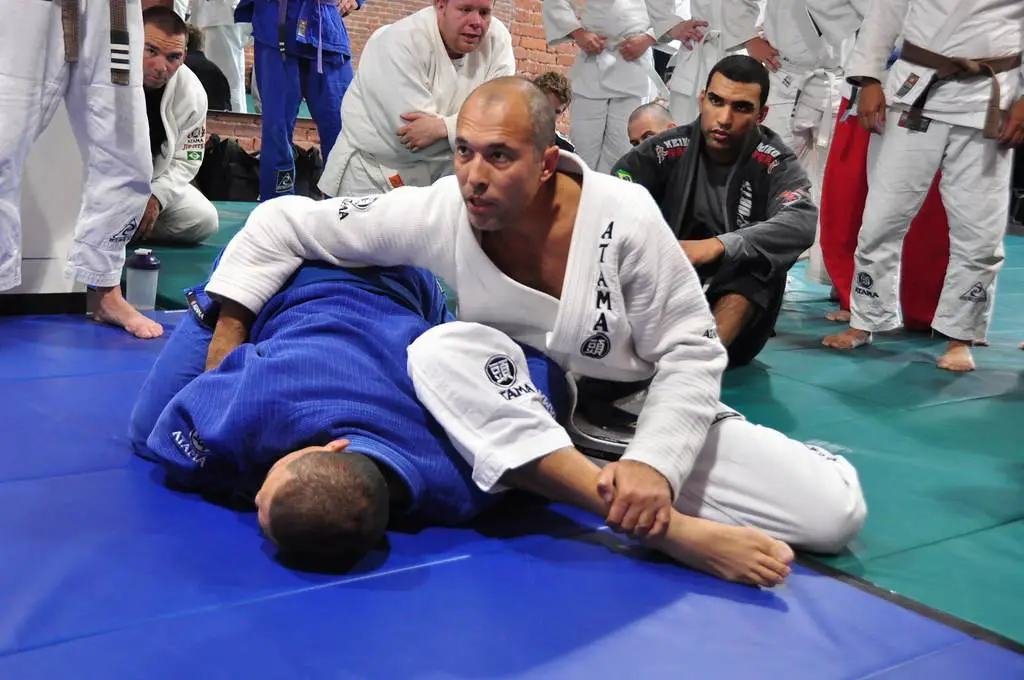
Knee-on-belly is side control‘s mobile cousin: shin across your torso, other leg posted long, the top player’s weight driving through the knee. It hurts, it scores, and — this is the part beginners miss — it is designed to be uncomfortable enough that you volunteer your arms. The top player is not resting there; they are waiting for your hands to push so they can spin to an armbar or, in the gi, drop a baseball-bat choke as you turn. Alliance great Cobrinha built a signature attacking sequence on exactly this bait-and-spin.
So the survival rule inverts instinct: the worse the pressure feels, the more disciplined your elbows must be. Exhale, keep the elbows connected to your ribs, and frame with structure — forearm and knee — rather than palms.
Free every Tuesday
The Grappler Brief
The week’s biggest stories from BJJ, judo, wrestling, and submission grappling—curated for people who train.
Sent out weekly.Opt out anytime.
The turn-in escape, step by step
- Frame low, not high. One forearm frames the shin or knee near your hip line; the other hand controls their ankle if you can reach it. No pushing yet — just structure.
- Shrimp away from the knee. A sharp hip escape toward the open side takes your torso out from under the shin’s pressure line.
- Slide the inside knee through the gap your shrimp created, connecting knee to elbow so no shin can recross.
- Recover guard in stages — half guard first if that is what is there, full guard when the second leg clears.
Timing note: all of this is dramatically easier during the knee’s landing. Ride the moment they transition — that is when their base is in the air and the 2 points are not yet banked.
The underhook alternative
When the top player leans heavily over your head to attack, the far-side underhook appears. Swim it, turn into them, and come up to your knees exactly as in the side-control dogfight escape. It trades the safety of guard recovery for offense — a single leg or reversal is often waiting — but keep your head tight as you rise; the front-headlock chokes punish a loose entry here just as they do everywhere else.
Common mistakes
| Mistake | Why it fails | Better cue |
|---|---|---|
| Pushing the knee with both hands | Your extended arms are the armbar and the choke grip’s opening | Frame with forearm and knee; elbows never leave the ribs |
| Bridging straight up in panic | They ride the bridge on the posted leg and settle heavier | Shrimp away from the knee, don’t buck under it |
| Turning away from the knee | Back exposure, and the shin follows you anyway | Turn in, toward the pressure, behind your frames |
| Accepting the position to rest | The points register and the attack menu opens | Escape during the landing — the position gets worse with age |
How top players counter your escape
- The spin: as you turn in and push, they circle to the far side or straight into an armbar. Answer: your elbows were supposed to stay home — escape behind frames, not pushes.
- The switch: they hop the shin to the other side of your torso as you shrimp. Answer: knee-elbow connection travels with you; re-frame and repeat.
- The drop back to side control: when the escape half-works, they concede knee-on-belly and settle chest-to-chest again — which is a win for you; side control is a better problem than knee-on-belly.
Scoring and competition context
Knee-on-belly scores 2 points under the IBJJF-style points system once stabilized for about 3 seconds — which makes the landing-moment escape literally point-saving. It is also a favorite points-machine in gi competition precisely because defenders react badly under pressure. Deny the stabilization and you deny the score; the BJJ rules and scoring guide covers the framework and its event-to-event variations.
Safety and training notes
- Knee-on-belly pressure on the floating ribs is a real injury vector — in drilling, the top player keeps a hand or foot post carrying part of their weight, especially across size gaps.
- Sternum and diaphragm pressure can wind a partner; a winded partner cannot tap loudly. Watch for the flat slap or verbal signal and release fast.
- If the armbar catches you mid-escape in drilling, tap early — the spin arrives with momentum, and late taps against fast armbars are how elbows get damaged.
Stop if a partner reports unusual pain, numbness, or trouble breathing beyond normal positional discomfort. This article does not diagnose injuries; seek qualified medical care for concerning or persistent symptoms.
Examples to study
- Cobrinha’s knee-on-belly attack sequences. Watch from the defender’s perspective: every finish starts with the bottom player’s hands leaving their ribs. The escape lesson is in what the victims did wrong.
- High-level gi matches with heavy knee-on-belly players. Note how experienced defenders escape during the landing — the position rarely gets three clean seconds against them.
Related GrapplerHQ guides
Sources and further reading
- IBJJF Books and Videos — current rules materials
- ADCC Rules and Regulations
- Injury prevalence among BJJ practitioners — PubMed
FAQ
How do I stop knee-on-belly from hurting?
Turn slightly toward the knee behind your frames so the shin loses its flat platform, and exhale rather than holding breath against the pressure. Then escape — comfort under knee-on-belly is not a long-term plan.
Why do I always get armbarred from knee-on-belly?
Because you push the knee with both hands. That reaction is the position’s whole business model — the spin to the armbar starts from your extended arms. Frame with the forearm, keep elbows on ribs.
How many points does knee-on-belly cost me?
2 points under IBJJF-style rules once it is stabilized for roughly 3 seconds. Escaping during the landing denies the score entirely.
Is it better to escape toward or away from the knee?
Shrimp away from the knee’s pressure line, but turn in toward the opponent — hips go away, chest stays facing them. Turning fully away gives your back and solves nothing.
Bottom line
Knee-on-belly is a pressure trap: it hurts so your arms betray you. Keep the elbows home, frame the shin and ankle, shrimp during the landing, and bring the knee through. Escape it early and it costs nothing; feed it your hands and it costs the armbar. The pressure is the test — the frames are the answer.