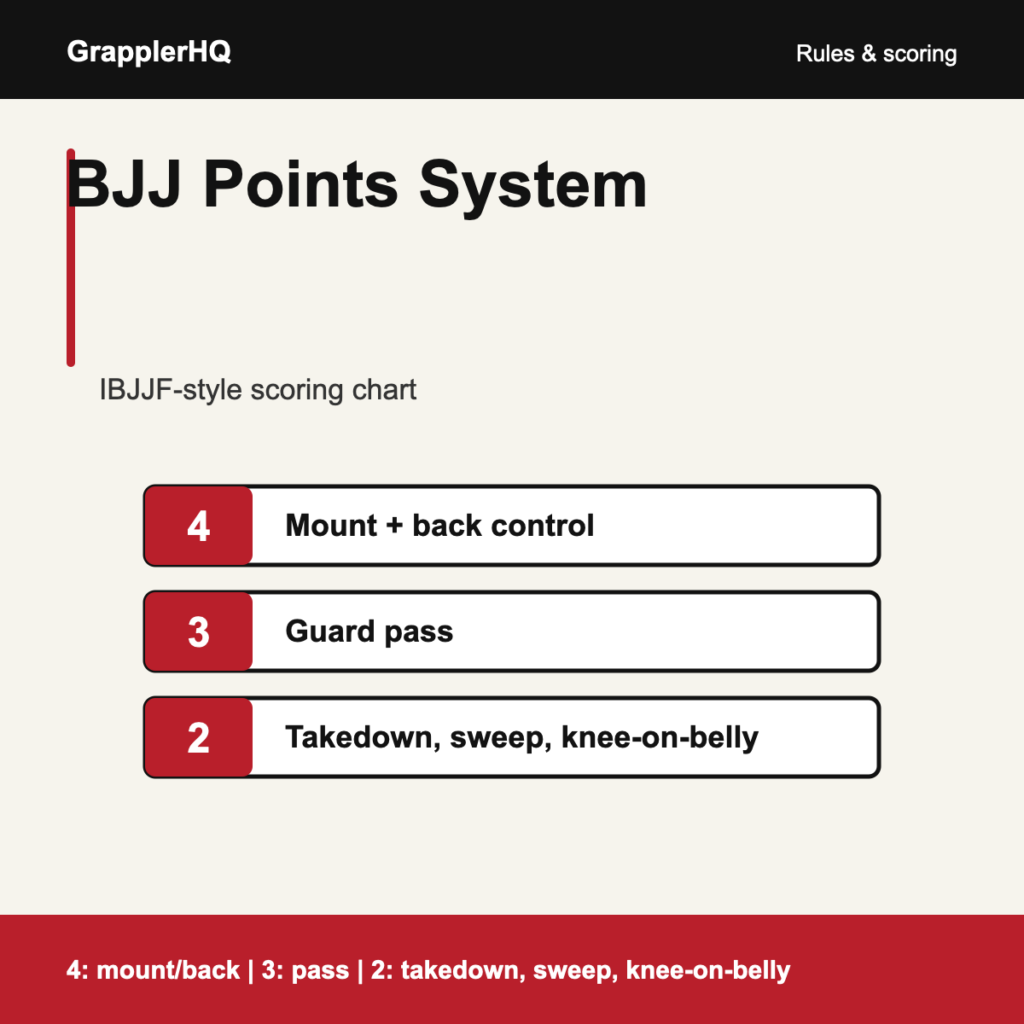
Quick answer: under common IBJJF-style scoring, the BJJ points system gives 4 points for mount or back control, 3 points for a guard pass, and 2 points for a takedown, sweep, or knee-on-belly. Points usually require control after the action, not just a brief touch or scramble. If the points are tied, advantages, penalties, and referee criteria can decide the match depending on the tournament rules.
This guide explains the BJJ points system in practical terms: what scores, why it scores, what does not score, and how beginners should think about points in a match. It uses IBJJF-style scoring as the baseline because IBJJF rules are a major reference point in sport Brazilian Jiu Jitsu. For a specific competition, always confirm the current event rules and the official IBJJF rules page.
| Action or position | Common points | What must generally happen |
|---|---|---|
| Mount | 4 | The athlete establishes a controlled mount position. |
| Back control | 4 | The athlete controls from behind with legal control of the opponent’s hips or legs. |
| Guard pass | 3 | The athlete clears the guard and stabilizes a controlling top position. |
| Takedown | 2 | The athlete brings the opponent from standing to the mat and establishes control. |
| Sweep | 2 | The athlete reverses from guard to top and stabilizes control. |
| Knee-on-belly | 2 | The athlete establishes the knee-on-belly control position. |
BJJ points chart
The simplest way to remember BJJ points is 4-3-2. The most dominant finishing positions are worth 4 points. Passing the guard is worth 3 points. Actions that change the phase or create strong top control are usually worth 2 points.
| Points | Scoring actions | Beginner memory cue |
|---|---|---|
| 4 | Mount, back control | Dominant finishing positions |
| 3 | Guard pass | Beat the legs and control from top |
| 2 | Takedown, sweep, knee-on-belly | Get on top, reverse, or establish pressure |
This chart is useful for watching matches, but it is not the entire rule book. Details such as stabilization time, edge-of-mat resets, legal grips, and whether a position counts during a scramble can change the final call. That is why the referee’s view of control matters.
Free every Tuesday
The Grappler Brief
The week’s biggest stories from BJJ, judo, wrestling, and submission grappling—curated for people who train.
Sent out weekly.Opt out anytime.
Why the BJJ points system rewards position
BJJ scoring is built around positional progress. A takedown moves the match from standing to the ground. A sweep reverses bottom position into top position. A guard pass clears the main defensive barrier. Mount and back control put the athlete close to submissions.
That structure is why BJJ can look slow to new viewers. Competitors are not only chasing submissions. They are also fighting for positions that create points, control, and safer submission opportunities. A competitor who is ahead by a guard pass and mount may choose to protect position instead of forcing a risky finish.
Examples of how points are scored
Takedown: 2 points
A takedown commonly scores when an athlete starts from standing, brings the opponent to the mat, and establishes control. A throw that causes a scramble but does not lead to control may not score the way beginners expect. The key idea is control after the action.
Sweep: 2 points
A sweep commonly scores when the athlete starts from guard, reverses the opponent, and comes up into a controlled top position. Not every reversal is a sweep. If the action does not start from a guard position, it may be treated differently depending on the rules and the referee’s interpretation.
Guard pass: 3 points
A guard pass commonly scores when the top athlete clears the opponent’s legs and stabilizes past the guard. This is one of the most important scores in BJJ because the guard is the bottom athlete’s main defensive structure. Passing the guard often sets up mount, back control, armbars, chokes, and other attacks.
Knee-on-belly: 2 points
Knee-on-belly commonly scores when the top athlete establishes the position with control and pressure. Briefly stepping over the opponent during a scramble is not the same as securing the position. The referee is looking for a clear positional achievement.
Mount: 4 points
Mount commonly scores 4 points because it is a major dominant position. From mount, the top athlete can control the hips, isolate arms, attack chokes, or transition to the back. For a beginner, mount is one of the clearest examples of why the points system rewards positional dominance.
Back control: 4 points
Back control commonly scores 4 points because it gives strong control and direct access to submissions like the rear naked choke. Back exposure by itself is not always enough. The scoring question is whether the athlete established the required control under that rule set.
What does not always score in BJJ
Many beginner scoring mistakes come from assuming that motion equals points. BJJ points usually require a completed action plus control. These situations often confuse new competitors and viewers:
- A near takedown: if the opponent immediately escapes or reverses, the takedown may not score.
- A loose guard pass: clearing one leg during a scramble is not always a completed pass.
- Back exposure: seeing the opponent’s back does not automatically mean scored back control.
- A reversal outside guard: it may be a useful movement without being scored as a sweep.
- A submission attempt: a serious attack may earn an advantage in some rulesets, but it does not add points by itself.
Points vs advantages vs penalties
Points are the main score. Advantages are smaller signals for near-scores or serious attacks when the full scoring action is not completed. Penalties are negative consequences for rule violations, stalling, illegal actions, or other conduct depending on the rule set.
A practical hierarchy for most beginners is: submission first, points second, advantages third, penalties fourth. If one athlete submits the other, the score no longer matters. If there is no submission, points usually decide the match. If points are tied, advantages and penalties may decide the result.
Beginner strategy for scoring points
For a new competitor, the points system should simplify your strategy. You do not need to chase every position at once. You need to understand which actions create reliable progress and which mistakes give your opponent easy points.
- Protect the first score: takedowns and guard pulls can shape the whole match.
- Stabilize before advancing: points often depend on control, so do not rush out of scoring positions.
- Do not turn your back casually: back control is a major score and a major submission threat.
- Respect the guard pass: giving up 3 points can force you to chase later in the match.
- Know the clock: a tied match with one minute left is different from a match where you are down 7 points.
If you are still learning the positions themselves, start with GrapplerHQ’s BJJ for Beginners guide. If you want the broader tournament overview, read the BJJ rules and scoring guide.
How points connect to weight classes and rules
The scoring system is only one part of competition planning. Match length, legal techniques, uniform rules, and divisions can all affect how you compete. Before registering, confirm your division on the event page and review GrapplerHQ’s BJJ weight classes guide if you are trying to choose the right bracket.
Also remember that rules can vary outside IBJJF-style events. Submission-only events, ADCC-style events, in-house tournaments, and local promotions may use different scoring or no points at all. This article is a practical guide to common sport BJJ scoring, not a substitute for the event rule book.
Bottom line
The BJJ points system rewards positional progress: 4 points for mount or back control, 3 points for a guard pass, and 2 points for a takedown, sweep, or knee-on-belly. The most important detail is control. A clean position that is stabilized is more likely to score than a fast scramble that never settles.
The same scoring logic is useful in no-gi, but the uniform and grip rules change. GrapplerHQ’s IBJJF no-gi rules guide covers those differences for beginners.
FAQHow many points is mount in BJJ?
Mount is commonly worth 4 points under IBJJF-style scoring when the position is properly established.
How many points is a guard pass in BJJ?
A guard pass is commonly worth 3 points when the top athlete clears the guard and stabilizes control.
How many points is a sweep in BJJ?
A sweep is commonly worth 2 points when the athlete reverses from guard to top position and establishes control.
Do submission attempts score points in BJJ?
Submission attempts do not usually score points by themselves. A serious submission threat may earn an advantage in some rulesets if the attack comes close to finishing.
Are BJJ points the same in every tournament?
No. IBJJF-style scoring is common, but other tournaments may use different point systems, overtime rules, legal technique lists, or submission-only formats.
For a source-led overview of the full rules ecosystem, including official rule book links, uniform checks, divisions, scoring, and legal-technique cautions, see GrapplerHQ’s IBJJF rules hub.