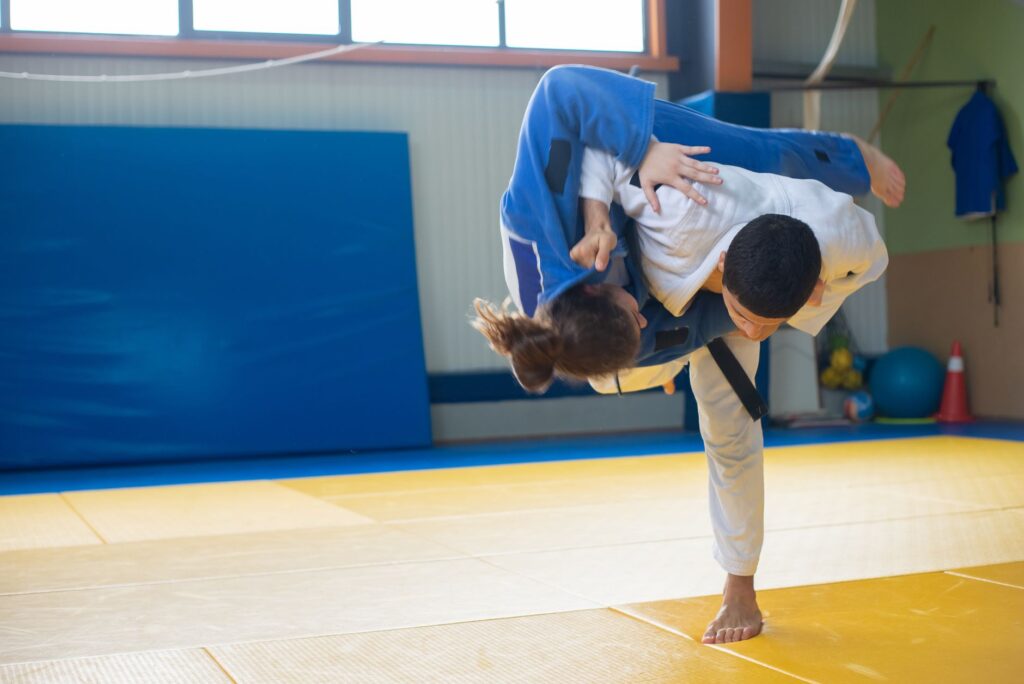
Quick answer: The body-lock takedown clasps your hands around the opponent’s torso in the clinch — from the front or the back — and uses that whole-body connection to trip, turn, or mat-return them to the ground. It’s an upper-body takedown with no leg grab at all, which makes it low-risk against the guillotine and a favorite of grapplers who’d rather clinch than shoot.
This guide is educational. Drill on suitable mats with qualified coaching, learn breakfalls, control the descent, and avoid uncontrolled twisting or head impact.
| Detail | Body-Lock Takedown summary |
|---|---|
| Technique family | Clinch / upper-body takedown |
| Main variations | Front body lock, rear body lock, with inside or over-under trips |
| IBJJF scoring | 2 points once the takedown lands and control is established |
| First control priority | Hands clasped low, on the hips — not high around the ribs |
What is the body-lock takedown?
A body lock is exactly what it sounds like: you connect your hands around the opponent’s torso and lock them to you, then use trips, angle changes, or a mat return to take them down. It can be a front body lock (chest to chest) or a rear body lock (behind them), and the finish usually comes from a trip or a lift-and-turn rather than attacking a leg directly.
What sets it apart from the leg-attack takedowns is that there’s no shot and no reaching for a leg. That means no ducking your head into guillotine range — the body lock is a stay-connected, wear-them-down takedown that rewards clinch control and pressure over speed. It shows up constantly in no-gi and MMA precisely because it’s so hard to counter with a submission on the way in.
Free every Tuesday
The Grappler Brief
The week’s biggest stories from BJJ, judo, wrestling, and submission grappling—curated for people who train.
Sent out weekly.Opt out anytime.
How the body lock works
- Clasp low, around the hips. A body lock high around the ribs is easy to strip and lets the opponent posture; locking low pins the hips, which is where their base and power live.
- Kill the space between you. The lock only controls if you’re chest-to-chest (or chest-to-back) with no gap — distance is what lets them turn and escape.
- Break the base with a trip or an angle, not brute lifting. Stepping a leg behind theirs or turning the corner takes their base far more reliably than trying to muscle them up.
- Follow to a controlling position, not just the ground. A body lock that dumps them but lets them recover guard hasn’t finished the job — keep the connection into the pin.
Common entries into the body lock
Body locks are earned in the clinch, usually after the hand fight is already underway.
- From an over-under or collar-tie clinch. Once you win an underhook and pummel the second arm inside, closing the hands into a lock is the natural next step.
- Off a defended shot. When a double-leg is stuffed but you’re still attached, climbing up into a body lock keeps the attack alive instead of resetting.
- Taking the back to a rear body lock. Getting to the opponent’s back in the clinch and locking the hands is one of the most controlling takedown positions in grappling.
- Against the cage or in a pressure clinch. Trapping the opponent and closing the body lock is a mainstay of MMA-style wall wrestling.
Common mistakes
| Mistake | Why it fails | Better cue |
|---|---|---|
| Locking high around the ribs | Easy to strip and lets the opponent keep their posture and base | Clasp low, around the hips |
| Leaving space in the clinch | The gap gives the opponent room to turn and escape the lock | Close chest-to-chest or chest-to-back with no gap |
| Trying to muscle the opponent up | Lifting a based, resisting opponent is slow and gasses you out | Break the base with a trip or an angle instead |
| Letting go on the way down | The opponent recovers guard and you’ve scored nothing | Stay connected into a controlling pin |
How to defend the body lock
Defense is about denying the lock before it closes and creating space once it has.
- Fight the hands before they clasp. Once the lock is closed it’s very hard to strip — the battle is keeping it from connecting in the first place.
- Get an underhook or a frame to create space. Space is what lets you turn, re-square, and peel the lock.
- Lower your level and widen your base. A low, wide stance is much harder to trip or turn than an upright one.
- Turn into the lock, not away from it. Turning away exposes your back; turning in keeps you facing the opponent and fighting for the underhook.
Is the body lock legal in BJJ?
Yes — body-lock takedowns are broadly legal and score 2 points under IBJJF-style rules once control is established.
As with any takedown, the finish is where the rules tighten: lifting-and-slamming and certain boundary actions are treated differently across rulesets, ages, and belt levels. A trip or mat return is generally the lower-risk finish.
Details differ by organization and division — confirm the current rulebook for the event you’re actually entering via the BJJ rules and scoring guide or the event page itself.
Safety and training notes
- Favor trips and mat returns over lifts while learning. Lifting body locks can drop a partner from height; a controlled trip keeps the fall low and manageable.
- Never squeeze the body lock as a compression. The lock is for control and takedown, not for crushing the ribs or spine — keep the clasp about position, not pressure.
- Guide the landing. Chest-to-chest, you’re falling with your partner; land in a way that doesn’t drive your combined weight through them.
Stop if a partner reports unusual pain, numbness, or joint discomfort beyond normal positional pressure. This article does not diagnose injuries; seek qualified medical care for concerning or persistent symptoms.
Examples to study
- Rear body-lock takedowns from back exposure in no-gi competition. Watch how the finish flows straight into back control or a strong pin rather than stopping at the takedown.
- Pressure body locks against the cage in MMA. Note how the lock closes low on the hips and the takedown comes from a trip, not a lift.
Pause footage at the moment the hands clasp, before the finish — whether the lock is low on the hips or high on the ribs usually decides whether the takedown lands or stalls.
Related GrapplerHQ guides
- Single-leg takedown
- Ankle pick
- Back control — where the rear body lock leads
- BJJ rules and scoring
- Wrestling: styles, rules, and what it teaches grapplers
- Judo: history, rules, and how it connects to BJJ
Sources and further reading
- How To Use The Body Lock Takedown In BJJ And Wrestling.
- IBJJF Books and Videos — current rules materials.
- ADCC Rules and Regulations.
- Injury prevalence among BJJ practitioners — PubMed.
FAQ
Why use a body lock instead of a leg attack?
Because there’s no shot and no reaching for a leg, so your head never enters guillotine range. It’s a control-heavy, low-risk takedown that suits clinch-oriented grapplers and is very common in no-gi and MMA.
Where should the body lock be clasped?
Low, around the hips. A lock high on the ribs is easy to strip and lets the opponent keep their base; a low lock pins the hips where their power comes from.
Does a body-lock takedown score in BJJ?
Yes — 2 points under IBJJF-style rules once the takedown lands and control is established. A trip or mat-return finish is generally lower-risk on the rules than a lift.
What’s the difference between a front and rear body lock?
A front body lock is chest-to-chest; a rear body lock is behind the opponent. The rear version is more controlling and often flows straight into back control, while the front version trades some control for being easier to reach.
Bottom line
The body lock is the takedown for people who win in the clinch. No shot, no exposed neck — just a low clasp on the hips and a trip that takes the base away. If your body locks keep failing, look at where your hands are: high on the ribs, they get stripped; low on the hips, they finish.