Quick answer: Cyborg Abreu, full name Roberto de Abreu Filho, is a Brazilian BJJ black belt, submission grappler, coach, ADCC absolute champion, and seven-time IBJJF No-Gi World Champion known for the tornado guard.
Last updated: 2026-06-18
Cyborg Abreu quick facts
| Detail | Summary |
|---|---|
| Full name | Roberto de Abreu Filho |
| Nickname | Cyborg |
| Nationality | Brazilian |
| Team/academy | Fight Sports |
| Rank | BJJ black belt |
| Known for | ADCC absolute title, IBJJF No-Gi world titles, heavyweight no-gi success, and tornado guard |
Career snapshot
| Year | Milestone | Why it matters |
|---|---|---|
| 2000 | Returned to competition after a serious car accident and took silver at the Brazilian Nationals four months later. | The comeback became an early defining story in his competitive career. |
| 2004 | Received his black belt after five years of training. | The promotion began a long adult black-belt career across major gi and no-gi events. |
| Late 2000s | Established Fight Sports in Miami and developed the tornado guard as a signature competition position. | The academy and position became central to his identity as both coach and competitor. |
| 2013 | Won the ADCC absolute division, defeating Keenan Cornelius and Marcus Buchecha in the final rounds. | The title is the defining competitive achievement of his career. |
| 2013 | Earned ADCC’s Best Fighter recognition for the Beijing championship. | The award reflected the quality of the absolute run, including a 10-0 final over Buchecha. |
Why Cyborg Abreu matters in grappling
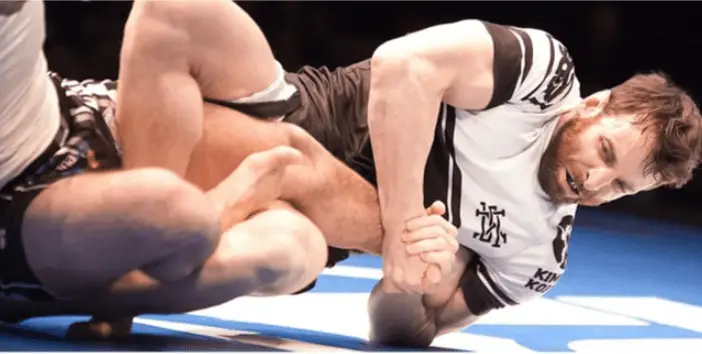
Roberto ‘Cyborg’ Abreu brought an unusual combination of heavyweight pressure, explosive wrestling, and inverted guard to elite competition. His 2013 ADCC absolute title is the clearest result, but the longer technical legacy is the tornado guard: an inversion-based way to enter leg and sweeping exchanges against opponents who expected a conventional heavyweight game.
The tornado guard works because Abreu first controls the distance at the opponent’s leg and only then rotates underneath. The inversion is not the goal by itself; it changes the angle of the opponent’s knee and exposes a path to a sweep, leg entanglement, or back side. From top position, Abreu shifts to a much more direct game, using wrestling pressure and fast passing attempts before the guard can settle. That contrast makes him difficult to prepare for: a heavyweight opponent has to defend both dynamic inversion and a physical standing exchange.
Free every Tuesday
The Grappler Brief
The week’s biggest stories from BJJ, judo, wrestling, and submission grappling—curated for people who train.
Sent out weekly.Opt out anytime.
His 2013 absolute bracket also shows the value of strategic contrast. Abreu did not force tornado-guard exchanges in every round; against Cornelius and Buchecha, he mixed wrestling, top pressure, and selective guard work according to the score and opponent rather than performing a signature move on demand.
Cyborg Abreu’s grappling style
Cyborg Abreu’s style is best understood through the positions and habits that repeatedly show up in high-level matches. For a grappling fan, this is the part of the profile that turns a name and record into something useful to watch, compare, and learn from.
- Unusual inversion and tornado-guard entries for a heavyweight athlete.
- Explosive no-gi scrambling and top-pressure sequences.
- Absolute-division experience against a wide range of sizes and styles.
- A career built around heavyweight physicality mixed with unorthodox guard work.
What to study in Cyborg Abreu’s game
| Match | What to watch | Why it matters |
|---|---|---|
| Roberto Cyborg Abreu vs. Keenan Cornelius, 2013 ADCC absolute semifinal | Watch Abreu manage Cornelius’s long-range guard and create enough pressure to score without becoming trapped in extended lapel-style control. | The semifinal shows his tactical discipline before the defining final. |
| Roberto Cyborg Abreu vs. Marcus Buchecha, 2013 ADCC absolute final | Study the pace, wrestling exchanges, and the way Abreu keeps attacking after gaining the first score. | The 10-0 win delivered his ADCC absolute title against the era’s leading heavyweight. |
| Roberto Cyborg Abreu tornado-guard sequences | Focus on the grip and leg position before the inversion, then identify whether the rotation is leading to a sweep, leg entry, or back-side angle. | It separates functional inversion from movement performed without control. |
Training takeaways
Do not invert without first controlling a leg or hip. Abreu’s tornado guard works because the opponent cannot freely step away from the rotation.
Heavyweight grapplers can benefit from contrasting tempos: threaten a dynamic entry from distance, then settle into stable pressure once the top position is secured.
How Cyborg Abreu compares with related grapplers
Cyborg Abreu pairs naturally with Kaynan Duarte, Vagner Rocha, Nicholas Meregali, Gordon Ryan, and Marcus Buchecha because those names create useful context around teams, divisions, rule sets, and technical choices. Comparing them helps readers see whether an athlete is winning with pressure, guard retention, passing, wrestling, leg attacks, back control, or a blend of several areas.
Related grapplers and pages
Cyborg Abreu connects naturally to Kaynan Duarte, Vagner Rocha, Nicholas Meregali, Gordon Ryan, and Marcus Buchecha. These profiles and guides are useful if you want to compare eras, teams, rule sets, or stylistic matchups across BJJ and submission grappling.
- /profiles/kaynan-duarte-grappler-profile/
- /profiles/nicholas-meregali-grappler-profile/
- /profiles/marcus-buchecha-grappler-profile/
- /brazilian-jiu-jitsu/ibjjf-no-gi-rules/
- Browse all BJJ fighter profiles
Sources and further reading
- Official 2013 ADCC results.
- ADCC 2013 final-round report.
- Roberto Cyborg Abreu biography and record.
- Cyborg Abreu entity reference.
FAQ
What is Cyborg Abreu known for?
Cyborg Abreu is known for ADCC absolute success, multiple IBJJF No-Gi world titles, heavyweight no-gi grappling, coaching, and the tornado guard.
What is Cyborg Abreu’s real name?
Cyborg Abreu’s full name is Roberto de Abreu Filho.
Did Cyborg Abreu win ADCC?
Public references list Cyborg Abreu as the 2013 ADCC absolute champion.